Life Between the Levels
Visit the MIT Press shop

This column is a reprint from Unwinnable Monthly #198. If you like what you see, grab the magazine for less than ten dollars, or subscribe and get all future magazines for half price.
———
Architecture and games.
———
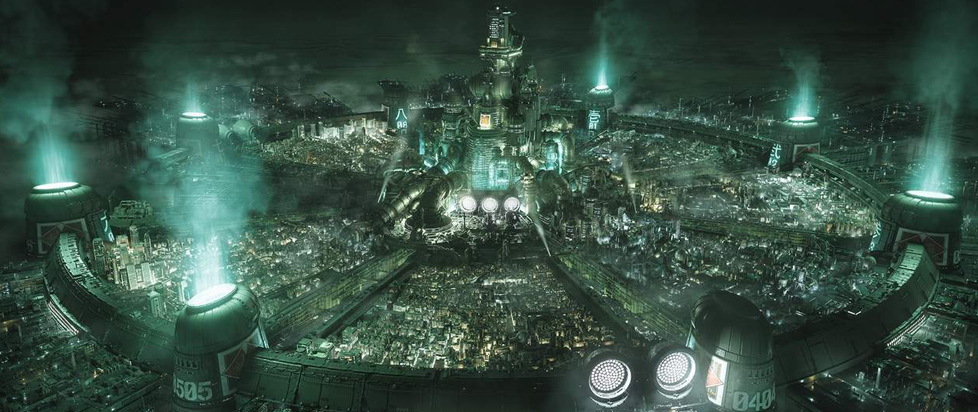
Midgar doesn’t so much rise above the landscape as it hovers over the hovels underneath. When seen from a distance, the place appears to be a perfect circle, a sort of mechanical halo set gently against the horizon. The illusion however quickly fades away as you draw closer. The city is technically but not metaphorically grounded. Midgar is in many ways held in suspense, divided but held in place by an immense system of steel and strength which quite literally separates people into the ones who prosper above and the ones who survive below.
The defining feature of the city is of course the plate, a vast, continuous disc elevated above the earth, supported by towering pillars which are spaced around its incredible circumference. Lying on top of this plate is the Upper City, a place of relative order and stability. The streets run in deliberate patterns, buildings align with one another and the light, mostly artificial and filtered through smog, is at least consistent and reliable. There’s a faint sense of normalcy. The plate creates an artificial baseline which replaces the unpredictability of landscape for the certainty of engineering.
The ground is however deceptive. This would be much less a foundation than a ceiling. Somewhere under the floor of the few is the ceiling of the many, with slums that stretch outward in a ragged, uneven sprawl. The architecture loses any sense of coherence. Structures appear more assembled than built, pieced together from salvaged materials and the trash emanating from the city above. The patched roofs are cobbled together with corrugated metal, walls leaning at uncertain angles and pathways emerging somewhat organically, bending in their adaptation to obstacles, which typically contain signs of habitation. There’s no symmetry here, and certainly no sense of completion or even real construction. There’s only continuation.
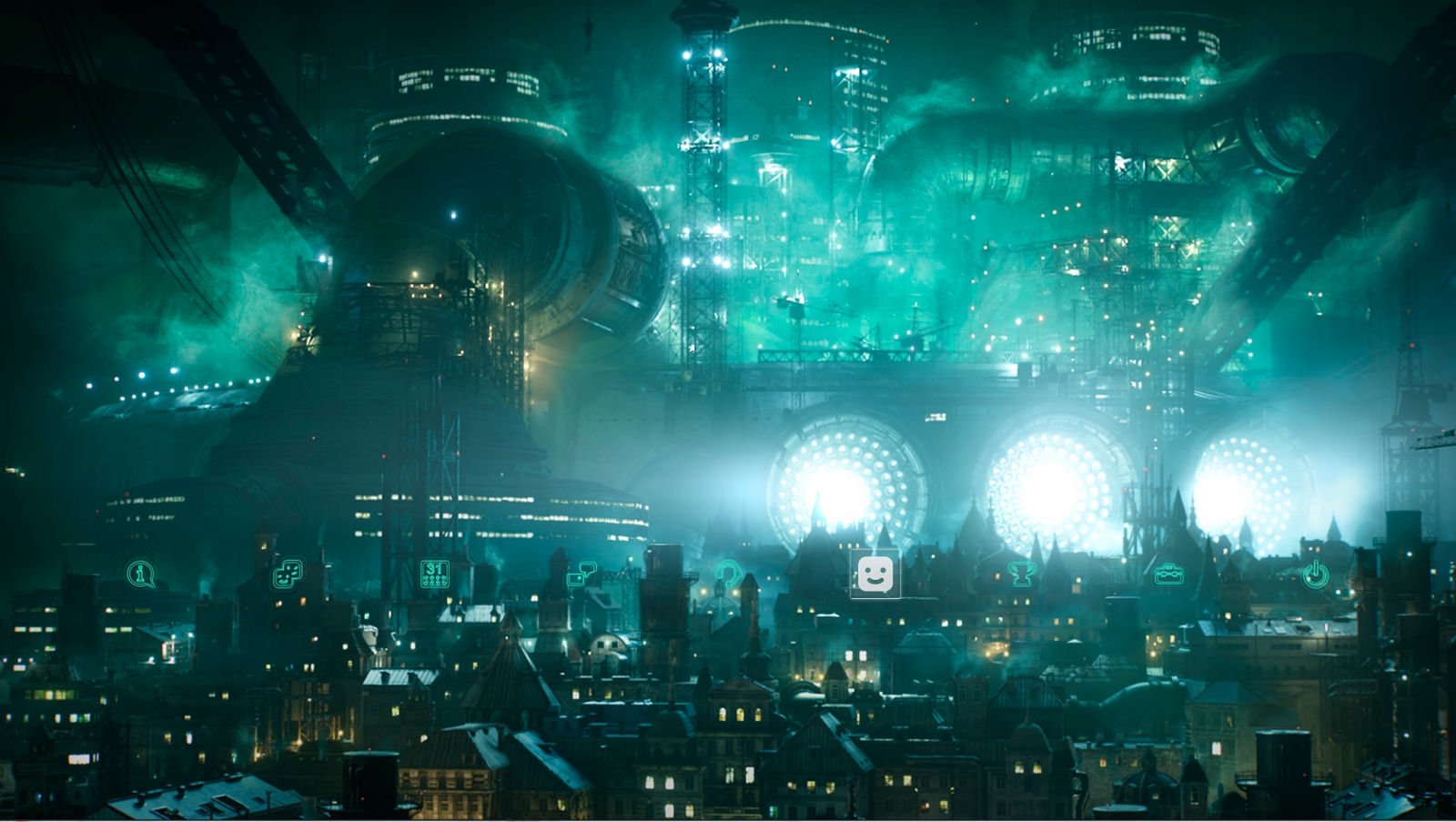
The light behaves differently in the Lower City, filtering through gaps in the plate above, arriving in fragmented shafts which illuminate one corner but leave another in shade, or more appropriately shadow. The result is perpetual twilight, a flattened sense of time in which day and night converge. Such absence of natural light is far from incidental. This would be a structural consequence of the plate, as the comfort of the Upper City is made possible by the darkness and of course the poverty underneath.
What makes Midgar so striking is the way in which these two environments are adjacent but also physically interdependent. The plate above doesn’t just hover over the slums below but relies on them. The pillars which support the plate rise from the Lower City, embedding themselves within its urban landscape. These dominate the skyline, their immense forms disappearing upwards toward the underside of the plate. They’re both reassuring and oppressive, symbols of a certain stability which also underscore a clear social imbalance.
Projecting above the plate is the Shinra Building. This looks like a structural anomaly within the already unnatural landscape, a vertical assertion of dominance within a city defined by division, both vertical and horizontal. The incredible height exaggerates this logic of division, separating the upper and lower classes within the Upper and Lower Cities. The tower isolates the literal power within, promoting its proponents beyond even the privilege of the people on the plate. When seen from nearly any vantage point, the Shinra Building will be visible, providing a constant reminder that hierarchy doesn’t end at the surface but continues upwards.
Movement through Midgar tends to reinforce the apparent social divisions. The transition from the slums below to the Upper City above is far from fluid. This would be highly controlled and mostly restricted to specific access points which require explicit permission to cross. The city itself seems to resist mobility, preferring that its inhabitants remain within their assigned strata.
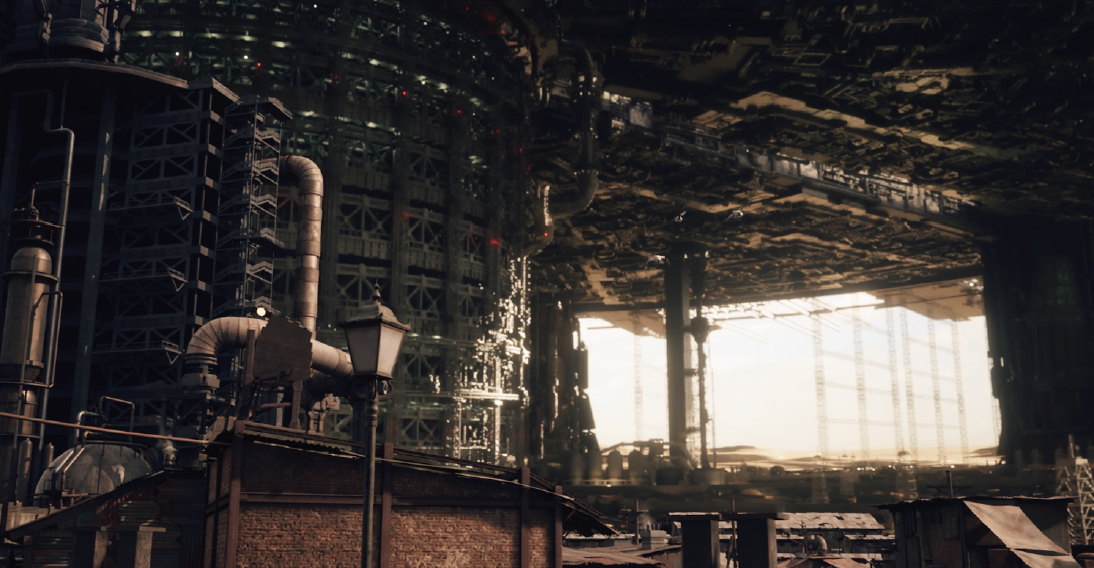
The materials of the city participate in the hierarchy. The surfaces above are consistent, manufactured and clearly designed. You’ll find a sense of abundance, and systems functioning as intended, of course. The materials below are varied, inconsistent and extremely haphazard, with histories visible in every dent and ding. Metal sheets bear the marks of previous use, and the wooden surfaces are splintered, uneven and occasionally rotten.
The plate is ever present overhead. The underside stretches endlessly, a darkened sky of steel humming faintly from the machinery of the world above, both shelter and burden. The plate protects the slums from the elements but more importantly defines their sense of place, enclosing the poor and beaten down within a space which is contained but also neglected. The people who live under the plate aren’t just out of sight, they’re out of mind.
The most unsettling aspect of Midgar is perhaps how natural this type of arrangement seems, even to the casual observer. The separation between high and low is clear and complete, in other words physically embedded. The impression is one of inevitability or perhaps even much worse, normalcy. The plate is present as the ground for some but the sky for others. The hierarchy is no longer something imposed but something built, and something reinforced by every beam and embankment.
The fallacy of social hierarchy is made clearly manifest in the urban landscape of Midgar. The same could unfortunately be said about the real world, although such urban landscapes are more often defined by subtlety than candor.
There is however a certain fragility to this particular design. The Upper City depends upon a limited number of supports, each one carrying immense weight, both literally and metaphorically. The system appears immovable but is in fact not invulnerable. The structures which create separation also reveal the instability of the system. Supposing that one of these supports should fail, the consequences would be immediate and catastrophic, in this case collapsing not only the unequal physical but also the unequal social systems, and the sense of permanence which sustains them.
———
Justin Reeve is an archaeologist specializing in architecture, urbanism and spatial theory, but he can frequently be found writing about videogames, too.