Final Fantasy IV and the Necessary Weeding of Kings
Visit the MIT Press shop
This column is a reprint from Unwinnable Monthly #198. If you like what you see, grab the magazine for less than ten dollars, or subscribe and get all future magazines for half price.
———
Wide but shallow.
———
Fantasy, final or otherwise, seems to have always required kingdoms. There are plenty of shades to work with throughout that palette, but monarchies and bloodlines and fealty usually play a significant role. And while despots are often challenged and defeated, with peace spread across the realm once more, the result is not that the system of feudal rule is knocked down and something sturdier constructed in its stead, but rather a nicer more benevolent king is put upon the throne. As if the problem was just the occasional bad monarch, rather than kings altogether. But monarchies are weeds, and Final Fantasy loves to tear out the plant but leave the roots – as if bloodlines had any relation to stability, or that there is any goal in monarchy other than the concentration of power.
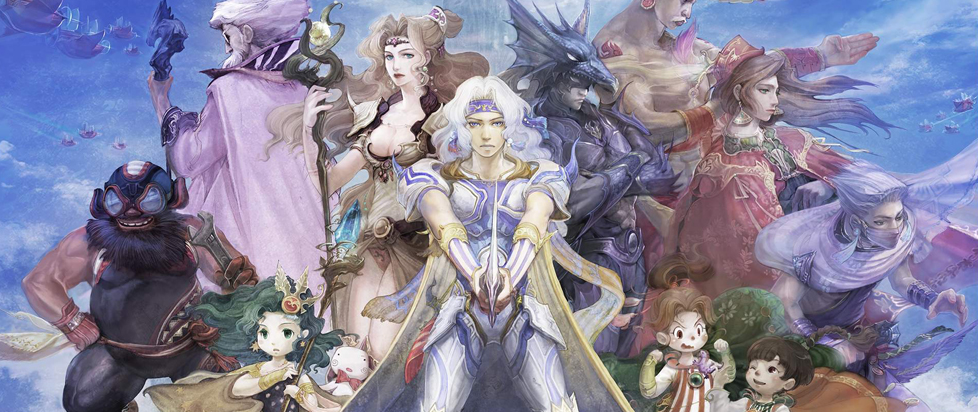
The first Final Fantasy game to ask the player not to follow their hollow puppets rocketing through the world doing good, Final Fantasy IV instead features a linear story about specific characters with given names and locked classes. You’re reading their story rather than imaging your side of a turn-based roller coaster, and this is probably why this RPG in particular hooked me so cleanly early on. Part of me wants to write here that IV is rudimentary compared to more sophisticated entries in the series, but honestly it seems like every entry has been hovering around these themes for thirty years. Which is to say that Cecil, the Dark Knight turned Paladin and central party member throughout Final Fantasy IV, should be aware of structural limitations of monarchy.
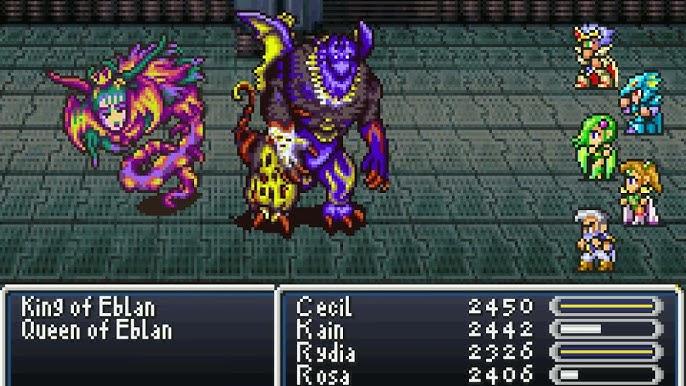
From cutscene one (Cutscenes! In a Super Nintendo game!) we learn that Cecil is tasked with the world’s only flying navy (the Red Wings of Baron) to scoot around the globe and steal the elemental crystals from other sovereign nations. He questions this order, but follows it, like a good soldier and a heavy metaphor – the Dark Knight who uses evil-themed swords with his ability “Darkness.” But he cannot contain himself and stands up to the king, asking why there is this turn in his temperament towards empire. Cecil’s reward is being stripped of his command of the Red Wings and ordered walk through a cave with his friend and fellow soldier Kain to deliver an unmarked package to a neighboring village. Cecil accepts this fate and moves ahead with his new mission.
Cecil carries on with a sliver of contemplation, delivering the package – a magical firebomb that destroys the village, and learned that he orphaned a young mage on the way. Why would the king do this? The Dark Knight questions the king, who we later learn was replaced by a monstrous doppelgänger, but doesn’t really even consider why the original king (who raised him as an orphan) pressed the Dark Knight’s sword into his hands. His adoptive regal father might not have been a literal monster, but his willingness to press a young man into evil knighthood puts his compassion for his subjects into question.
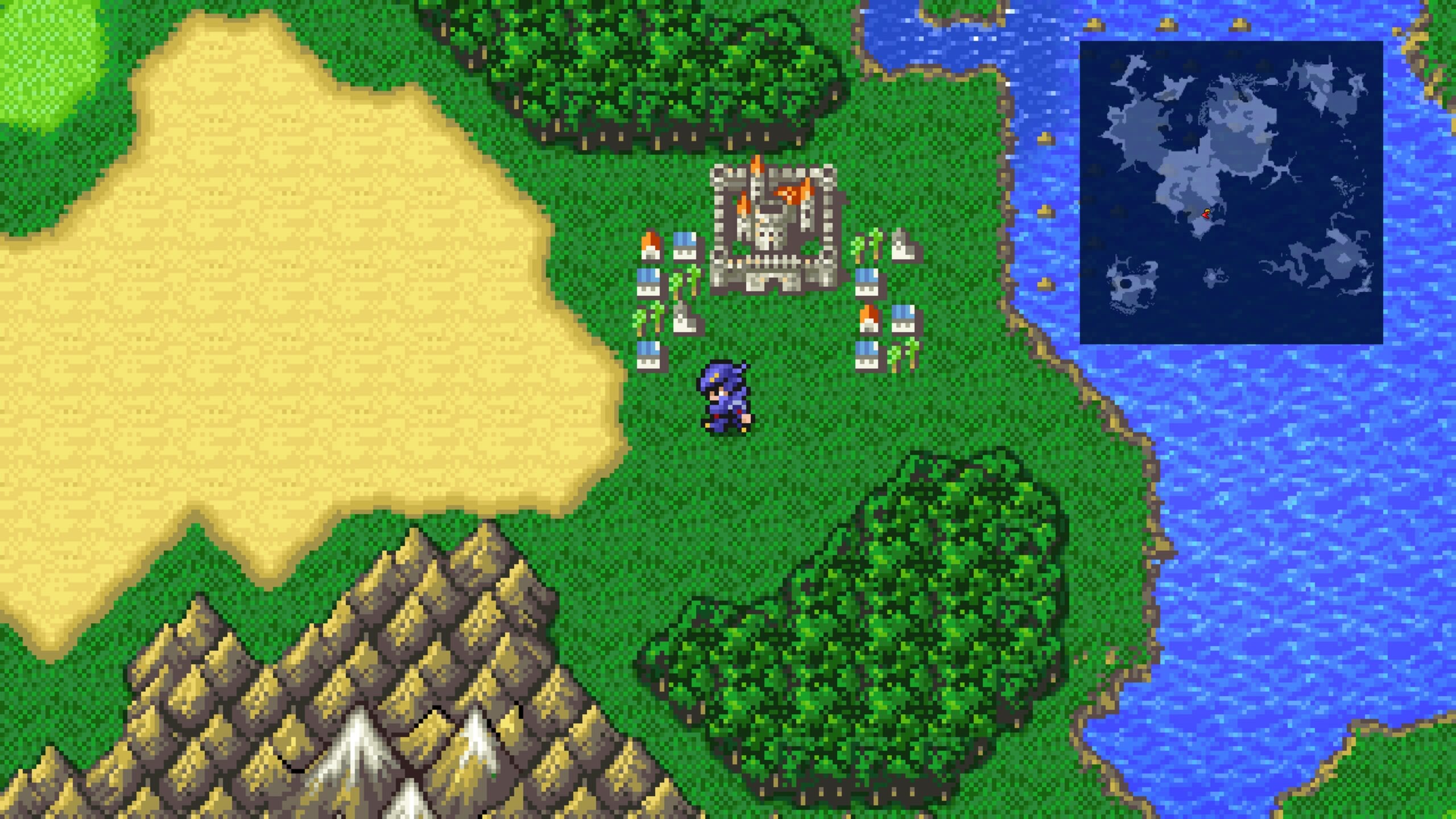
From there Cecil goes on a wild ride, exploring the world and gathering allies in the fight against Golbez (his brother) and Zemus (racist Lunarian who wants to wipe out the humans on Earth to take over the planet). He moves through many kingdoms in his journey – a land of monks, back to the mage kingdom he robbed at the introduction, a palace of ninja reduced to a single prince, kingdoms of faeries and dwarves underground and eventually the slumbering Lunarians on the moon. Each and every one of these states is susceptible to easy manipulation because of their weak monarchic structures (though Troia, the matriarchal society ruled by a council of eight, is also bamboozled, they at least read the writing on the wall and tried to prepare accordingly). Nearly every kingdom falls as Cecil and the gang chase Golbez through the world, Kings and Queens and courts destroyed or defeated with ease.
In the end Cecil, and by extension the world, rallies to defeat Zemus and restore peace to the planet. Most of the characters go through at least one stage of growth or experiences some deep loss (RIP Tellah, get well soon spoony bard), learning the importance of community and collective action. But in the end, the monarchy must be maintained – Cecil becomes King of Baron, Yang rules his country as a Duke, Edge takes his place on the shinobi throne. The roots are watered, the system remains, and Final Fantasy can’t help but maintain the status quo. The series forgets the relentless march of time and that capable, compassionate leadership is not genetically passed down but something that needs to be forged and maintained through the ages.
For a genre and series steeped in imagination, it’s vexing that Final Fantasy can rarely picture something beyond kingdoms. The romance of service is clear but even a realm of magic and monsters could stand to pull together a tale that reinforces the benefits of organizing one’s community. Humans are fallible, but kings always fail, power corrupts or is easily stolen or manipulated when concentrated in these ways. How many times must the world teeter on obliteration before my beloved dragoons and wizards figure this out?
———
Levi Rubeck is a critic and poet currently living in the Boston area. Check his links at levirubeck.com.