Captain of the Ship
You feel compelled to support great writing…

This column is a reprint from Unwinnable Monthly #197. If you like what you see, grab the magazine for less than ten dollars, or subscribe and get all future magazines for half price.
———
What does digital grass feel like?
———
This piece contains spoilers for Flotsam.
According to the achievement statistics, about 20% of people who finish Flotsam lose a drifter in the process.
I’m not entirely sure how. Drifters, the people you order around to build, scavenge and craft on your salvage ship after a flood overtakes most of the world, are pretty hardy. They can go four days without water or miss four meals, although food and water are plentiful enough that none of my twenty-something strong band of ragtag sailors had to miss more than one. They can also get sick from spending too much time around pollution, but again, this only happened to me a couple of times and was easily remedied.
I found Flotsam easy, which isn’t to say I didn’t like it. It’s satisfying to build a self-sustaining machine, one that only needs directions to the next major plot point with a few stops to grab resources along the way. It’s fun to not have to struggle, only to grow.
It does feel strange, though, to get by with ease in a post-apocalyptic setting. A whole rack of incredible technologies seems to have been invented just a bit too late, from perfect plastic recycling to, eventually, fusion energy. Rusted out cars, fish oil, and driftwood can become a spaceship. There’s a cure for every disease, and there’s no concern about waste management; absolutely everything gets reused or is else elided. And yet, in 20% of games, someone dies.
I played Flotsam in two long sessions across two days, gliding efficiently through the story. Many of the higher-end systems, like better electricity production, I didn’t find much need for. By beelining between one quest and the next, pausing whenever the ship’s battery was low to gather whatever was around (and maybe read a book for a bit in real life to let it recharge) I could keep progressing without having to make resource-heavy and ship-ballooning investments. I only had to engage with the weight mechanic at the very end of the game, building a literal rocket ship, and even then, only half of it – there are two ways to reduce weight and I needed only one.
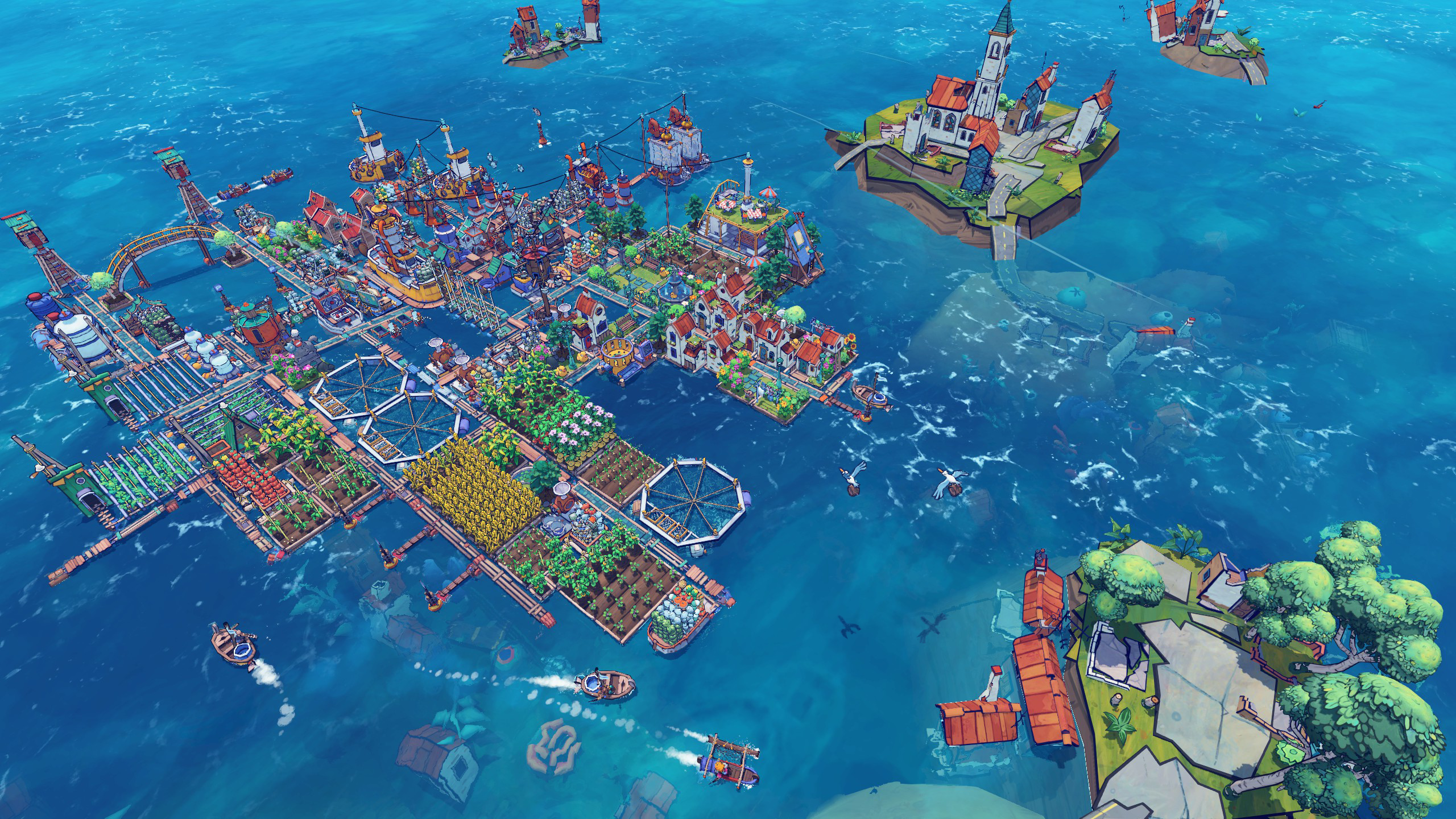
The ease of it all means that I felt Flotsam didn’t really engage with its setting; its climate catastrophe a thin lick of paint over an ordinary colony sim. To me, it was like my ship itself: streamlined, but without much weight to it. It presented a story of people living well after the end times, able to get by on scrap and elbow grease. But if things had gotten bad enough for someone to die, it would have been very different. It could have been a story of the grinding horror of scraping by, of not everybody making it.
I have a confession to make. Not everybody in my world of Flotsam made it.
Yes, none of my drifters died. But towards the end of the game, I stopped picking up survivors. Another achievement I don’t have: a town of over 25 people. Because, I reasoned, the way I had laid things out didn’t give me room for another home to be built. Because my water consumption was perfectly balanced. In short, because I could see the logistics becoming complicated and ruining my smooth efficiency, and I didn’t want to deal with it. Without realizing, I had slipped into running my boat with an eco-fascist god-hand. Take what we need and use it only for the chosen few. And in a game about recycling resources so efficiently there’s not a single scrap of waste, people, too, became resources. They were either repurposed into a part of my beautiful machine, or left behind.
Flotsam, like so many videogames, is a story where the player is the main character. It cannot easily account for what its own narrative is because it doesn’t have narrative control over its protagonist. It can only set up a sandbox for them to build their own castles.
But it can control what tools they are given, and what kind of castles they are encouraged to build. It was my decision to go down an eco-fascist path, but I was primed for it by the very nature of a colony sim. I have total control over the actions, living conditions and lives of the people on my boat. Perhaps Flotsam could have avoided it by more effectively characterizing the drifters as something other than worker bees buzzing around the sea, or which had a clearer throughline about communal survival.
But I’m not sure it would have. At the end of the day, it made the game easy.
———
Jay Castello is a freelance writer covering games and internet culture. If they’re not down a research rabbit hole you’ll probably find them taking bad photographs in the woods.