How Creature Kitchen Blends Creepy and Cozy
You feel compelled to support great writing…

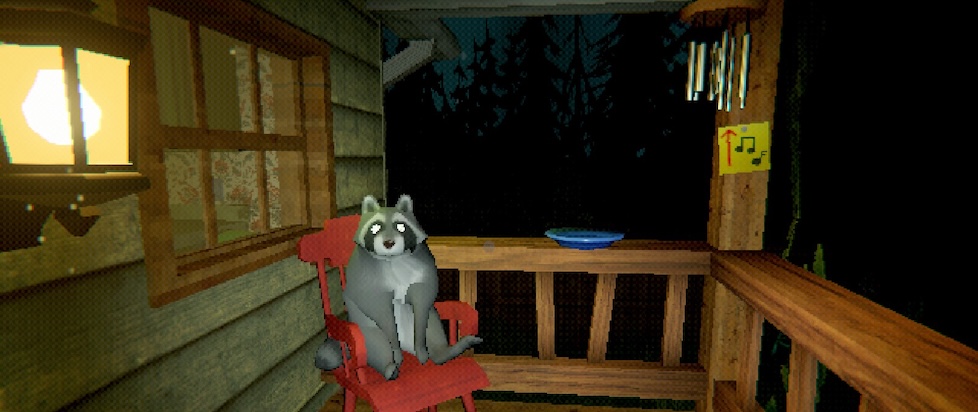
On booting up Creature Kitchen for the first time, players find themselves in a mysterious, dark forest. A lone owl hoots as the moon looms high above. Crickets sound from somewhere among the low-poly trees. Players instinctively hit F and a flashlight flickers on, illuminating the path to the lonely cabin in front of them. The lights there are already on. Players hurry to the safety of the indoors, but soon find it is just as creepy as the outdoors. The pantry seems to stretch on forever into the dark, locked rooms line a dark hallway, and something chitters from the walls. Just then, there’s a knock at the door.
All of these game elements are designed to put players on edge and to make them feel as though they are being watched. Creature Kitchen describes itself as creepy-cozy, which, while seeming like an oxymoron, could not be a more apt description. This game by The Rat Zone plays on players’ fears just to slowly soothe them with cute critters, peaceful cooking mechanics, and a sweet story about family and loss. The game masterfully blends genres by keeping players feeling just shy of safe, but more and more at home with their new family as the game progresses.
Creature Kitchen uses three main tools to raise hairs: narrative/atmosphere, sound design, and visual design. In reality, there is never any threat to the player. The most dangerous creature is the one in the pantry, and all it can do is knock things off shelves. As for the knock at the door; once the player gets over their initial fright and opens the door, in shuffles a creature reminiscent of the Fresno Nightcrawler, although much cuter. This is Pants, a character who appears every hour or so to sit in your kitchen and demand a snack. The note about them indicates they are quite picky, but their favorite ingredient is hidden away somewhere in the cabin, just for them. About halfway through the game, the player sets out a cup of coffee for a “big oaf.” What comes storming through the woods after the scent is a horrifying beast much like a sasquatch, but covered in shadows, with white eyes poking out.
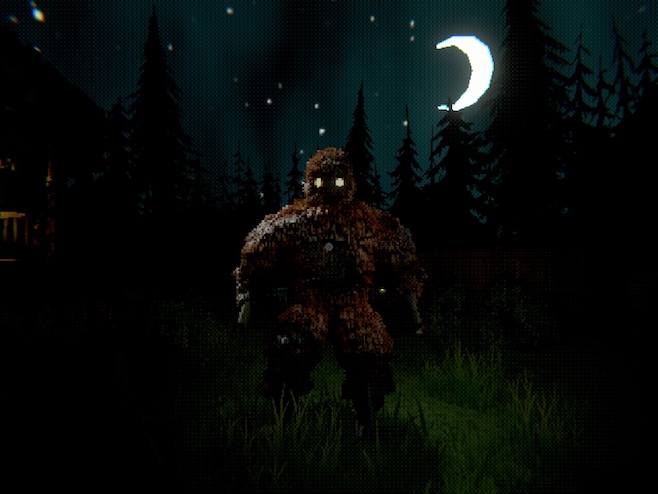
These three creatures demonstrate the three tools mentioned above: The demon in the pantry is scary because of how much the cabin’s previous resident calls it things like a demon, Pants frightens the player because the last thing they are expecting is a knock at the door, and the shadow man is scary just to look at. Even beyond just the creatures, these tools are used in every aspect of the game.
There is a demon in the pantry. The journal the cabin’s previous resident left behind refers to it as such. Scribbles and shapes fill the page where the demon’s entry lives, almost as if warning the player of the demon’s effect on the mind. This creates a narrative, leading the player to be scared of the demon. Eventually, the player learns the demon is entirely harmless, just mischievous, much like a cat. Even so, the narrative keeps the player on their toes. Similarly strange and often off-putting notes litter the cabin, many of which reference “a new steward” for some power in the forest. Others point to the previous resident slowly losing their mind, and hint at other terrifying monsters in the woods. Once again, there is no real threat, and the “monsters” are quite kind once you get to know them. Nonetheless, the player is kept on their toes, and must make the game cozy for themselves.
Much of the audio design that contributes to the horror of the game comes from the forest ambience when outside. These sounds are largely what one might expect: an owl hooting, a frog croaking, crickets chirping. Once the shadow man is introduced, grunting sounds and thudding footsteps begin to join the choir. It is admittedly difficult to get used to, even though the shadow man is quite gentle. In the cabin, things are mostly silent, with the occasional creaking of the rocking chair on the porch, knocking at the door when Pants visits, or the crashing of the demon throwing things off shelves in the pantry. These noises help the cabin feel alive, and keep the player on edge in the dark forest.
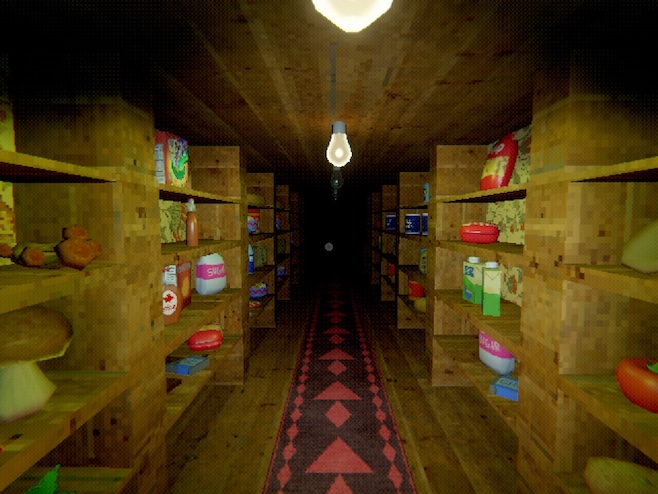
With a visual style reminiscent of popular horror games like Mouthwashing and Buckshot Roulette, Creature Kitchen primes the player for horror that never comes, instead turning this style into something comfortable and warm. This even stretches to the minigames that compose the cooking mechanics. Interacting with the cutting board or the hand mixer leads to a harsh jump cut to a spotlight on a table, in the center of which is the tool being used. The visuals here are harsh and simple, with a dark void surrounding what is in the spotlight. The rest of the world completely falls away, replaced with the thudding of a knife falling or the whir of a hand mixer. Once the job is done, there is another harsh jump cut to reality, making the cooking sequences feel more like a dream or a nightmare.
The game resolves with a sweet message about finding new families and moving on from loss, completely the opposite of what players might expect from how the game starts. The resolution perfectly nails home the true coziness of the game – since it is so wholesome, any lasting hesitation about the cabin and the woods fades away, making both permanently feel familiar and comfortable. The creatures welcome you as their new friend, and you live on in your new home in the woods.
———
Bea Cadigan is a video game freelancer based in Madison, Wisconsin. She has been a podcast host, streamer (at twitch.tv/astrofaun), youtuber, TV news producer, and reporter on all sorts of topics. Her favorite video game genre is Metroidvania.