Space is a Flop: Innerspace (1987) on UHD
Visit the MIT Press shop
“When things are at their darkest, pal, it’s a brave man who can kick back and party.”
“It’s a dumb, stupid comedy, which is exactly what people need in the summertime,” star Dennis Quaid told the Washington Post in June of 1987, talking up the imminent release of Innerspace. “It’s very idiotic and I love it. We encounter every dumb, stupid cliché in the book. Leave your brain at home and you’ll have a good time.”
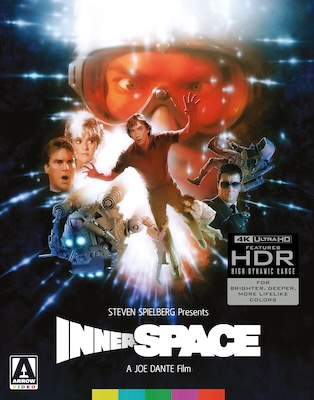
Maybe not the most glowing sales pitch for a movie that hasn’t even been released yet, but perhaps a more accurate one than the film’s initial ad campaign. “It was just a giant thumb with a little tiny pod on it,” director Joe Dante told Den of Geek in 2010, describing the film’s original theatrical poster. “You couldn’t tell that it was a comedy – you couldn’t tell anything – and it had a terrible title, because we could never figure out a better one.”
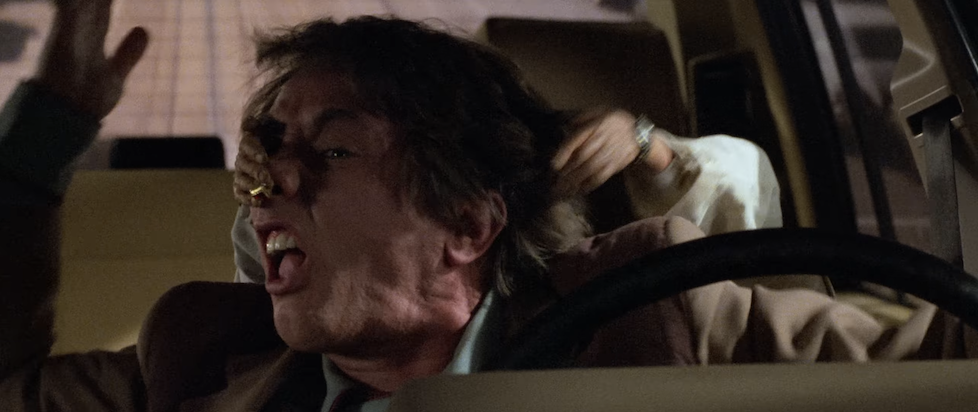
When I was a kid, one of the ways I watched movies was that my older brother had HBO and he would occasionally record movies off it and give them to me on VHS tapes – usually three movies to a tape. One of those tapes had a recorded broadcast of Innerspace, and I probably watched it a lot, but even back then, I don’t think I liked it as much as most other Joe Dante movies.
Maybe it’s the lack of monsters. “Now I can make a mainstream, commercial movie that will be a success,” Dante says in an interview on the special features of the loaded new 4K UHD from Arrow Video. “Not realizing that, of course, once I was done with the movie it would be just as strange and weird and far out as all the other movies I’d done.”
And while Innerspace may not have any monsters, it is certainly strange and weird and far out, before all is said and done. Conceived by Chip Proser as “basically a rip off of Fantastic Voyage,” the initial script played the idea straight, until Jeffrey Boam was brought in to rewrite it as a comedy. At the time, Boam was fresh off the 1983 adaptation of Stephen King’s The Dead Zone, but his subsequent filmography would include The Lost Boys, Indiana Jones and the Last Crusade, and two Lethal Weapon sequels.
“I think when you’re asking audiences to give up their sense of understanding of what’s really happening, you have to give them a little leeway to find it absurd,” Dante says in that same interview on the Arrow 4K. So, the comedic approach to the screenplay became, “What if Dean Martin was shrunk down and put inside Jerry Lewis?”
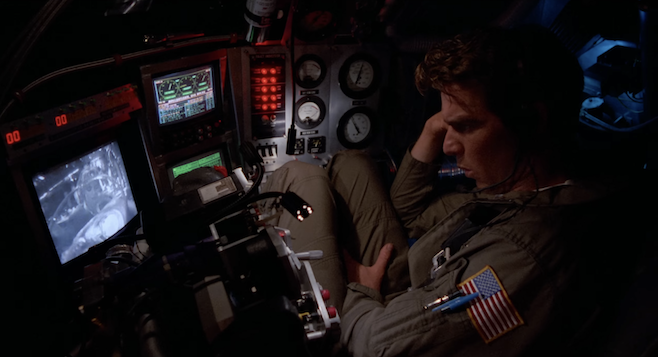
To pull that off, they needed a Dean Martin and a Jerry Lewis. The latter is provided by manic actor Martin Short, turning in what is actually one of his more subdued performances as a neurotic grocery store clerk who gets in over his head when he is accidentally injected with a microscopic explorer in a one-man sub as part of a top-secret science project. As for the former, that’s handled by Dennis Quaid, who played a similar role just a few years before in 1984’s Dreamscape, a flick that actually feels more like a Joe Dante movie than Innerspace does.
While these two are required to anchor the film, it is the people around them who make it. An early-career Meg Ryan as Quaid’s put-upon ex-girlfriend. James Bond villains played by Fiona Lewis and Invasion of the Body Snatchers’ Kevin McCarthy, complete with a one-handed henchman who switches out his missing hand with various weapons (and… other implements). Robert Picardo as a European dealer in black market technology who is only ever called “the Cowboy,” and who steals most of the movie. Plus a host of other Joe Dante regulars.
As it happens, Ryan and Quaid met for the first time on the set of Innerspace. The movie ends with the two characters tying the knot at California’s Wayfarer’s Chapel, and the two actors would shortly be married themselves, after starring together again in the 1988 thriller D.O.A. They divorced a decade later.
Though not as cartoonish as some of Dante’s subsequent work, Innerspace is a broader comedy than most of what he had done before, while also feeling oddly restrained compared to many of his other films. Nonetheless, there are certainly plenty of Dante touches before all is said and done, from the shenanigans of the miniaturized villains, who end up doll-sized and are, at one point, packed into a suitcase, to a tiny skeleton dissolved in stomach acid.
It’s a very silly movie, but it also knows that it’s silly, and never pretends otherwise. What keeps the film from rising to the status of “underrated classic,” as some would have it, probably lies mostly with Quaid’s Tuck Pendleton. Tuck is another in a long line of 80s heroes who all share the same basic DNA: cocky, arrogant hotheads who can’t take authority and are allergic to responsibility, who live in cluttered bachelor apartments littered with ridiculous visual gags, and who are often (though not exclusively) alcoholics.
Someone has probably written a book about why there were so many protagonists who matched this broad outline in the movies of the 1980s, but a key element of them is that they’re required to have enough charisma to make themselves likable despite their many character flaws. Unfortunately for Tuck, he just comes across as an ass.
Partway through the movie, Martin Short’s character tells Tuck that Meg Ryan’s character deserves better than him, and it’s pretty much impossible for the audience not to agree. Which is a problem, because the film kind of requires you to root for Tuck, at least a little bit.
Quaid has been in plenty of movies, and while I can’t remember his performances from enough of them to have a strong opinion, one can assume that he probably knows what he’s doing – he’s been nominated for a Golden Globe on at least two occasions.
Maybe part of the problem is that Quaid seems to kind of be an ass in real life, too. He called Ronald Reagan his favorite president, publicly endorsed Donald Trump in 2024, and was flying with Trump on Air Force One at the time the president kicked off the current war in Iran.
While much of Innerspace is broad comedy, the special effects are deadly serious. Produced by Industrial Light and Magic, the elaborate effects showcasing the inside of Martin Short managed to nab an Academy Award – the only time a film by Joe Dante has ever gotten one.
“Created using scale miniatures and rod puppets, the sequences inside Jack’s body are very different from those in Fantastic Voyage,” Ryan Lambie writes at Den of Geek. “Where the ‘60s film imagined the human body as a psychedelic lava lamp, Innerspace is far more fleshy and claustrophobic. Tuck’s tiny metal pod picks its way through throbbing veins and arteries, buffeted by blood cells floating in the foggy plasma.”
That those blood cells are sometimes lentils that have been painted red, pumped through a miniature set filled with water, makes the final effect more impressive, rather than less.
Which is all to say that the VFX in Innerspace almost certainly deserve their Oscar, even if the rest of the movie isn’t necessarily one of Dante’s best. You’ll like it better than original screenwriter Chip Proser, though.
“I never actually have been able to sit through it all at once,” he said in a 2008 interview. “They don’t pay me to watch this crap […] I wear a mask to cash the check.”
———
Orrin Grey is a writer, editor, game designer, and amateur film scholar who loves to write about monsters, movies, and monster movies. He’s the author of several spooky books, including How to See Ghosts & Other Figments. You can find him online at orringrey.com.