
War is His Friend: Revisiting Soldier (1998) on UHD
Visit the MIT Press shop

“A soldier shows no mercy. Mercy is weakness and weakness is death.”
At one time, director Paul W. S. Anderson must have felt like a better bet than he does today. Sure, even his earlier films weren’t necessarily critical darlings, but my impression is that they were better met by their target audiences and, in 1998, the only credits he had to his name were Shopping (1994), Mortal Kombat (1995), and Event Horizon (1997). 2004’s Alien vs. Predator and a spate of Resident Evil movies were still several years away.
Even then, I remember my various nerd friends not being as pleased with Soldier as they had been with Mortal Kombat or Event Horizon, which I think are still better thought of than most of what came later, leaving aside that Anderson’s Resident Evil franchise has made roughly a gazillion dollars.
Which makes sense, as Soldier probably has less going for it than either of those films, especially if what you’re expecting from it is what you got from them. This recollection is born out by the fact that Soldier bombed at the box office, only raking in around $15 million against a $60 million budget.
The Critics Consensus on Rotten Tomatoes refers to it as, “A boring genre film and a waste of a good set,” which could honestly be a review of most of Anderson’s filmography – he’s always seemed better at dressing a set than helming a movie, which is certainly true here.
Perhaps more interesting than its director is Soldier’s screenwriting credit. Though released in 1998, it was adapted from a 1984 screenplay by David Webb Peoples, better known for writing the revisionist western Unforgiven and a lot of better sci-fi stuff, including Blade Runner, 12 Monkeys, and The Blood of Heroes, which he also directed.
In a 1998 interview with Cinescape, Peoples said that he considered Soldier to be a “spin-off sidequel” to Blade Runner, set in the same universe – the film makes numerous references to its better-known progenitor, including claiming several times that Kurt Russell’s titular soldier fought in battles referenced in Roy Batty’s legendary monologue.
Later, however, in a 2023 book about the film by Danny Stewart, Peoples contradicted that account, stating that, “I never had any thoughts about that […] I wrote it because I saw the first Terminator in the theater, stunned. And it was such a wonderful movie. I’d always wanted to write a movie in which there was a tough guy who would be seemingly unsympathetic in the lead…”
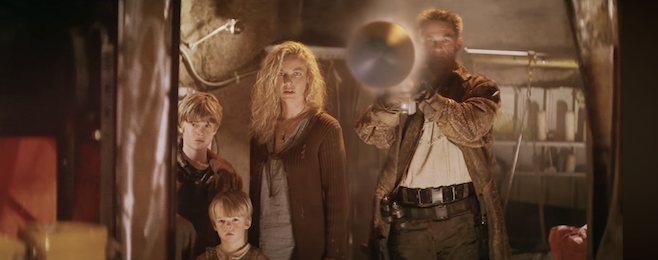
Tasked with the thankless role of playing that unsympathetic tough guy is Kurt Russell, who has the unenviable job of holding the center of the film despite saying maybe ten lines and not being allowed to alter his facial expression. And, because this is Russell, he does pretty well with that, acting almost entirely with his eyes. According to Wikipedia, he speaks only 104 words in the entire picture – having just watched it, even that sounds like a lot.
Whether it was actually intended as a “sidequel” to Blade Runner or not might go some distance toward explaining one of the oddest things about Soldier: its lack of world building. We never see what life is like for a normal person in the film’s vision of 2036. The soldiers of the title live a programmatic life in which they are functionally machines, while the only other people we see are the survivors of a colonist ship that crash-landed on a garbage planet, where they’ve been eking out an existence as refugees ever since.
We know that there must be a much larger and more populous universe out there. Not just because of the various wars in which the soldiers apparently fought, but because of the vast and numerous garbage ships which bring the detritus of some unseen society to this planet-sized dumping ground.
What is life like, for the people who generate that trash? We have no idea. Maybe it doesn’t matter.
Certainly it doesn’t for Russell’s soldier, who has never experienced any of it, any more than we have. Like all the other soldiers, he was selected for his role from birth, and desensitized into a life of violence. When the attractive refugee who takes care of him asks him what he feels, he says, “Fear. And discipline.”
“Now?” she asks, as they are in the midst of an ostensibly charming domestic scene.
“Always,” he replies.
Right wingers almost certainly watched this and went, “now that’s how you make a soldier,” rather than the movie’s actual intended message, which is “that’s how you make a broken person who sucks.” Russell’s protagonist may eventually prove not merely useful but even heroic, but his own inner life is misery.
That this sort of soldier is not actually a particularly good thing to be is not an especially novel message, however. Perhaps more interesting is the film’s other big theme: no matter how good of a soldier you are, the government will not give a single shit about you the second you are no longer useful to them, and will literally throw you out with the trash.
I’m sure plenty of modern veterans can relate.
———
Orrin Grey is a writer, editor, game designer, and amateur film scholar who loves to write about monsters, movies, and monster movies. He’s the author of several spooky books, including How to See Ghosts & Other Figments. You can find him online at orringrey.com.