Even Batman Can’t Fight City Hall
Visit the MIT Press shop

In my last article, I talked about the Batman: Arkham Series and the ways in which Batman inherits the violence of the American police state in his endless war on crime. Somehow, though, the state finds a way to be far, far worse.
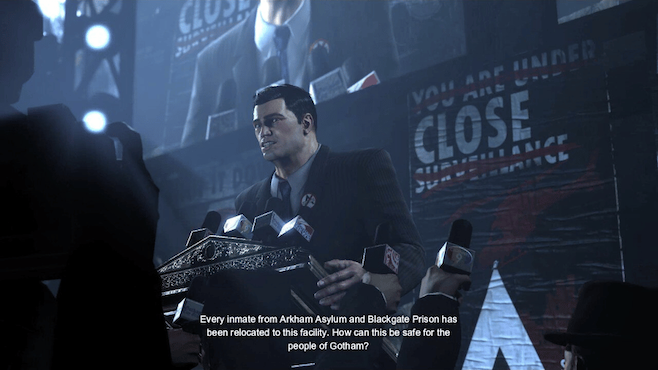
Arkham City opens with the extrajudicial arrest of billionaire playboy Bruce Wayne for opposing the construction of a mega-prison, in a scene that has only become more eerie in the decade-and-a-half since its release. I can’t help but to see masked, anonymized ICE agents storming a stage to pull him away from the crowd to punish him for the crime of speaking against state violence (hypocrite as that may make him, behind the curtain).
The journalists covering the event also get detained, for good measure.
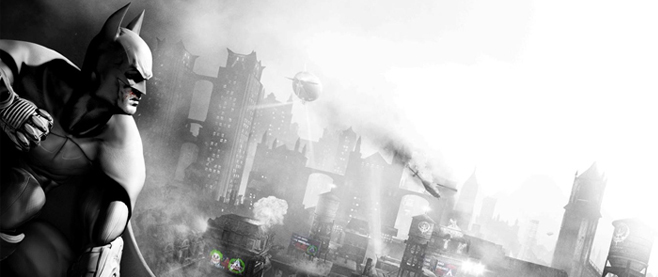
In the aftermath of the burning of Blackgate Prison and the Joker’s latest attempt to raze the city, Gotham politicians have all marketed themselves using tough-on-crime rhetoric. The city sells itself on a new solution spearheaded by the psychologist Hugo Strange, part of the city is walled off, renamed to Arkham City, and transformed into an open-air prison. Entry points are heavily guarded; masked, armed goons patrol and demand obedience from inmates; sniper towers sit along the perimeter; and helicopters fly about, patrolling the barren streets.
Part of the city is turned into a concentration camp.
I’m awed, slightly, by the way that City mostly avoids using this language in its script. Pragmatically speaking, it is a T-rated game and a superhero game at that, and thus it has to pull that rhetorical punch to maintain its rating. However, as I’ve watched the news and read quite a bit of history, I’m also struck by a certain intentionality in this choice: concentration camps are only identified as such after the fact, past the point where, as Omar El-Akkad put it, “everyone will have always been against this.”
The agents of TYGER – the goons supposedly hypnotized by Hugo Strange to become the faceless enforcers of this new fascist Gotham apparatus – do not discriminate against criminals by degree of their (alleged) crime(s). No judicial process occurs between detention and indefinite imprisonment. The Joker and Two-Face, Black Mask and the Penguin, Catwoman and Batman, are all thrown in alongside thousands of (accused) thieves, arsonists, wife-beaters, financial-criminals, drunk-drivers, as well as those not even accused of crimes, people with priors, journalists and public critics. Every last one is guilty-until-proven-innocent.
All the goons seem the same, on the street, in the moments before Batman swoops in to pummel them, but I have to question how much is performative in a lawless society. The TYGER guards aren’t swooping in to stop the beatings, murders, rapes, or robberies. They are simply passive observers – every crime within is granted a further punishment.
Arkham City has a sidequest about rescuing what it calls Political Prisoners. Identified by big fluffy overcoats with the hoods up, these guys are being held up and threatened by the real scum within the camp. We hear them being beaten, being threatened with rape or death, helpless against their attacker. I have to question how their presence further justifies the violence that we as Batman inflict, too. The idea that the camp harbors “good” people versus “bad” people, immediately discernible, is yet another tool of the state. I asked in my prior article how many of these goons have inhabited the role as a survival mechanism, and that question remains, but let me take it one step further: how many of those goons have been shaped into the monster-criminals used to fear-monger by an over-aggressive, inherently violent police state?
Shortly after replaying Arkham City last month, I ended up reading Michel Foucault’s Discipline and Punish (it was on my list, and this project served as a good excuse). I’ve had to fight the urge to litter this piece with selections from that text, but I will indulge myself once here:
“The feeling of injustice that a prisoner has is one of the causes that may make his character untameable. When he sees himself exposed in this way to suffering, which the law has neither ordered nor envisaged, he becomes habitually angry against everything around him; he sees every agent of authority as an executioner; he no longer thinks he was guilty [of the crime that originally saw him punished]; he accuses justice itself” (266).
Arkham City splits its attention, perhaps to its detriment, between the slow crawl to Arkham City’s Protocol Ten and a plot about Batman being poisoned by a diseased Joker. It does, however, make the reveal of what that term means makes it all the more stunning.
Protocol Ten is liquidation. Batman doesn’t kill, but the state he upholds does.
Those looming helicopters that have existed for surveillance alone suddenly launch salvos into the buildings of Old Gotham. TYGER goons open fire into the streets. The sniper towers target indiscriminately within the camps.
“Fifteen dead in Sector 4. Going for three more.”
“Got two casualties confirmed.”
“Can do, reloading, preparing for second barrage.”
We don’t get a lot of time to listen to Protocol Ten in motion, because the end of City breaknecks towards its conclusion, but I think the speed at which things go to Hell is useful from an analytical perspective: The purpose of Arkham City was never just detention. It was always going to become a genocide of the criminal element. Hugo Strange actively traffics guns to the Super-Criminals and their goons, escalates the rhetoric to the political bodies of the city, such that the milquetoast council members and organizers agree that the last, final solution is necessary as a matter of public safety.
In replaying the game and getting to this point, I couldn’t help but think of the Gaza Strip, surrounded by barbed wire, a decades-long open air prison, full of third-class citizens under perpetual suspicion of crime, finally crossing a threshold that allowed even the liberals to justify their total decimation. Some innocents may die, some children may die, some mothers and babies may die, but if they get Hamas, it’ll all be worth it.
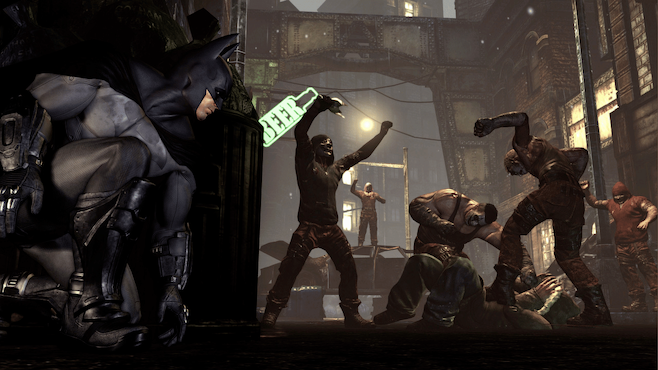
I can already hear one response now: “J.M., all the goons in Arkham City are adult men – and surly thugs at that.” Sure they are – a game from 2011 is not going to machine-generate thousands of character archetypes, and men who fall into the binary definition of evil are a lot more acceptable to smash into the ground than anyone else. Batman’s a hero, he can’t beat up a woman in the same way, lest people be made to empathize at all with the mooks.
Catwoman and Poison Ivy are thrown in there, though. Surely they’re not the only women deemed worthy of dehumanization by the state. Additionally, does being male immediately make extrajudicial execution/detention more excusable? Male civilians are still civilians, and thus they should be protected by international law. Being suspected of a crime/affiliation with criminality is not evidence that a crime was committed. The act of throwing a rock at a uniformed soldier should not be equivalent to opening fire on them with a gun. These are rhetorical traps that only further justify escalation – we’ve gone this far, too far to stop, but it is not far enough.
I hear the TYGER guards conversing and I think of the videos of live-streamed IDF violence, the videos of ICE cruelty, and the same glib, fetishistic tone of both groups who have totally dehumanized their victims.
Hugo Strange and his Wonder Tower are blown up, and Protocol Ten is halted, but not until thousands are slaughtered and the apparati of state terror have been fully manifested behind the walls for public consumption. The survivors of the “Arkham City program” are compensated after a massive class-action lawsuit. Arkham Knight tells us that many of these people used their money to further inundate themselves in the criminal lifestyle. Frankly, I’d never trust the state nor its illusions of justice ever again, either.
Hugo Strange dies, and Quincy Sharp commits suicide in disgrace while awaiting trial for his complicity in the violence. What of the other people who facilitated it, though? We hear nothing in Arkham Knight about the TYGER agents who actively murdered citizens of Gotham. They have qualified immunity, too, I suppose. We hear next to nothing about those many people who voted yes on the proposals for Arkham City, who wielded their own form of a Crime Bill to justify its formulation, who counseled and justified and ran interference against the naysayers. One might say that they, as parts of a system too big for any one person to take responsibility for, were simply bamboozled by a smooth-talking demagogue. The purpose of a system is what it does, and a system drenched in blood stains the hands of all who touch it.
There’s only one moment in which the game identifies Arkham City as a “camp,” and it’s during that final ascent into Wonder Tower to stop Strange, during a stealth segment that will occupy most of the player’s attention. We hear Strange’s gleeful boasting to his minions about the success of Arkham City, the success of the liquidation, and the fact that “soon, camps will begin construction across the world” to put an end to criminality – whatever that even means.
It was never going to stop in Gotham.
———
J.M. Henson is a freelance critic/author who haunts the Blue Ridge Mountains and is in turn haunted by most things out of their control. Follow on Bluesky.