Navigating Desire Through Lynch, Pluribus, Romantasy and Bollywood
No ads. No AI. So many bats.

Lately I’ve been wondering if David Lynch ever watched a Bollywood movie.
I’m telling you this because I’m about to do something a little wild, and I want you to trust the process: I’m going to link Mulholland Drive to Pluribus via a Yash Chopra movie.
Just pretend you’re in a dream: you don’t know where you’re going or why, but you know you must go there. Follow me.
One of the things David Lynch was famous for was his work’s exploration of duality through the use of surrealism. His specific dream-like tableaus encourage us to think of his works as psychological landscapes: the way a dream, as a doorway into the subconscious, tells you something about yourself you might not otherwise understand – or, at least, helps you ask the right questions about yourself. In pursuit of these deeper truths, Lynch’s dream-scapes are often occupied by the same actor playing multiple characters, or different actors playing the same character, encouraging us to think about the multiple aspects of a single consciousness.
There’s a Bollywood trope that resonates with this. A top-billing actor plays a character that dies at the end of the first act, but do not fear: we don’t have to bear their absence for the rest of our 180 minute runtime, because the miracle of reincarnation or the birth of their child who looks exactly like them means they will return in the second act as another character. From Aradhana (1969) to Om Shanti Om (2007), we can certainly understand this through a cynical-film-industry and tired-melodramatic-formula lens, and I think both are true. But speaking of multiplicity, let’s use David Lynch to find that diamond in the rough.
In Lamhe, Sridevi plays two characters. In the first act, she plays Pallavi, an orientalized object representing the romantic, unattainable image of Rajasthan to London born-and-raised Viren. In the second act, she plays the starry-eyed Pooja, Pallavi’s daughter and a young, malleable version of her, but one that actually wants Viren back. In the film’s uncomfortable conclusion (that “age is just a number” in the relationship between a teenage girl and a middle aged man), Viren, despite his insistence to the contrary, wins a version of Pallavi that is thrall to him… at last.
Ten years later, enter Mulholland Drive. I dare say that, in a way, this movie is Lamhe backwards.

Betty hops off a plane at LAX with a dream in her cardigan. She wants to make it big as an actress in Hollywood, and encounters a beautiful woman who has just survived a car crash and doesn’t know who she is. The woman gives herself the name Rita – after we see a reflection of her looking at a poster of Rita Hayworth reflected in another mirror – and the only vestige of her past she has is a mysterious blue box with no key.
Betty assists Rita in the search for her identity, while trying to forge her own. On the way, she encounters the harsh reality of Hollywood, while her and Rita slowly fall in love. One night, Rita wakes up with a desperate, inexplicable need to go to a very particular place: Club Silencio. The key to the blue box is recovered, and many have read what happens from this point onwards as the “truth” (where what I described two paragraphs ago is the “dream”). I don’t necessarily subscribe to this reading, and I’ll tell you why very soon. But what we discover here is that a woman who looks like Betty, called Diane, and a woman that looks like Rita, named Camilla, were lovers that worked in Hollywood together, keeping their relationship a secret until Camilla, the more successful actress, decided to end it and marry a male director. In a jealous rage, Diane hires a hitman to kill Camilla, and, perhaps unable to live without her, perhaps unable to live with herself for what she’s done, takes her own life.
The film very firmly places us in Betty/Diane’s point of view, and from that perspective, it’s hard not to read Rita/Camilla as the orientalized object of her desire. Betty/Diane, if you hadn’t guessed, is white.
Played by Mexican actress Laura Harring, Rita/Camilla is notably racialized. In the fleeting moments we see her alone, she speaks Spanish – her whimpering “Betty, dónde está?” never fails to move me – and, as I mentioned, she’s associated with Rita Hayworth, an actress who was famously “whitened” through electrolysis, hair bleaching and name change (her name was originally Margarita Carmen Cansino) for success in Hollywood.
At the same time, Betty/Diane and Rita/Camilla are… the same. That image of Rita donning the blonde wig, standing side by side with blonde Betty, is the starkest representation of it: Two women forging identities in the face of violent forces that reward certain performances and punish others.

There’s an undercurrent of violence to that: The wig could represent the “whitening” that Rita’s name is prophetic of, perhaps telling us that Betty is the “image” of what succeeds in Hollywood, and Camilla’s success tastes so sour to Diane because it’s supposed to be hers. Equally these scenes are charged with such profound intimacy, particularly when, at Club Silencio, they hold each other and cry as one.
In an earlier scene, Betty is sexually assaulted during an audition; later Adam kisses Camilla on set, a moment which is framed through Diane’s envy but can also be read, in dialogue with the former, as representing the sexual coercion that is commonplace in Hollywood. Images of sameness and difference regard race, then, but also compulsory heterosexuality. Diane sees the horrifying performance of a heterosexual life, one which she feels so unable to partake in she literally cannot live (I think this is the horror of the elderly couple that she envisions before death). But does Camilla also eviscerate herself (as represented by her amnesia, at the start)? Not through rejection, like Diane, but through conformity?
Betty/Diane’s distinctly racialized fantasy of possessing Rita/Camilla pushes and pulls against what I think is both the possibility and the reality of genuine love for a person who is, in some ways, very similar to her. This is the great tragedy of Mulholland Drive – Betty/Diane cannot see through her whiteness, and perhaps Rita/Camilla cannot see beyond compulsory heterosexuality. Instead of building solidarity, a powerless Diane ultimately chooses to express violence, not against the power represented by the Hollywood executives, but against someone she loves, objectifies, and relates to all at once. In doing so, she eviscerates both the Other, and herself (who is the Other).
Twenty-five years later, enter Pluribus.
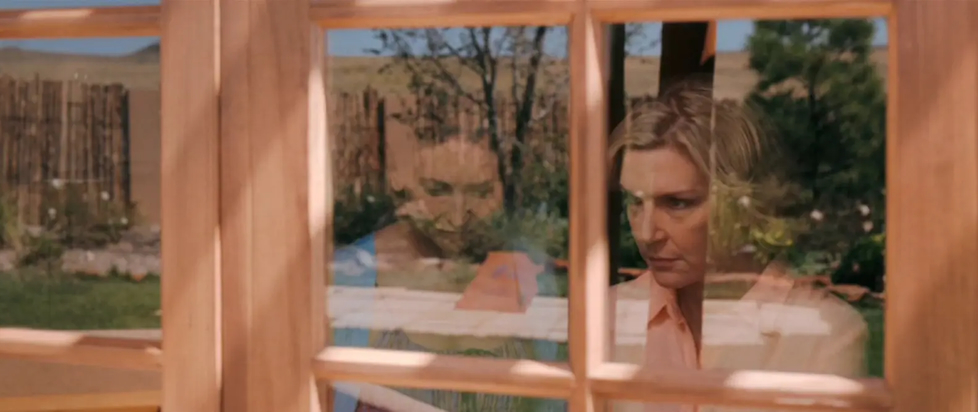
It was the Tumblr GIF-set industrial complex that got me thinking about the parallels between Mulholland Drive and Pluribus. On the surface you’d think all they have in common is the blonde-brunette lesbian couple trope and that one scene in the diner, but these visual threads highlight how both texts explore a white lesbian’s simultaneous otherness and objectification of others.
Like Betty/Diane, Carol is lonely woman who, as a lesbian, doesn’t fit into the world of (in this case) romantasy fiction. When almost every human on earth is pulled into a singular hive mind (the Others), Carol finds herself feeling more alienated than ever (it’s arguably an exaggerated representation of how she felt before). Carol is torn between the desire to feel like she’s part of something, to feel like she belongs, and eviscerating herself as an individual in order to feel that way. Her being a lesbian is an incredibly important part of that storytelling, as this conflict is contextualized by the knowledge that Carol was forced into conversion therapy as a child.
But Carol is a white woman, and I think this is an equally important part of what’s going on. She has an extractive, superior mindset when she tries to team up with the other individuals (those that haven’t joined the Others). They all come from different, mostly Global South and Indigenous cultures, and Carol’s whiteness only increases her isolation because the individuals are, understandably, extremely put off by her behavior (including the refusal to meet with those who don’t speak English).

In the original draft of her romantasy series, Winds of Wycaro, Carol writes the love interest, Raban, as a woman. She changes this out of fear, or in a bid to be more commercially successful. When the Others take over the earth, their appeal to Carol is to send a woman named Zosia, who looks like a female Raban. Before we learn anything about who she is or what’s happening, we’re introduced to Zosia through the oriental image of her toiling in the arid climate of Morocco. While Zosia is played by Polish actress Karolina Wydra and the character herself seems to be Polish, the image of Morocco and the in-itself orientalized image of the “pirate lady” (the exotic love interest from Carol’s romantasy novels), construct Zosia as an orientalized object of desire.
Uncomfortable coincidence, then, that this relationship is marked by Zosia’s apparent lack of individual identity and free will, and Carol’s ability to ask her to do and say anything she wants her to. Carol, something like Betty/Diane, constructs a lover in and around her fantasies of belonging and possession – through Zosia, Carol “belongs” with the Others, but Zosia “belongs” to her (Carol is so angry and disappointed when she realizes she cannot possess her). At the same time, it’s almost certainly true that Zosia (as part of the Others) is manipulating Carol. At the same time, Carol may not want to possess as much as she wants to be loved as an individual, by an individual, imperfectly – the way her wife Helen used to.
I think I sort of share Carol’s relationship to romantasy fiction. That’s more or less why I brought Bollywood into this at all – it’s hard for me not to reflect on how patriarchal tales of conquest beamed into my skull since I was three year old in my grandmother’s arms shaped my ideas about love. Even now, when I see Shah Rukh Khan’s trademark look of longing as he parts ways with Preity Zinta and the angelic voice of Lata Mangeshkar swells into the moment, I feel my heart racing and my stomach dropping and I’m sure it’s frivolous to be so moved by something so saccharine (and so propagandist). But I guess the love and the violence are both as real as each other.
Mulholland Drive and Pluribus encourage me to think about my own culpability, as a racialized lesbian, in these whirlwinds of projection and objectification. It’s easy to see myself reflected in the orientalized object of desire, but I know I’ve turned others into the same. It’s harder to admit that I see myself, undeniably, in the lonely universe of the desiring white woman.
Well, is there any duality more Lynchian than that?
———
Sara Khan (they/she) is a freelance writer and co-founder of Game Assist, a multimedia project exploring liberation and politics in gaming. Their work aims to center marginalized perspectives, and to explore how culture shapes politics (and vice versa). Find them on Bluesky and Instagram.

Sign up for the forthcoming weekly Unwinnable digest!