Smash ‘Em: Necromolds and the Power of a Good Idea Done Well
Visit the MIT Press shop
I see board games in the store and they always look so cool and then I buy them and bring them home, I’m so excited to open them, and then I play them, like, twice… This column is dedicated to the love of games for those of us whose eyes may be bigger than our stomachs when it comes to playing, and the joy that we can all take from games, even if we don’t play them very often.
———
With the rise of generative “AI,” it has become more obvious than ever before that ideas are largely worthless and execution is what matters. Every now and then, however, an idea comes along that is so good it cries out for execution than can do it justice. Enter Necromolds.
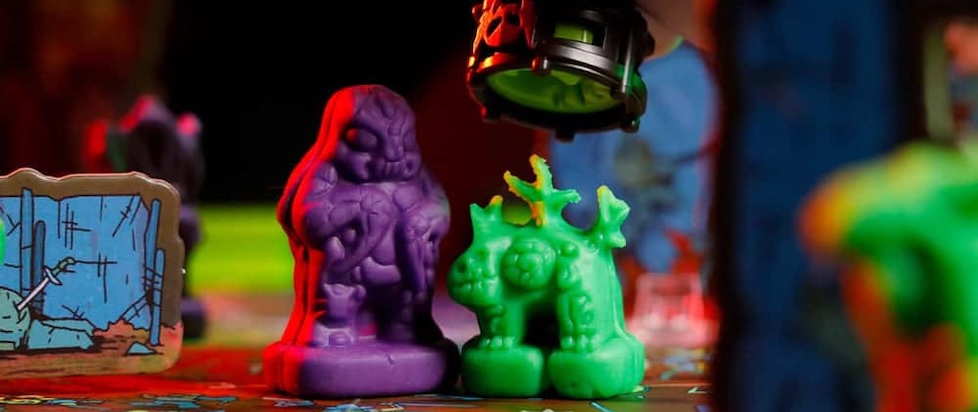
First launched in 2021, Necromolds is many things, but at its heart it’s a concept so ingenious one wonders why it hasn’t been tried many times before: a tabletop wargame (a la Warhammer) where you mold your troops out of Play-Doh-like “Spell Clay” and then smush them when they are defeated in combat.
Fortunately, the idea seems to have found creators equal to its brilliance in game designer Clint Bohaty, artist Thad Stalmack II, and writer Julian Bernick, as well as the rest of the team who worked on the game.
As is often the case, the first place this is apparent is in the artwork, which captures the chunky, archaic vibes of the Necromolds world in everything from the designs of the various monsters to the cluttered battle map on which the game is played.
Packed into the thirty-page rulebook are several different ways to play, including simplified rules designed to introduce young players to the concepts of tabletop wargaming. (The game’s website advertises it as “the best gateway wargame for introducing kids and adults to miniature gaming…”) There are also more complex rules, not to mention a solo play variant, optional house rules, and even a Where’s Waldo-esque “Hidden Objects Mini-Game” that can be played with the game’s battle map.
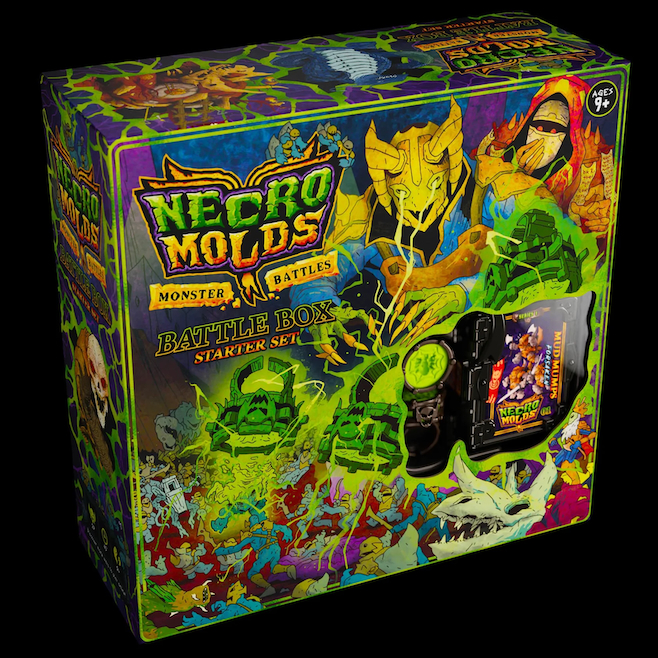
That’s a lot, for such a compact box, and it’s not even getting into what we’re all here for: molds for making gribbly little monsters out of Play-Doh and then smushing them. The game comes with everything you need to do that, too, including three “spellbooks” (the molds you use to make your monsters), two cans of “Spell Clay,” and two “caster rings” in the $65 Battle Box.
When I was a kid, I had one of the Mad Scientist toys made by Mattel; specifically, I had the “Ogore” one. They were basically just molds in the shape of monsters, accompanied by “Monster Flesh Compound” – basically Play-Doh. So, in essence, the same thing as Necromolds, but without a whole wargame to help you get added use out of your doughy creations.
(I actually still have the Ogore mold around here somewhere. It’s pretty great. I could totally use it to make an illicit Necromolds monster, albeit one that had no rules and was so large that it would probably be most of my army.)
Here, we get into one of the other interesting innovations of Necromolds. For those who have actually played tabletop wargames such as Warmachine or Warhammer, you’ll know that, usually, balance in these games is achieved by means of “points.”
Each player has a certain number of points to build their army, and more powerful troops cost commensurately more points, so that, ostensibly, both armies are at the same strength when you start the game – unless you’re intentionally playing one of many scenarios where that isn’t the case.
Necromolds jettisons the points idea, but keeps balance via a similar methodology that is tied to its unique central conceit. Each player gets an equal amount of colored “Spell Clay” – the different colors are also how you tell your forces apart, since you’re each allowed to make monsters using the same “spellbooks” – and you use your clay to make your armies. The more powerful a monster is, the bigger it is, and the more clay required to make it. Meaning that, again, your armies are ostensibly of equal strength, limited by the amount of clay you have to pour into them.
The monsters range in size from the Mud Mumps, the weakest and most common of the critters available, to the large Insectomites, biggest and strongest of the monsters released so far. In the Battle Box, those and mid-size Graveghouls (literally walking coffins) are all you get – but the line doesn’t stop there.
Necromolds may be designed as a gateway to tabletop wargaming, but as its aesthetics (and its similarity to those aforementioned Mad Scientist toys) would suggest, it is also beholden to 80s toy lines, and that extends to how it is marketed and sold.
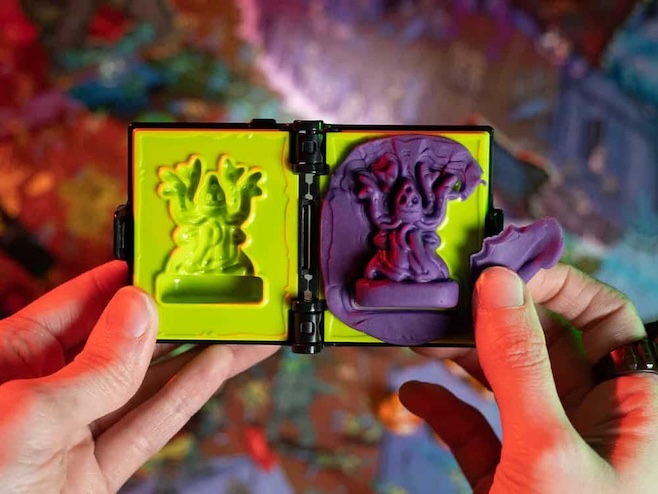
We have the vibrant colors, the gross yet cartoonish designs, and everything else you might expect from 80s toys, but we also have a similar marketing strategy. Players of Necromolds will find themselves as often reminded of He-Man toys and Monsters in My Pocket as Warhammer. To wit, the game can be expanded with a wide array of additional products.
Most obvious of these are the Monster Packs, which add new “spellbooks” and the ability to mold new monsters for your battles. The back pages of the rulebook are given over to lovingly disgusting descriptions of these various new horrors, which each have their own strengths and weaknesses. Each Monster Pack comes with two “spellbooks,” some more “Spell Clay,” and a random “caster ring.”
The “caster rings” are the other place where the collect-‘em-all aspect of Necromolds comes into play. Plastic rings with an indented shape where a setting would normally be, the “caster rings” are what you use to smush your defeated enemies.
There are 22 such rings listed in the rulebook, along with convenient checkboxes so you can mark them off as you get them. Besides random “caster rings” in the Monster Packs, you can also buy them in blind bags at a cost of around $6 a pop.
These are all accompanied by other expansions, such as the Call to Arms box, which adds rules for arming your various clay monsters with little plastic weapons, hats, shields, and so forth. There’s even a digital-only Tome of Golems that lets you incorporate Necromolds critters and magic in D&D 5e, and a kit for competitive play.
And that’s all in the game’s original lineup. Necromolds was clearly designed with more iterations in mind. So far, however, those haven’t come to pass. Are they still waiting in the wings? Only time – and the sales of these initial offerings – will tell.
———
Orrin Grey is a writer, editor, game designer, and amateur film scholar who loves to write about monsters, movies, and monster movies. He’s the author of several spooky books, including How to See Ghosts & Other Figments. You can find him online at orringrey.com.