The Player as an Unwanted Guest
Visit the MIT Press shop
In the end, I think it was my fault. The habit of using a controller comes with a series of assumptions that can easily be taken as universal truth. With one input from my side, the character will execute one action; if the pixels on the screen were to draw a problem, it would be my job to find a solution. An asymmetric dialogue, based on a vocabulary that began taking roots – in my case as in that of many others – during my childhood. It’s not about claiming to always be right, no matter what happens on screen: I met my first Game Over screen so long ago, and I’m used to defeat. No, that’s not it: the sour taste of defeat only burns for the time it takes for it to go through my throat. I would rather say that, as much as it pains me to admit it, when I play I’m expecting to be indulged.
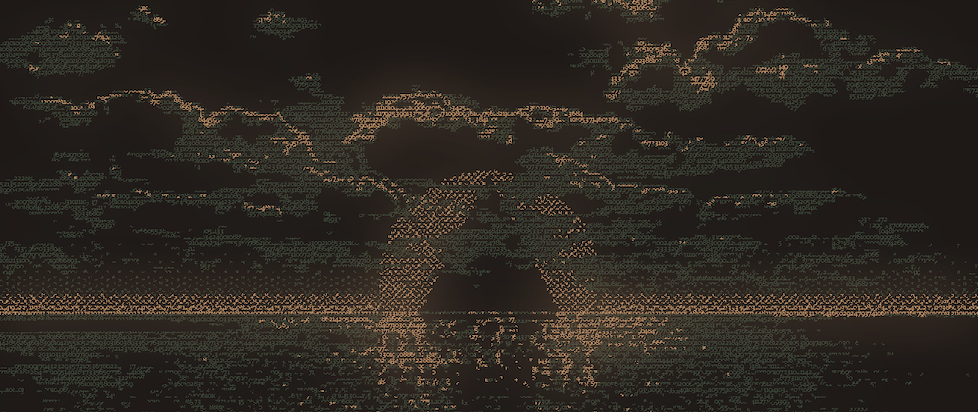
Without a Dawn made me believe that I was the one in control. Transported into the mind of a girl, confined (by her own will?) to a remote cabin, I deluded myself into thinking I was in a position to make decisions. The ASCII characters were dangling on the screen, generating an image both realistic and distorted of that space: realistic enough to make me hear the wood creaking, bended by the relentless push of the wind, but at the same time distorted to the point that I understood, from the first moment, that something was wrong. I could not yet figure out I was falling for a trick, as, in those first moments of play, everything was still comfortably sitting inside the usual archetype of problems and solutions – to be found through inputs. My inputs.
I soon realized I wasn’t alone. The little box inside the screen was confining action inside a narrow space, a little box on the screen. However, it’s the girl’s mind that’s too crowded: I found myself fighting against something persistent, a voice overlapping mine, leaving me no time to get to know it. For her, for the girl, were my voice and the other one the same? This question was floating in the air in both our rooms – my study, her cabin – while tiredness was moving her towards her bed. And so the Visual Novel, in that moment, lured me into a trap by presenting me a familiar pattern: a puzzle. Problem, solution; something simple, the perfect choice for a first challenge in a videogame like this. I felt that typical, well-known satisfaction of having found and overcome an obstacle, and I was ready for the next one. The next one, however, would never come.
From then on, I was only able to observe the spiral that was leading the girl to the abyss. I tried to fight back every time the game made me believe I could. The fight with that damn voice, the intrusive thoughts that were haunting the mind of the protagonist – that’s it, that’s the point: She is the protagonist, not me – there was no way to win. I hit Enter dozens of times, pressing over options like “Hesitate”, or “Don’t wake up”, hoping that anything would change. Every new input on my part didn’t do anything but bring me back to the starting point, until even the voice in her head stopped caring about me, deciding I was no longer worthy of an answer. Silence was on its side, and so it was time. After a while I gave up on trying. Like her, I let the maelstrom drag me in without a word, accepting that there was no other way. That nothing else was worth it. The only way to move forward was downwards, through accepting those thoughts, those pictures, and the darkness that came with those.
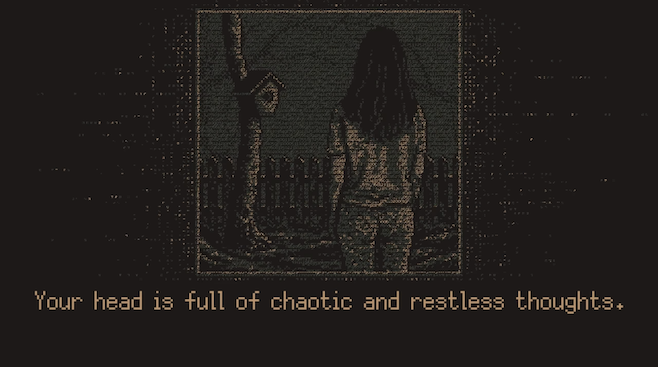
I was reading words, seeing them. The images on the screen were made of an endless stream of shapeless letters, and they had begun to take on other meanings for some time. The inner chaos of the protagonists was reverberating on the screen, affecting everything until it became confused, indistinct. The graphic style choice perfectly conveyed the idea of disorientation at the heart of the girl’s state of mind, lost in a cabin in the woods which she can’t remember getting to in the first place. She was isolated and drowned by her own thoughts squeezing her throat, suffocating her. My own inability to act was becoming unbearable; but how else could the game put me in the position of being able to understand the depth of the whirlpool that was sucking the girl’s mind if not by stubbornly refusing to indulge me? To let me get her out of there simply by inviting or even ordering her to do it would have been like asking someone who is watching their whole world crumble into pieces to “just stop being sad”. It would have reduced the magnitude of what was happening, while also belittling the power our own mind can exert on us to force us into oblivion.
So yes, I think it was my fault. I have been so thoroughly programmed to consider freedom of action as a yardstick for measuring the quality of a videogame experience, that I have taken for granted that, in this game too, I would have been a superintendent and commanding presence. With each of the girl’s refusal to obey me, I saw the illusion of control falling apart before my eyes. All that was left of me was an unwanted guest, whose highest aspiration was to drag the game into a loop made of silence. The only way to break the loop was to either surrender and accept the destiny that was portrayed on screen, or to escape and close that window over the girl’s crumbling word, rejecting the only role I could aspire to in that play.
Why did I stay? If all I could hope to do was to watch, why didn’t I just turn my back and leave? The truth is that the strength of that refusal, of the deliberate and conscious choice to prevent myself from influencing the narrative, got me much closer to the protagonist than any kind of freedom could have done. The more the game prevented me from acting, the more I wanted the girl to find the strength to rebel. In a more accommodating game, every time she gave up would have meant failure – and a probable, subsequent attempt. In this one, I couldn’t do anything but accept each surrender and make it my own. It was only the limited duration of the experience that made it bearable. But it was its intensity that made it so precious and memorable.
———
Diego Cinelli is a freelance writer from Italy. In fact, what you just read was actually written in Italian, but your mind tricked you into thinking it was English. Find him on Bluesky.