The Stuff of Future Memory: Speedrunning Arthurian Myth with Excalibur (1981)
Visit the MIT Press shop
“When a man lies, he murders some part of the world.”
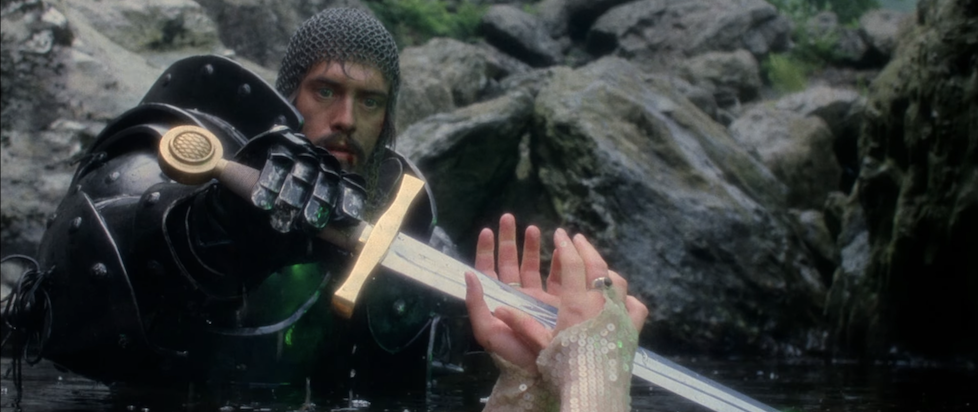
These days, every Spider-Man movie is, like, three hours long, but, once upon a time, such bloated runtimes were typically reserved for big, sweeping historical epics – and John Boorman’s 1981 speedrun of the length and breadth of Arthurian myth certainly fits the bill.
Even at two-hours-and-twenty-minutes long, Excalibur still feels like one of those movies made by cutting down a bunch of episodes of a TV show or miniseries. Characters are introduced (and dispatched) with little fanfare, and sometimes simply vanish from the narrative altogether without explanation. Almost nothing that happens gets any buildup to speak of, with the filmmakers seemingly trusting the familiarity and mythic resonances of the material to carry you through.
And the thing is, it mostly works. This is probably the best cinematic adaptation the material has ever gotten, even while it’s flying by at, like, 2x speed. Boorman’s view of the Arthurian world is simultaneously gaudy and cheap, filthy and sparkling – light has never glinted off so much armor. And, on home video at least, it has probably never looked better than on the fancy new 4K from Arrow.
There’s very little attempt to humanize the characters, instead leaning into their status as archetypes. Arthur even says it, near the end: “I was not born to live a man’s life, but to be the stuff of future memory.” Hence, Lancelot is a literally shining example who just shows up guarding a bridge one day, looking for someone worthy enough for him to follow.
Each player’s fate is charted for them, even while their own weakness seems capable of frustrating it at every turn. Arthur is destined to draw the sword, Lancelot destined to betray him with Guenevere, Percival destined to rise from nothing to be the last knight standing, Morgana destined to bring ruin to Camelot and to herself – the list goes on and on.
Against such a backdrop of elemental forces, Nigel Terry’s Arthur is often the most human-seeming character. Indeed, Boorman and frequent collaborator Rospo Pallenberg seem to have approached Arthur from the perspective, “What if there was a guy who could admit when he fucked up?”
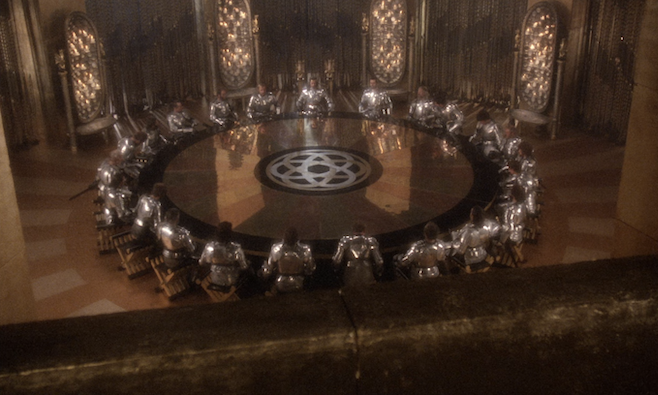
Around Arthur are, of course, a stable of other iconic characters. Nicol Williamson is the one most likely to steal scenes (and the one who seems to be having the most fun) as the sometimes-Mephistophelean Merlin. (I had seen this movie once before, a million years ago when I was a little kid, and one of the few things I remembered was Merlin’s weird metal skullcap.)
It also features early-career performances by a number of actors who would later become much more widely known. A young Helen Mirren plays Morgana in (inclusively) a molded breastplate complete with nipples. An early-career Liam Neeson is a drunken Gawain, and none other than Sir Patrick Stewart plays an early ally of Arthur and the father of Arthur’s queen Guenevere (remember that this would have still been six years before Star Trek: The Next Generation, and even a few years before either Dune or Lifeforce).
Perhaps the most striking, however, is Gabriel Byrne in very nearly his first cinematic production as Arthur’s father, Uther Pendragon. Merlin describes Uther as “rash,” and he certainly is, but Byrne gives him an unforgettable intensity, even if Uther is only in the opening few minutes, to tell the story of Arthur’s conception and set the stage for his eventual kingship.
(Of that conception, incidentally, let’s just say that Dario Argento apparently doesn’t have the monopoly on casting his own daughter in his movies as a sex object that gets graphically ravished onscreen.)
Vividly weird to look at, Excalibur careens between looking like an album cover and looking like a Renaissance festival after a rainstorm. There are huge, elaborate sets and also just a bunch of dudes sweating and stumbling around in armor out in the woods.
Once Morgana has set her eventual plans into motion and the Knights of the Round Table have departed in the quest for the Holy Grail, the film takes on genuine horror movie imagery, from young Mordred – who looks like the killer in a fucked up giallo – to the tree hung with dead knights.
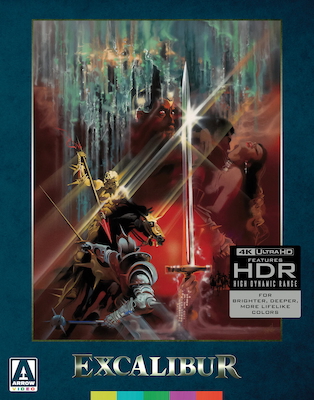
Like most everything else about the film, it probably shouldn’t work as often as it does, especially since the fights between the knights are never short of awkward and dull. Yet here we are, probably in part because we’re not really watching a story unfold as much as we are sort of absorbing a kind of mythic delirium. Malory’s Le Morte d’Arthur as told by cocaine. And let’s face it, Carmina Burana can make even two tin cans banging together feel epic.
Ironically, Excalibur almost wasn’t Arthur’s story at all. In 1969, Boorman had tried to get his Arthurian epic off the ground, only to be rerouted into an attempt to adapt J.R.R. Tolkien’s Lord of the Rings as a single three-hour feature.
“I saw it as this big dystopian story,” Boorman told Xan Brooks of The Guardian many years later. “I was going to cast nine- or ten-year-old boys as the hobbits. Put them in makeup; beards and things. And then dub them with adult voices.”
“Jesus,” the interviewer replied. “It would have been a disaster.”
“Yeah well,” Boorman acknowledged. “It might have been.”
———
Orrin Grey is a writer, editor, game designer, and amateur film scholar who loves to write about monsters, movies, and monster movies. He’s the author of several spooky books, including How to See Ghosts & Other Figments. You can find him online at orringrey.com.