Sentiment Has No Value: American Yakuza (1993) on Arrow Video Blu
Visit the MIT Press shop
“Words are pretty much overrated anyway.”
“I agree; actions speak best.”
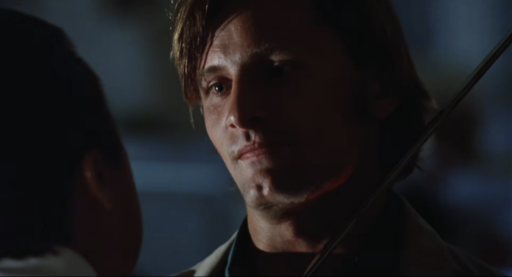
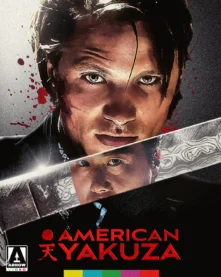
In 1993, Viggo Mortensen had been in around fifteen movies – everyone in the special features that accompany the new Arrow Video Blu-ray of American Yakuza talks about having seen him in Sean Penn’s The Indian Runner, from 1991. The Reflecting Skin was already behind him, but Lord of the Rings was almost a decade away. Despite this, director Frank Capello, in an interview filmed for the Arrow Blu-ray, describes Mortensen as a “leading man,” and that’s exactly how American Yakuza deploys him.
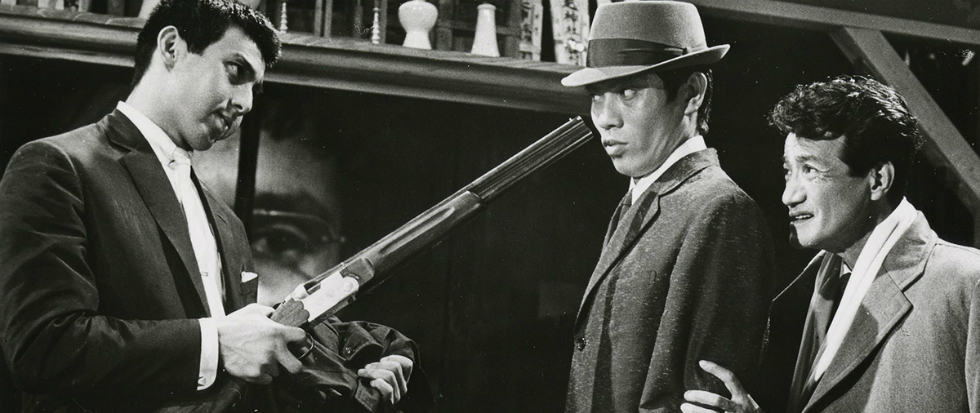
Mortensen plays a newly-released ex-con who gets a job driving a forklift at a yakuza-owned warehouse in LA and, from there, manages to ingratiate himself into the life of his yakuza boss (Ryo Ishibashi, Audition among others) despite actually being an undercover FBI agent. He does this by saving his boss’s life from a hit arranged by the mafia crime family of local mobster Dino Campanela (Michael Nouri, Flashdance et al).
For those who don’t remember, the early 90s were relatively obsessed with yakuza vs. mafia stories. Just as there were ninjas in pretty much every comic book at the time, the yakuza were infiltrating American action films, and often running up against their Italian-American counterparts.
Ridley Scott had made Black Rain four years earlier, in which Michael Douglas plays an NYPD cop who travels to Japan as part of the extradition of a yakuza killer, and becomes mired in the Japanese underworld. According to Frank Capello, American Yakuza actually performed better in Japan than Black Rain did, because it “didn’t make fun of the Japanese people.” This despite being a million dollar movie, as compared to Black Rain’s $30 million budget.
Of course, Black Rain and American Yakuza were far from alone. A war between the yakuza and the mafia forms the backdrop of the first Punisher film (also from 1989), and by 1997 even The Simpsons had gotten in on the action. In the eleventh episode of the show’s eighth season, “The Twisted World of Marge Simpson,” Marge buys a pretzel franchise, which eventually gets protection from local mob boss Fat Tony, only to have her business rivals employ the yakuza to defend their pita franchise.
In most of these movies, the yakuza are emphatically the bad guys, a sort of latter-day riff on early “yellow peril” stereotypes that show the Japanese gangsters as more disciplined and more deadly than their western counterparts. “When your ancestors were shepherds screwing sheep on the Mediterranean coast,” yakuza boss Lady Tanaka (Kim Miyori) says in The Punisher, “ours were the crime lords of Asia.” Agnes Skinner puts it more simply in The Simpsons, “They’ll kill you five times before you hit the ground!”
This may be where American Yakuza sticks out the most from among its contemporaries. Here, the yakuza are the ersatz “good guys” – still dangerous criminals, but ones who welcome Mortensen’s character into their lives and give him a family that he never had. The mob, by comparison, are portrayed as mostly crass, violent, and treacherous. As are the FBI.
When the authorities tacitly sign off on a bloodbath in which the Campanella family intends to wipe out the yakuza presence in the city, Mortensen and Ishibashi team up to get revenge in a guns-blazing finale that’s essentially an American take on the Hong Kong “heroic bloodshed” subgenre – complete with a shot of Mortensen jumping through the air firing both guns at once, a la John Woo.
The international flavor of American Yakuza came about partly because it was the first of a planned series of joint US-Japan action movie productions by Toei Company. It was co-produced by the indie shingle Ozla Productions, whose other joint ventures include 1994’s Blue Tiger, starring Virginia Madsen and Ryo Ishibashi again, the 1995 American version of Fist of the North Star, as well as Return of the Living Dead 3 and Necronomicon (both 1993), and even the 2014 Takashi Shimizu (The Grudge) thriller Flight 7500, starring Leslie Bibb and Ryan Kwanten.
As such, the cast and crew of American Yakuza includes a mixture of American and Japanese (and Japanese-American) talent, among them Yuji Okumoto, who played Chozen Toguchi in The Karate Kid Part II (1986) and more recently reprised his role in the series Cobra Kai.
Other cast members include Nicky Katt ,a child star turned regular character actor who died by apparent suicide in 2025; Anzu Lawson, a singer, comedian, and actress in something approaching a debut role who has since gone on to tuck dozens of movie and TV credits under her belt (she joins Frank Capello on the Blu-ray commentary track); stand-up comic Franklyn Ajaye; and none other than Academy Award-nominee Robert Forster, among others.
It’s a surprisingly stacked cast – and a surprisingly stylish movie – that has been largely forgotten by time. Which is okay, actually, as it’s a pretty forgettable one, in spite of all that. Director Frank A. Capello’s screenwriting credits include the 1991 Hulk Hogan vehicle Suburban Commando and 2005’s Constantine (being a screenwriter is a weird business), but his directorial efforts are relatively thin on the ground.
Among them is a 1995 actioner that also involves the mafia and the yakuza, starring a pre-fame Russell Crowe (Romper Stomper had already happened, but Virtuosity and The Quick and the Dead were that same year, and Gladiator was still half-a-decade away), not to mention the 2007 psychological office farce He was a Quiet Man, with a balding, mustachioed Christian Slater in the lead role, and a 2024 horror film I’ve never heard of called The Womb.
Unfortunately for both Capello and any fans of American Yakuza, that’s about it.
———
Orrin Grey is a writer, editor, game designer, and amateur film scholar who loves to write about monsters, movies, and monster movies. He’s the author of several spooky books, including How to See Ghosts & Other Figments. You can find him online at orringrey.com.