Failing to Fill Space
Visit the MIT Press shop
You can look next to you right now and find an empty space. Some of you will shake your head and call that lunacy. You’ll say, I’m next to my desk. I’m next to my dog. I’m next to my partner. But even then, most of you will still be wrong. That space is still there, but it’s small. Small enough that the things that are there, close and tangible, overshadow the emptiness.
Sometimes, that space grows. The desk is boxed, trashed, or sold. The pet is gone. The partner too, sooner or later, willingly or unwillingly. And somehow, the empty space that first helped you define shapes begins to erase their outlines — not in a way that makes you forget, but instead one that hardens their memory. The space becomes Space, a pseudonym for the things too heavy to be spoken aloud easily.
Unbeatable, the anti-fascist rhythm game from developer D-Cell, is bursting with Space. From the moment protagonist and lead vocalist Beat meets smart pre-teen and guitarist Quaver to the raucous closer of their adventure, the visual language of unbeatable creates landscapes often defined more by what’s missing than anything else.
Often, as Beat runs around through various settings, the camera is not just kept at a distance from her. The camera frequently makes the active motion of zooming out. At times, she’ll exit a building or barely hospitable shack — not exactly dominating the screen but unmistakably the center of attention — and as she moves, the camera zooms out and allows large swaths of the setting to enter the picture. It creates an effect where statues, buildings, train stations and more tower over the titular band members. What gives these scenes an extra gravity is how empty they are. While players will come across other people once in a while, especially in the city’s town square area, many spaces in Unbeatable are desolate. And frankly, even the ones that do hold a few faces should be filled with many more.
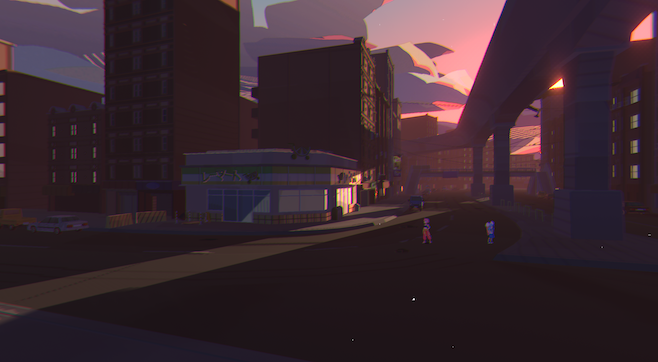
The perspective is oddly grounding — to go from the high-energy rhythm game action at one of Unbeatable’s concerts, which gives us one of the closer views of the band, to these strolls where the world looks like it can swallow you — in that it underlines both how grand the band is becoming while also portraying how small they ultimately are. It’s as if the world itself is presenting a call to action to the band members, and subsequently the player, to push back against the world’s emptiness with the only thing that can match its vastness: music. To put it another way, an individual body could never fill an empty stadium, but the music it produces might stand a chance.
This visual language also creates a lonely, almost nostalgic feeling that pairs well with Unbeatable’s narrative elements. Every band member is carrying some weight, the kind that is simultaneously invisible and all-encompassing. One of these weights is Quaver’s parents, a duo whose absence can be felt before you even know their names. After all, Quaver is twelve and a half, frequently mistaken for younger by most. Before context is given (something Unbeatable is allergic to in its opening hours), it is already very odd to see a child like her without parents nearby.
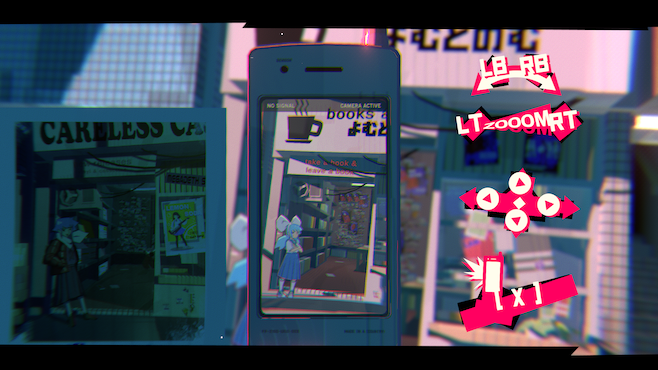
As a result, there’s always a sense of emptiness looming around Quaver, the knowledge of what arms should be surrounding her constantly badgering the mind of players and in-game characters alike, and it burdens Quaver with a distinct loneliness. This loneliness becomes most explicit during the moments Quaver asks Beat to help re-create photos Quaver’s parents took. The visual juxtaposition of Quaver at the same location as her parents, unable to fill the frame the same way one or two grown adults can, is almost heartbreaking. The girl’s desperation to reconnect with her parents is palpable, making the Space that fills the rest of the frame equally so. Despite being in the same area, the location itself has changed. The people who inhabited it are somewhere else. Even the device taking the photo likely isn’t the same given the borders. What once was can simply never be again. The Space remains.
Outside of Quaver and her bandmates, the fascist regime H.A.R.M’s oppression also narratively contributes to the game’s lonely atmosphere. As an armed group that punishes not only those who make music but also seemingly anyone who dares to exist loudly, their rule has the knock-on effect of vacating places usually brimming with people and noise. While the game plays music for the player as they traverse the world, the world itself is mostly quiet in text. The usual sounds are gone: no musicians giving impromptu concerts on the streets for tips; no chart-topping hits blasting from passing cars, no curated playlist to greet prospective customers as they enter a convenience store or bar. H.A.R.M, living up to its acronym, has created a world missing the things that give life texture, leaving nothing but an overwhelming Space behind that can only be captured by distance and wide shots.
The tragedy of Space is that it’s never really filled. This is something I was reminded of this past December, the first without my paternal grandmother — a passionate woman that commanded any room she entered with a warm ferocity and striking intelligence. She loved filling the stomachs of those she might find in those rooms too, especially if they’re family, with food that tongues were made for. There’s so much more to say. Nothing I could say would be enough. My grandmother passed away in June. Christmas still came in December. The tree’s base was still covered in presents. My phone was still buzzing with celebration and good wishes. My family still shared needed hugs and laughs. I had no shortage of love around me. But a name, a voice, was missing for the first time from the whole affair. The Space was still there because something was missing. It always will be now.
Few games capture Space like Unbeatable. It understands that words are doomed to fail sometimes. Maybe it’s because you’ll sound crazy trying to describe it, maybe it’s because attempting to use words will make you go crazy, but the point remains. Words won’t always capture Space. In Unbeatable’s case, it had to be felt through music. The omnipresent absence of others seen through what can’t fill the pervasive emptiness.
———
Wallace Truesdale is a journalist and critic who loves games and soft cookies. He’s written for Endless Mode, Stop Caring, Gamers with Glasses, and more. You can usually find him writing at his site Exalclaw, or hanging out on Bluesky and Twitch.