Layla was a Skater Bot

This column is a reprint from Unwinnable Monthly #193. If you like what you see, grab the magazine for less than ten dollars, or subscribe and get all future magazines for half price.
———
Thoughts about being something else.
———
The French animation school Gobelins provides a platform for many excellent student animated shorts. Layla is one of them, premiering last year and co-directed by a team of six – Oscar Baron, Diego H. Blanco, Emma Ferréol, Rachel Gitlevich, Lucille Reynaud and Narda Rodriguez. Set in the near future, it follows a trio of preteen 11-year-old boys fumbling for toxic ideas of masculinity with a highly advanced sex robot, the titular Layla – but with her help, they realize they’re still kids. And that objectifying women isn’t something you should do.
As much as the short is about the boys, this reading contends that Layla’s own story exists too. And while the boys could be seen as framed hilariously trying to appear grown-up by reaching for sex already, their behavior at times feels more obnoxious and off-putting than anything else. They feel more like the topic of biting satire about a toxic mindset defining gender based on what are ultimately delusions that objectify people. The short’s ending still points to them dropping that behavior as being ideal – and it’s ideal for several reasons, such as treating Layla with respect. Her side of the story shows the importance of ditching bizarre notions like the narrow view of manhood and its ties to sexism.
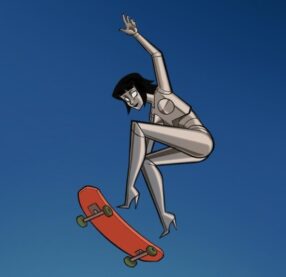
The short film starts with the boys hanging out in an abandoned motel, poring over magazines of women posing for pinup photos geared toward a narrow male gaze. One picture’s captioned with “REAL WOMAN,” all in caps lock and begging to be challenged later. While eyeroll-inducing, the boys’ reading material does actually feel somewhat innocuous. Until Lucky, the most vocal and obnoxious of the boys, crosses a line by bringing an actual sex robot. Lucky has her crate – branded with “Layla” – laid out on his skateboard to roll her in. Fresh from the box, Layla only has her programming and haplessly follows it, even if her “clients” are just 11 years old. As much as it’s a gag fiercely mocking the boys buying into the lie of toxic masculinity and making them confront that getting a sex robot was absolutely the wrong move, it feels like it also makes a satirical point about techbro companies that likely cut corners and missed setting age restrictions on their sex robot due to a mix of incompetence and another dose of toxic masculinity.
While Lucky’s the one to get an actual sex robot in his delusional pursuit of being a man, he ends up panicking and running away from Layla’s programming. Stevie, the most sensible and kindest of the boys, instead drops all juvenile pretense at bizarre notions of manhood and treats Layla like a person rather than a new object of fear and insecurity to run away from. He politely declines when Layla checks if anyone here wants what she’s been programmed for, calling her “ma’am” and instinctively acknowledging her individuality. Stevie shows what positive masculinity can look like. Along with the boys’ shifting behavior as their warped expectations come crashing back down to earth, Layla’s own curiosity helps her break away pretty quickly from the exploitative sexual script she was programmed into. She wonders what should they do if no human male wants to use her for what she was literally made for.
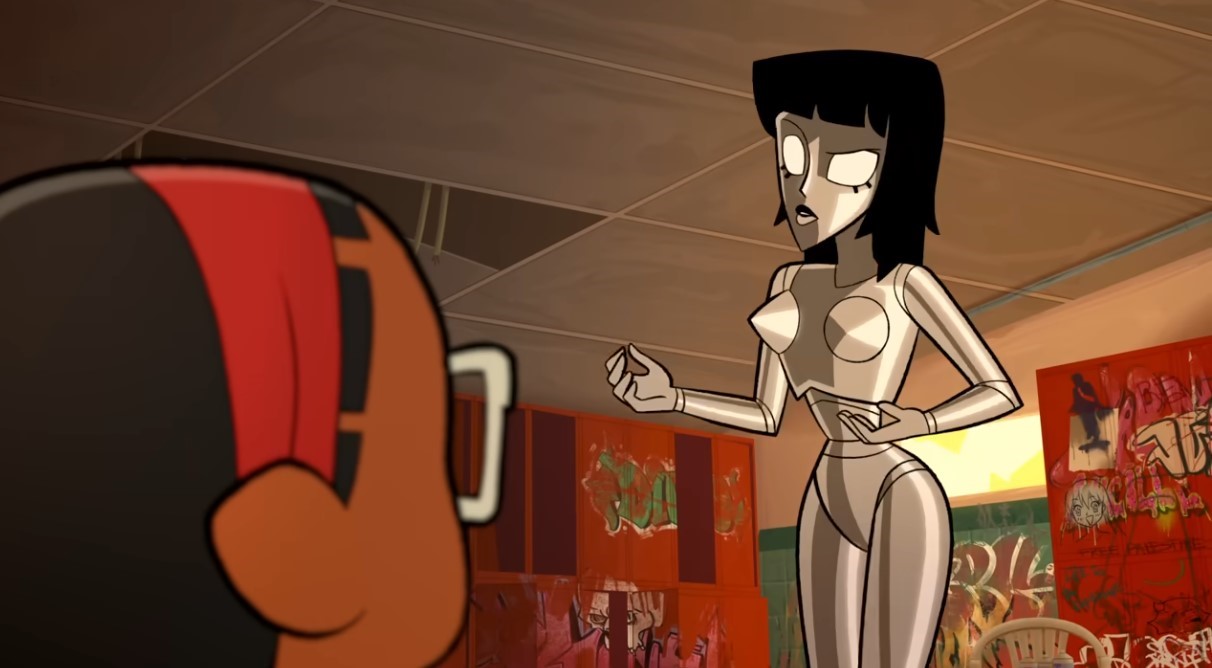
Metal introduces flash and flair to Layla, and an edge of the electric-fantastic; her female identity is grounding. It adds a layer of specific contrast. And yet the servitude inherent in robotics can emotionally synchronize with human matters in sci-fi, like traditions of women made to feel they must serve, that it’s what they’re there for (built for). The shared sense of servitude can also apply to other groups of people; but it can apply to women specifically based on a history of gender discrimination. People have pointed out disappointing patterns in letting prominent virtual assistants Siri and Alexa be coded as female. While male virtual assistants do exist now, it’s hard to deny that Siri and Alexa remain the major names in that area. Robotic characters in fiction have long provided another metaphorical arena for human stories to play out. There seems to be enough female-coded robots to populate their own subgenre. It’s not just a contrast between robot and woman in Layla’s character, between the inorganic and the organic; there can be crossover and synchronicity too.
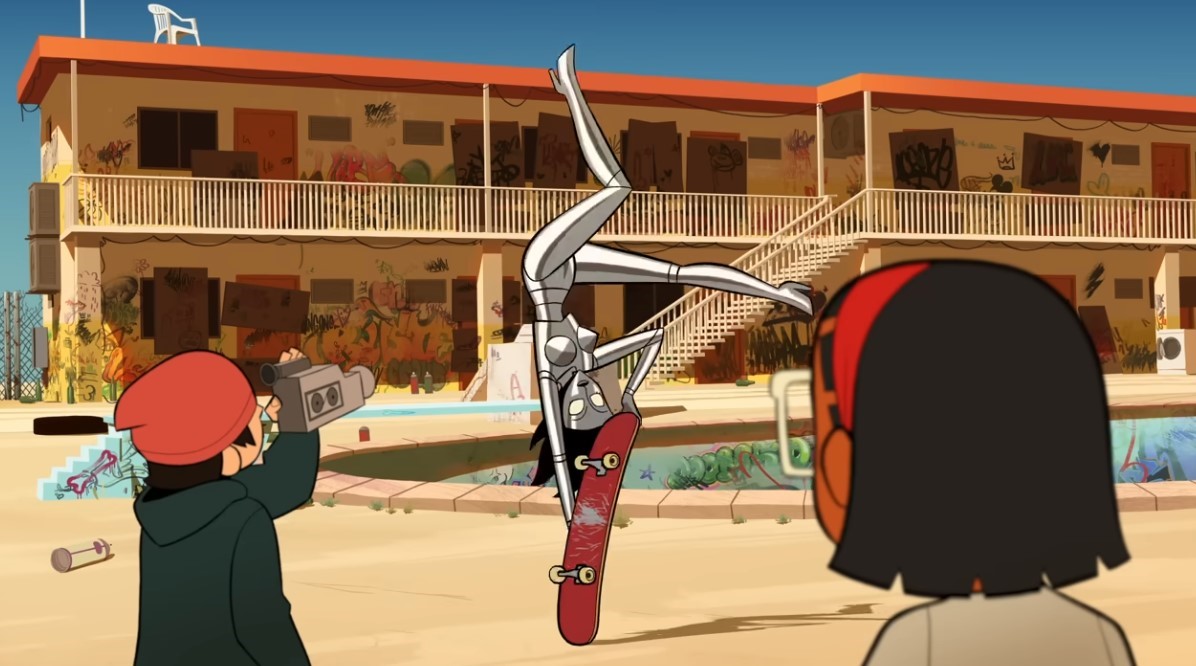
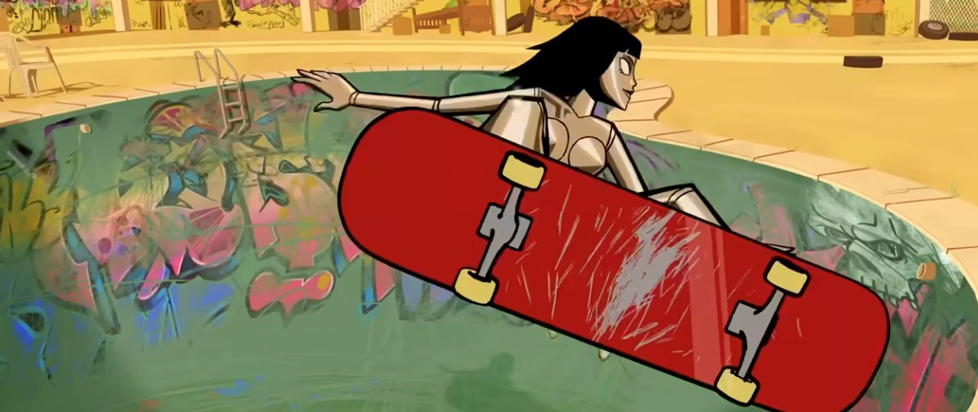
Free of pretense and the toxic quest for a strict definition of manhood, Stevie answers Layla’s genuine and existential question by pretty naturally suggesting doing something he considers fun – skateboarding – and figures that Layla would also like to do something fun. He assumes joy can be common ground with her, seemingly undeterred by her being a robotic woman. Surely she likes to have fun too. Lucky slips out of pointlessly kicking himself for not meeting his twisted standards of masculinity just long enough to sneer at the “sex robot” skateboarding, indicating his narrow-minded skepticism that she can do anything beyond her programming. Choosing to call her only “sex robot” instead of “Layla,” the closest thing she has to an actual name, shows another way he continues to objectify her. Layla doesn’t notice that nonsense and continues trying out this skateboarding thing…and finds that she’s good at it. She’s good at something beyond her programming. She can experience her unique robotic physicality through sport unplanned by her manufacturers. Stevie’s vocal admiration draws a small and genuine smile out of her in a nice show of subtle animation. She’s praised for something outside of what she was made for.
Cue the skateboarding montage. Completing the trio of boys is Bam, who has been filling a largely silent background role. But he’s there to immediately side with Stevie and Layla, providing further support to indicate that they’re the sane ones in this microcosm of an ideological divide that’s only developing because Lucky is acting like a jerk. He’s the odd one out in this case. His self-imposed solitude is significant – he’s stubbornly unreasonable in the face of rational, compassionate connection actually being framed like it’s the normal thing to do as represented by Stevie, Layla and Bam. It’s comforting to see the short so easily accept the new trio’s camaraderie as the natural reaction, to suggest that of course, you should be kind and treat each other like people.
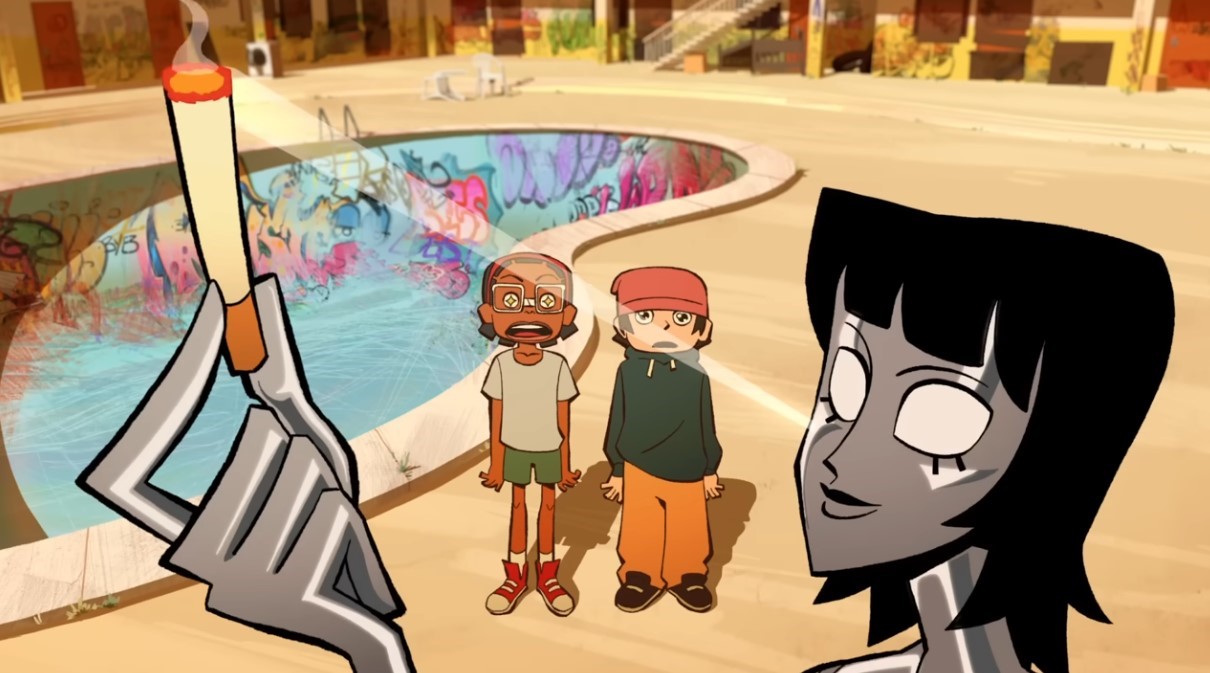
Besides quietly backing up Stevie and Layla, Bam also serves as their in-universe videographer, providing some neat retro-scratchy visuals via camera footage for the skateboarding montage. Outside of Bam’s diegetic recording, Layla again revels in her unique body, finding that she can do something as niche as letting the sun bounce off her metal exterior to light a cigarette held still at the right angle. She doesn’t have to lament over not being literally human. She can experience things that are unique to her. There is worth in her as she is, metal parts and all.
When the short started, Stevie was looking at pinup photos of women in magazines geared toward a strict idea of the male gaze. Lucky is looking at those magazines again while Layla’s enjoying skateboarding with the other boys. Rather than immediately acknowledge what’s right in front of him, Lucky clings to a delusional vision of overly sexualized women catering to a shortsighted male gaze and warped notions of what masculinity desires and demands. Tellingly, when he does lower the magazine for a second, he sees Layla looking very different from the women posing for the photos. She’s just sitting and chilling with Stevie and Bam like a person, not a sexual object. Layla may be a robot, but she feels more like a real person than the women posing for a paycheck in the photos meant for a male audience, snapshots of them having to work in artifice while Layla now has a chance to find herself. Tales that feature nonhuman characters that get to behave more emotionally or naturally than human characters often lead to interesting stories of fantasy and sci-fi. And yet, when Layla was fresh out of the box, she acted like she was one of those pinup women come to life, jumping off the page. Layla was literally programmed for artifice. The women modeling in the photos are likely similar to Layla when they’re off the clock, just as Layla feels more like her true self when she sets her programming aside. Layla gives a better idea of how a “real woman” is a person. But she also provides a glimpse at how the human women in the pinup photos are the same – real people when they’re not posing for the male gaze.
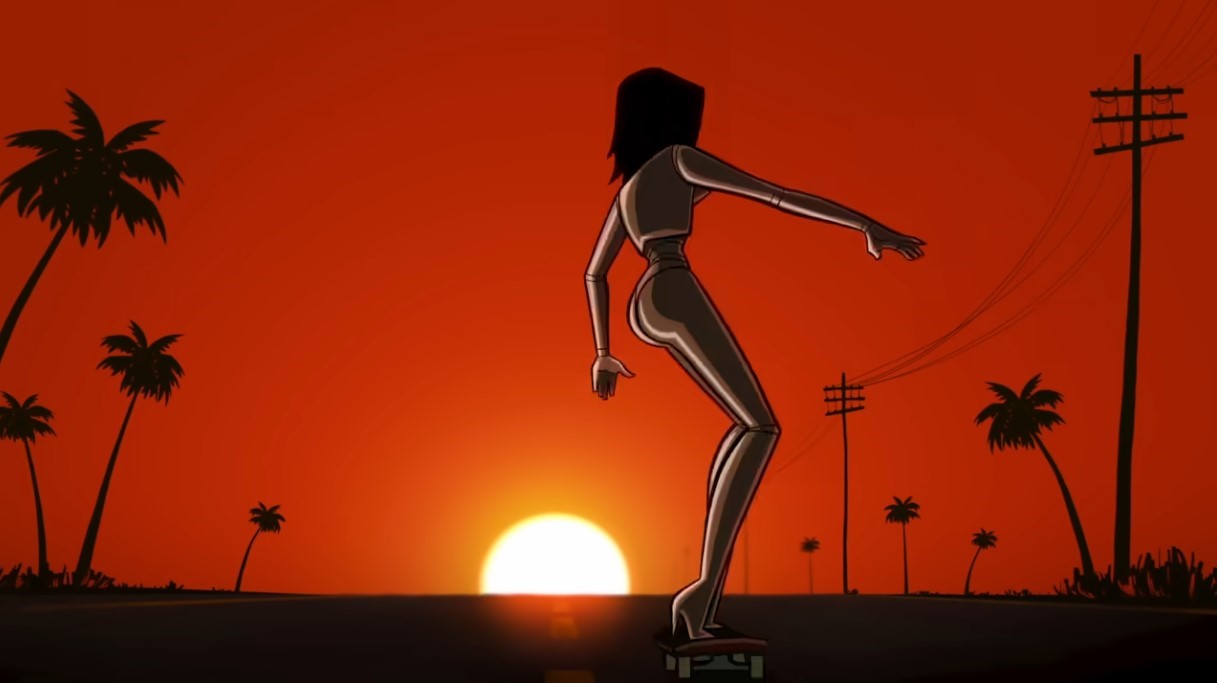
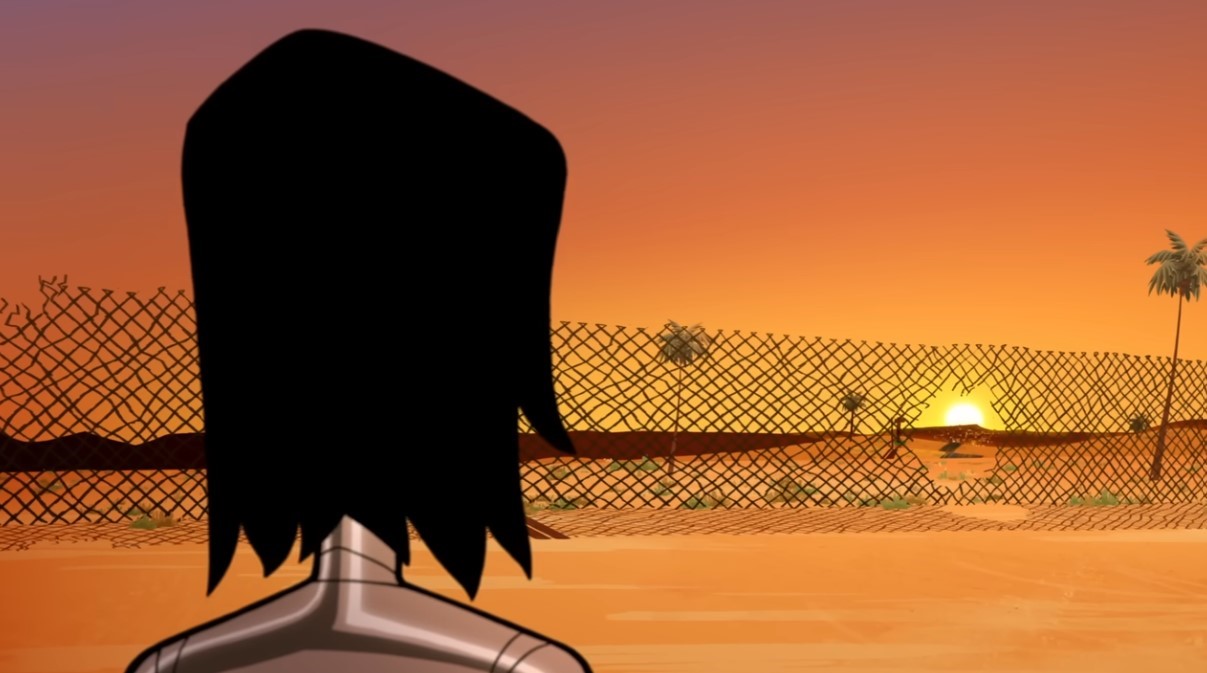
And in contrast to the magazine pinup art, a mural of Layla just riding a motorcycle and depicted like a badass is later graffitied in the empty swimming pool they’ve been using as a makeshift skatepark. Short close-up shots show it was an artistic collaboration between Stevie and Layla. The robotic woman looks up at the portrait of her as a biker, regarding it with delight. By her own hand and with the help of a friend, they make larger-than-life art of her at the wheel and in control. The skating montage has been subtly and quietly incorporating more of Layla’s POV. In a key moment, the camera follows one of her skate tricks, and stays with her when she lands. Once back on the ground, her exhilarated joy over another successful trick fades as she quietly watches the sun set through a hole in a fence. Her eyes go even farther past the gap in the barrier, to a road stretching onward, for a city. She could go there, by herself, outside of her programming. Her next moves are already forming in her constructed but no less sentient mind. Lucky’s preteen insecurities rooted in sexism are overshadowed by Layla’s growing desire for freedom from her programming that’s been chained to sexual exploitation. Lucky may whine louder, but Layla’s quiet actions and emotions have more heart.
When Lucky comes to mock the group again, deriding Stevie and Bam for behaving like “fucking kids” while he reeks of insecure machismo, Layla puts her foot down and reminds him that they’re all “fucking kids” before sending him down the empty pool on a grocery cart joyride with the other boys. It seems to do the trick, as Lucky finally acts like a human being and a kid, enjoying himself and dropping all pretense at twisted concepts of manhood. He even comes to invite Layla to have more fun with them, using her name for once.
But Layla leaves the boys, skateboarding away on that road she was already contemplating. The short ends with her riding off into the sun. She goes her own way. Her agency was sparked, and she’ll continue to pursue it. And just as Lucky delivered her like a package on his skateboard before, it’s his skateboard she takes to ride away on while she makes her bid for freedom.
While this article can be written more explicitly about objectification, sexism, gender discrimination, toxic views of masculinity, and Layla’s rejection of all that wrapped up in a sci-fi metaphor, it’s better that the short does not get too literal with it. Actual impact would be lost if the story ground to a halt to force Layla onto a soapbox to verbally preach about the wrongs of sexism, if it tried to shift genres from a sci-fi tale to an essay. There can be some dramatic monologues that avoid crossing that line into an overdone sermon – but it can be a hard line to avoid crossing, and other monologues have ended up spilling over into something that’s not functional. Fiction and nonfiction have their differences. There are some things fiction can do that nonfiction can’t, and vice versa. In a way, nonfiction can be direct and to the point. Fiction often works best when it stays in its lane of storytelling and characterization, and any messages it hopes to share work best when they stay in that mode of story and character. A story’s message can have more impact when it follows its own internal compass of dramatization, a story’s message can have more weight when it remains immersed in a character’s actions, thoughts, and emotions. Layla steering away from her programming, following her curiosity, bonding with the kids and reaching her own conclusions about them, finding her own personal love for skating and then skating away for somewhere unknown but entirely of her own will – that all works in a story and successfully shares a fantastical view of grappling with sexual objectification and seizing personhood instead. The story would’ve been robbed of all that impact if Layla had been made to give a clunky speech instead, if it had decided to become an essay when it was originally a story, when a switch like that wouldn’t fit. Layla was shown more respect as a female character by putting in the work to make her a character, who can act alive and not like a walking sermon. The creators didn’t just slap feminine coding on this robotic character and call it a day; it wasn’t just shallow window dressing. Layla was made a character, equal to any other character.
It’s even impactful that in this particular story, Layla doesn’t actually refuse her programming with something like a literal and verbal “no” – she just acts. She just…doesn’t do the thing she was programmed for. She doesn’t bother with talking at length about it. She doesn’t dignify it with speech. It’s not worth her time when she’s got places to be.
———
Alyssa Wejebe is a writer and editor specializing in the wide world of arts and entertainment. Her work has included proofreading manga, editing light novels, and writing pop culture journalism. You can find her on Bluesky and Mastodon under @alyssawejebe.