Control Explores Theology in the Multiverse

This column is a reprint from Unwinnable Monthly #193. If you like what you see, grab the magazine for less than ten dollars, or subscribe and get all future magazines for half price.
———
Finding digital grace.
———
Last month, we talked about a game that handled (among other things) theology in a multiversal setting… poorly. So, what if it was actually really good? A story with worship, idolatry, evangelism, conversion, dogma and faith through the lens of piercing reality’s multitudes? Well, funny you should ask, dear reader. Someone did!
To be fair, Remedy’s CONTROL needs little introduction. It was one of the bestselling games of 2019, it has been re-released on modern systems, there’s an (unfortunately rough) spin-off game, and even had tie-in DLC with Alan Wake II. If you are reading a magazine like this, you’ve probably at least heard about CONTROL, if not played it. Still, for those who haven’t, the short version:
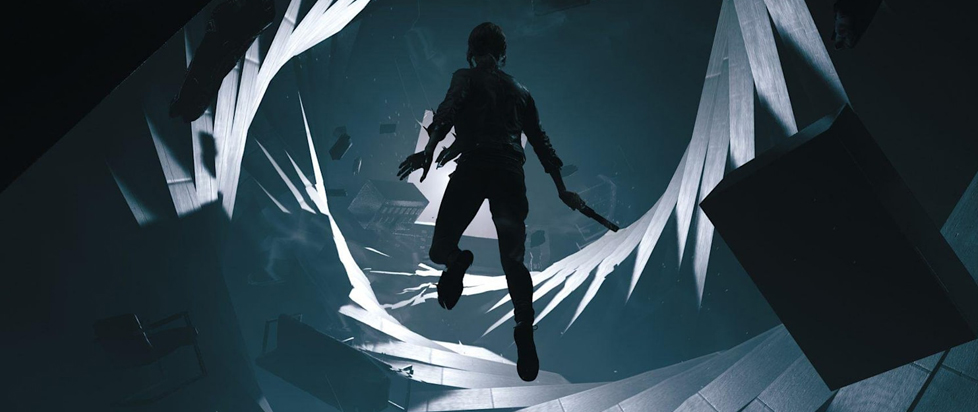
Jesse Faden, is one of two survivors of a horrific incident that’s basically “What if Coraline was given the edge of It?” After the dust settles, she’s now joined by a psychic companion in her head made of living sound, named Polaris. After years of drifting, trying to find the other survivor – Jesse’s brother Dylan – the pair of Jesse and Polaris arrive in New York City to locate the mysterious government agency, the Federal Bureau of Control (FBC for short). You see, the FBC covered everything up and abducted Dylan, turning him into a child lab rat for their scientists to study.
Except getting inside the FBC is the deceptively easy part. The headquarters actually is the sentient remains of the Norse world tree Yggdrasil, now an ever-shifting brutalist building complex with no windows. Oh, and the building janitor is likely a Finnish water god who likes to sing and jokes about how he outranks the director of the bureau. Confused? Unnerved? Great, that’s the vibe Remedy was going for!
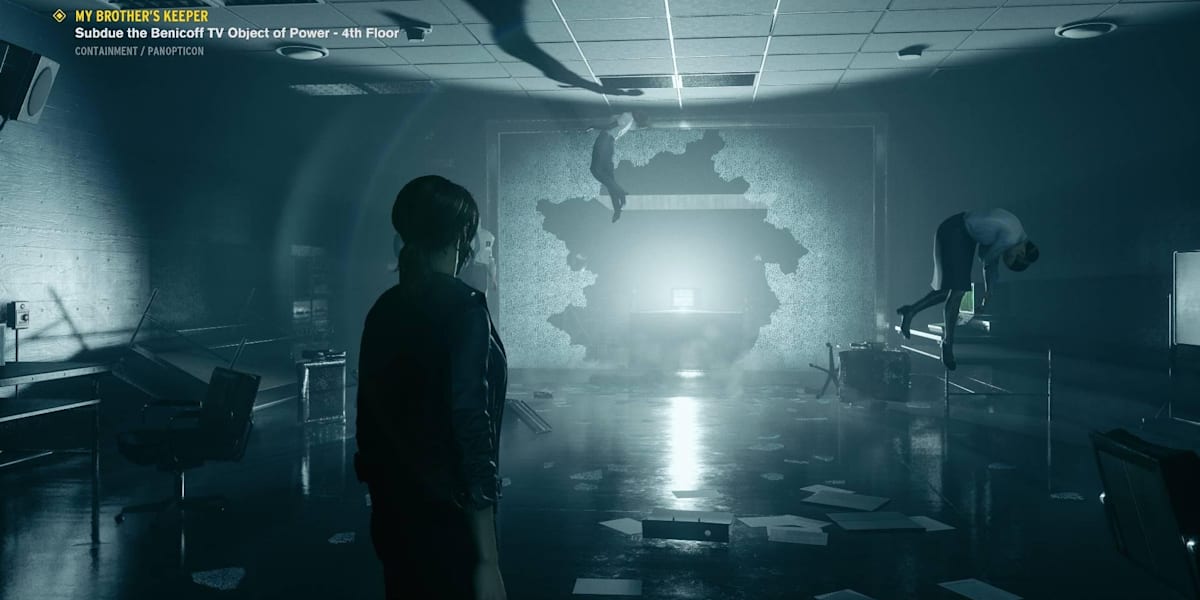
Through a series of mishaps, Jesse ends up chosen as the next Director of the FBC – given the last one let in a viral sentient psychic plague that Jesse dubs The Hiss. You see, the Hiss infects your mind and rewrites your DNA via a memetic prompt, sort of like an incantation. Think Pontypool but with possession and mutation rather than zombies. If Polaris helps someone “glow brighter,” then the Hiss desire submission and control. The Hiss are forcing everyone to become their thralls. So, Jesse, as her power grows as they receive new weapons and abilities, rips through the Hiss to save Dylan.
Unfortunately, the pair find that Dylan is aligned with the Hiss. He loves what they’re doing. His mind is so warped that he doesn’t dream anymore, but instead glimpses other realities in his sleep. He’s become so jaded from his abuse at the hands of the FBC that his empathy is fundamentally broken. He’s seen behind the curtain and he wants to see the world burn, full-on Paradise Lost “Better to reign in Hell than serve in Heaven” nihilism.
So, try as they might, Jesse and Polaris have to fight him with several unconventional allies. For instance, Jesse’s abilities weaponize beliefs centering around the “altered” items she encounters. Each item is influenced by the collective unconscious warping reality through belief and iconography. The very gun she carries might well have once been a sword, but now is a brutalist six shooter like Dirty Harry’s. The pair go through all this trouble, only to accidentally cost their last line of defense, Hedron. And unpacking the entity of Hedron is too much of a topic in of itself to summarize, but needless to say, Hedron’s absence is like losing an archangel in a battle with a hundred thousand devils at the door.
And at first, the Hiss win, however briefly, because of this turn of events. Jesse becomes infected, cut off from Polaris in the chaos, and experiences what every infected endures: a living Hell. The Hiss transform you by trapping you in a terrible nightmare that just infinitely loops until you break. This is what the Hiss want for the entire world. Except Jesse breaks free, remembering herself, remembering her worth, and reconnecting with Polaris. And then they, well… as the song goes: TAKE. CONTROL! *Guitar riffs intensify*
But seriously, I love that this is a story that explores a polytheistic, multiversal setting so bluntly yet cleverly. They make sure not all of it goes over your head, but the lore is deeper if you’re willing to dig and theorize. While some things are left up to theory crafters to make sense of, there are brilliant ideas at play.
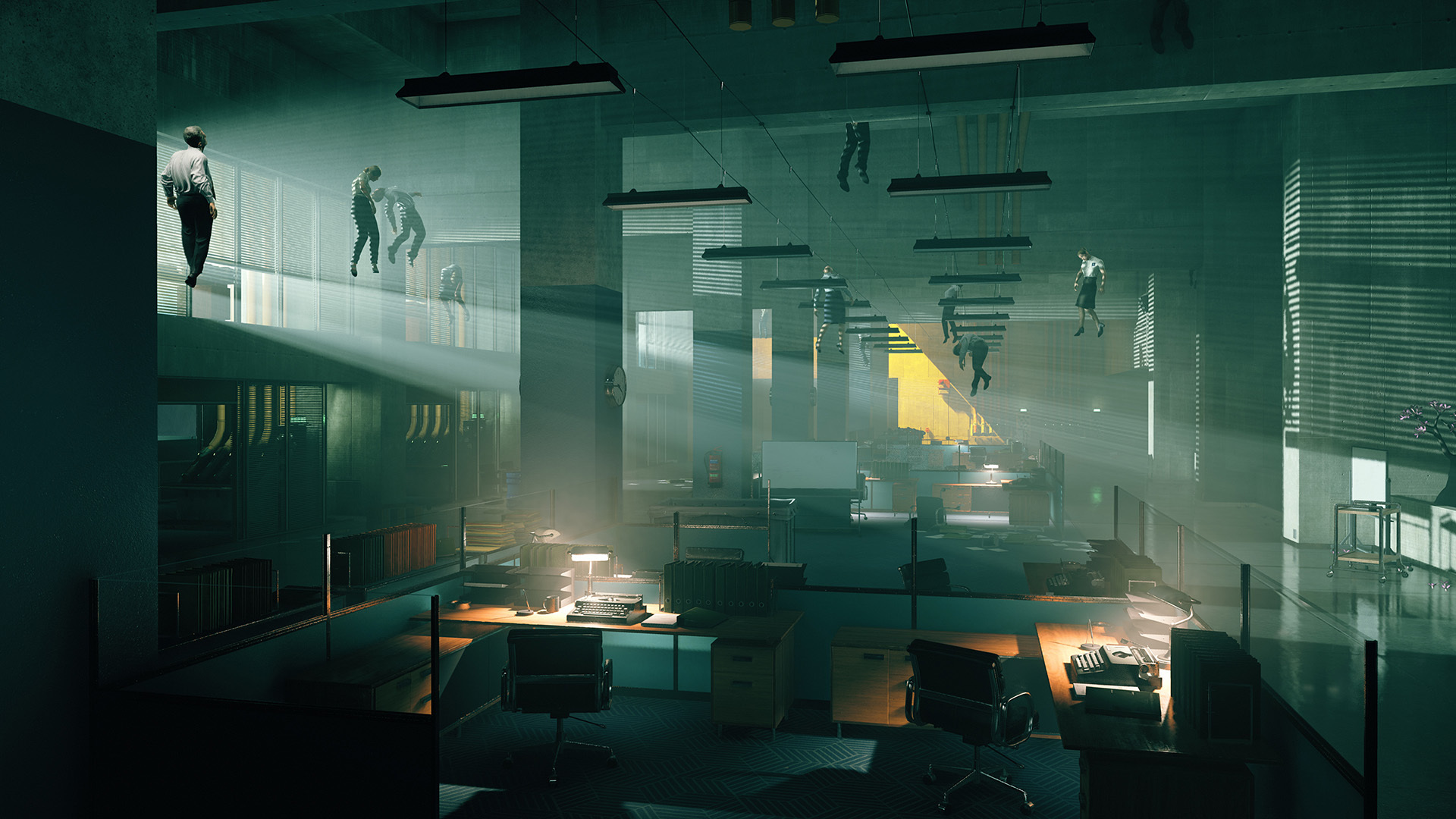
For instance – it’s obvious that The Board, the interdimensional worms ruling the FBC as false idols, rely more on Jesse than Jesse initially relies on them. As such, they keep entangling themselves more with her via Objects of Power that grant her those new abilities. Their influence co-opts the beliefs to serve their own ends. Yet for all their tangible benefits, The Board are powerless in the face of an apex predator like The Hiss. Yet the quiet, earnest faith Jesse has in herself and Polaris saves the day.
And as if that weren’t enough, there’s this one ex-member of The Board, known as The Former. Over time, it seems to be hinted that The Former could potentially be an ally that could break Jesse free of The Board’s influence. I really hope they pay off on this idea. It’d actually be an easy way to decrease the player’s abilities back to a low level in the seemingly inevitable sequel.
What’s particularly fascinating is how all the benevolent divine entities tend to either just exist in a chill fashion or act in service to others even if those others are beneath them. For instance, the resident god/janitor, Ahti. He knows the power he packs, calling Jesse his new assistant; yet he doesn’t look down on her. He treats her fairly, doesn’t pull any wool over her eyes, and if anything, is more candid with her than most of the humans under his auspices. He’s just rather quirky about it. And as an actual god, The Board doesn’t ever try to mess with him, knowing Ahti is crucial for their pyramid scheme of governmental worship to continue.
Just as crucial is how CONTROL argues that faith is a building block of reality, whether viewed spiritually or secularly. Jesse’s most ardent human ally, Dr. Emily Pope, is far from a religious woman. However, Pope’s pure desire to understand the scientific underpinnings of it all simply has her come at the question from another angle. She doesn’t dismiss what’s happening in front of her, she ruminates on what it all means. CONTROL really hammers home that idea that careful consideration and curiosity are equally important to understanding our world. She even has her own way at looking at supernatural intervention, chalking it up to “synchronicity” as another underpinning principle of the universe.
By contrast, Helen Marshall, the closest thing the FBC has to a general, doesn’t really give a crap either way. She’s willing to shoot whatever threatens humanity whether it calls itself a god, demon, or something in between. And she doesn’t feel contrived in this portrayal. I’ve seen some stories try to tackle “this person is atheist but they’re in a fantasy setting so how do we explain that?” only to miss the mark, but I’d say CONTROL does it fairly well. It’s not that she’s denying what’s right in front of her, she just knows unloading a hail fire of bullets into it gets the job done. She’s not concerned with the how’s or whys, rather like Aveline in Dragon Age II.
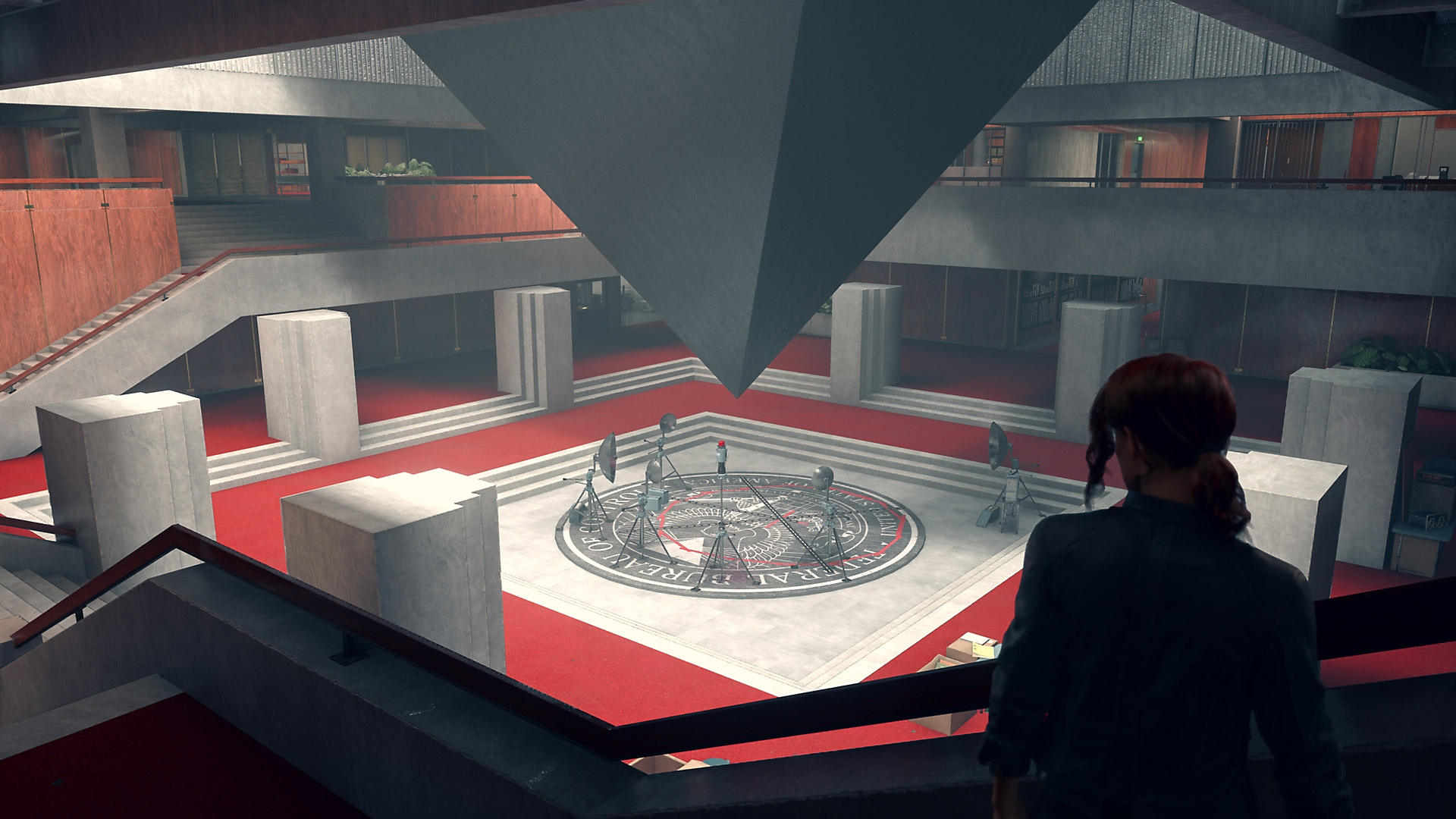
Which is to say, in CONTROL, faith is a fundamental force like gravity, which is a very cool idea, especially for this setting. It’d be great if I actually loved the gameplay half as much as the story, but at least the gameplay modifiers let me adjust the balancing to emphasize telekinesis over “this is fine, I guess” gunplay. Yet the lore, goodness me the lore is outstandingly fun! And it’s not simply bleak monsters hiding in the dark like Cabin in the Woods, but all kinds of oddities – some quite mundane or even friendly, like the rubber duck!
A world where belief influences metaphysics and metaphysics in turn influences the world back? Or the idea that gods are roaming the earth and beings of immense power from beyond can just leap between dimensions? How they choose to serve a world even though it’s largely forgotten them? There’s just so much to play around with! Yet most importantly, through all the surrealist humor and harrowing moments, Jesse’s journey is one of triumph and awakening. Her resoluteness grows with each step, rejecting the despair and hatred of The Hiss, even when at her lowest.
That is the message we need right now. That no matter what you believe, the light within yourself is worth fostering and sharing, enkindling hope in others. The most powerful action Jesse and Polaris perform isn’t hurling debris or grinding for gunmods – it’s shouldering what they can and inspiring. I’m not saying it’s a perfect story, but it’s more than just a step in the right direction. This is the kind of stuff we can be exploring with spiritual themes. And the way it handles it so agnostically can’t have been easy to achieve. And I hope Remedy gets to go even further with it next time.
———
Elijah Beahm is an author for Lost in Cult that Unwinnable graciously lets ramble about progressive religion and obscure media. When not consulting on indie games, he can be found on Bluesky and YouTube. He is still waiting for Dead Space 4.