Subjectivity and Exploitation: On the “Right Degree” of Alienation in Henry Halfhead
You feel compelled to support great writing…

Our concrete historical, socio-economic, and geographical situations generate countless perspectives, each with their own relation to reality. Yet, there is something that defines the human experience. Not a positive substantial thing that can be pointed to with nebulous reference to a “common humanity”, but rather, a singularized feeling of unease, disjointedness, or alienation.
By examining the stages of modern life as presented in Swiss Studio Lululu Entertainment’s Henry Halfhead, we can catch a glimpse of how subjectivity necessarily invokes, or is constituted by, this fundamental alienating relation. Henry’s experiences exhibited in the game make clear the delineation between the alterity inseparable from personhood and the exploitation that structures capitalist reproduction.
Doubly Incomplete, or, The “Half” of Henry’s Head
We meet Henry during his earliest experiences. As a toddler (un)like any other, Henry revels in the power to possess the objects around him. From building blocks to colored pencils, both the player and Henry find joy in discovering the bounds of certain materials’ potential, and intuitively playing within and beyond those given boundaries.
As an avatar for the player, Henry is explicitly defined as not whole – he is literally half a head. Henry learns who he is by interacting with the objects that contour his world. The environments we find ourselves in are defined only by the sparse population of these objects, with almost zero visual contextualization or the usual set-dressing expected in modern games.
The incompleteness of both Henry and his world demonstrates two key insights from the field of psychoanalysis. First, that subjectivity is constituted by a fundamental split or gap. In other words, the subject’s interiority includes something which is not quite itself. Henry is almost always Henry as well as something else, which changes both Henry’s nature and the nature of the object of his transformation.
This peculiar depiction of being-in-the-world leads us to a second lesson of psychoanalysis: that the split which structures the formal arrangement of subjectivity should be transposed into reality itself. Our world is necessarily incomplete, or “non-all”. Objects and new spaces of play pop into existence precisely at the moment Henry has exhausted the possibilities of his current horizon. We as the player know this aspect of the game’s unfolding is designed and scripted, but for Henry, the world imposes its necessity retroactively – it feels contingent based on its lack, or visual absence, but deterministically appears as his story progresses.
Combined, these two stipulations form the basis for unconventional applications of the concept of alienation. Traditionally, alienation describes the estrangement experienced by a specific subject in a particular world. As a description of lack, contradiction, or alterity, however, alienation also characterizes the structure of the relation between the subject and themself and between the world and itself.

Enjoying Your Own Rule(s)
To find wonder in objects defines our interactions with Henry and his world, exploring the limits of their intended function and transgressing the norms of their usefulness and social acceptability. From this inherently experimental act, we come to both erect new norms and redefine old ones. The satisfaction we find in this transgressive playfulness is derived not simply from an increase in the magnitude of pleasure associated with finding new uses for banal objects. Rather, surplus-enjoyment, in contrast to pleasure, is the way those potential uses translate to our sustained desire in exploring the objects and possibilities to come.
Henry’s relationship to himself – animated by the tension between his ludic and regulative capacities – encounters friction when he begins attending school. What breathes life into the world for Henry – transformative play – ends up putting him at odds with the social obligations of student life and the associated standardization of evaluation and performance.
The developers expertly craft the classroom as a sandbox, after having established Henry’s experimental nature in previous environments, but doing what Henry has always done results in a total failure to meet his teacher’s expectations. The next scene takes place in the same classroom environment, with the player’s control and Henry’s autonomy mechanically restricted so that progression requires conforming to the expectations and standards imposed on each student. Subversive play and transgression central to Henry’s identity up to this point are no longer an option as the game effectively transforms creative experimentation into the tracing of a pre-existing image.
If we fast forward years into Henry’s life (as the game does) the reason for this manufactured conformity becomes clear. Henry has entered the labor market, taking a job sorting parcels from letters. Throughout the next few scenes, the monotonous and repetitive nature of his labor begins to wear on Henry. As work dominates his life, he reorganizes every other activity around his waged productivity. His desire for commensurate recognition for his hard work results in the sacrifice of time and energy for his previously central creative outlets, causing him to become estranged from the Henry he used to be.
What once was the spontaneous and autonomous direction of his surplus-enjoyment has been directly supplanted with the becoming-instrument for the production of surplus-value for his employer. Reduced to his labor power, Henry is forced to sell his labor time in exchange for the basic necessities, only to recharge himself for the next day’s labor, thereby reproducing the cycle of exploitation central to capitalism’s functioning – without care for Henry’s personal flourishing.
The Restoration of a Life Worth Living
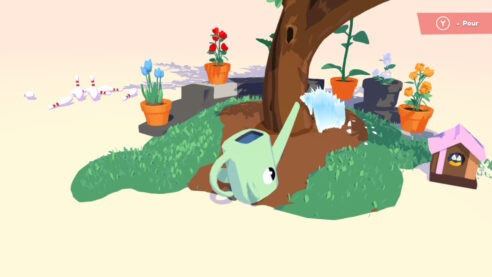
Henry does not succumb to this vicious cycle forever. Faced with increasingly unreasonable expectations at work, Henry is forced to use his creativity and, in doing so, remembers what it is like to explore, experiment, and be with the objects around him that defined so much of his early life. The next few scenes stand in contrast to the time he is fixated on and subjugated by work. Henry allows himself the grace of rediscovering the joy he found in transformation and creation. Artistic and musical endeavors, gardening, and cooking all serve to remind him what made Henry… Henry.
The developers at Lululu Entertainment leave open the question of what structural political changes must have occurred for Henry to be afforded the space to engage in non-instrumental activity, and yet are resolutely explicit about the unequal distribution of freedom under the capitalist mode of production, where workers lack the ability to express their labor power in forms other than wage slavery.
Seeing play as an essential part of human labor – the process through which we actualize our natural capacity – demands the recognition of the productive aspect of other forms of work. Household labor, creative hobbies, caregiving, and so on, are all expressions of our species’ propensity to work, for ourselves and each other. But under the current system of privatized ownership over the means of production, these forms of labor either go uncompensated or are treated as a luxury available exclusively to a minority of the global population.
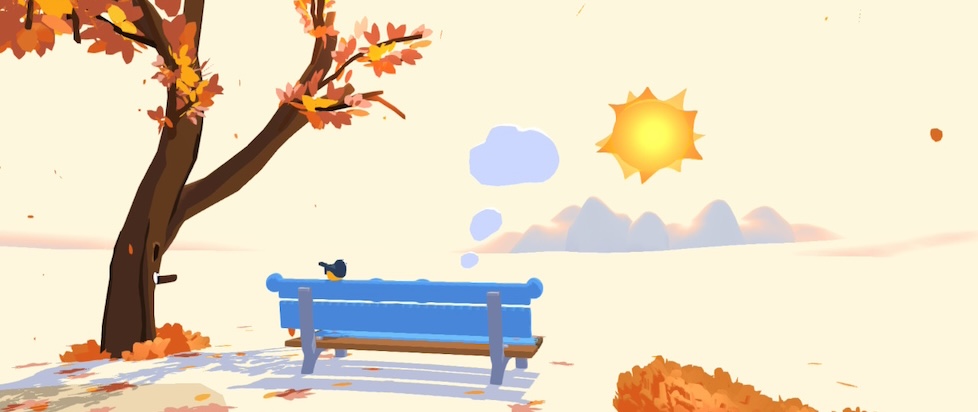
Returning to Henry in his senior years, his home bears the mark of a life well spent. It is clear he was able to pursue his creativity and afford himself the space to keep up with his hobbies and friends. As Henry leaves his home for one final stroll, the player is confronted with the beauty of the natural world, again presented in fragments. Jumping from object to object, one cannot help but admire Henry’s refusal to give up on this essential aspect of his being.
Embracing alienation as an inescapable, defining feature of ourselves forces us to orient our struggle towards confronting the ways in which societies regulate surplus-enjoyment and distribute surplus-value. Remembering the universalist core of emancipatory politics, grounded in this understanding of alienation, the task facing the Left today is clear: to envision, organize, and implement the “right degree” of alienation – the economic and political conditions that would make accessible the justice Henry eventually found for himself.
———
Christopher Spina lives in Toronto with his partner and their cat. When he’s not grumbling about capitalism to any and everyone who will listen, you can find him attempting to combat the endless waves of eSlop through curating games and writing short-form reviews here.
Sign up for the forthcoming weekly Unwinnable digest!