No Place for Heroes: Surviving in Spaaaaaaace with Outland (1981) and Red Planet (2000)
You feel compelled to support great writing…

Besides that both take place in outer space, Outland (1981) and Red Planet (2000) have very little in common. One is a blue collar space western/noir that treats the “final frontier” as just another banal source of corporate profit extraction, while the other is a survival thriller centered around at least some conception of the minutiae of “realistic” NASA-style space travel, a la an array of astronaut pictures made in the wake of first The Right Stuff (1983) and then Apollo 13 (1995). (What I mean by this is mostly that Carrie-Anne Moss spends a lot of time flipping overhead switches.) Also, one of them is pretty good, and the other… is not.
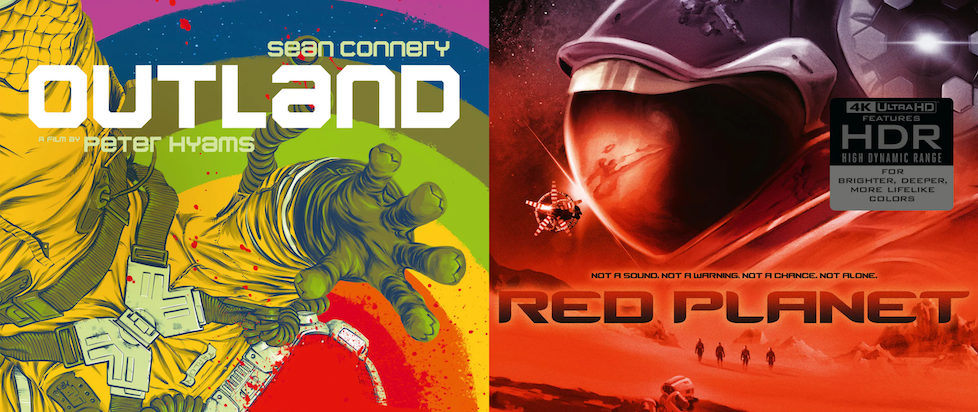
What they do have in common, though, is that both are being released in fancy new 4K editions by Arrow Video as part of their November slate – timed, as it happens, for the 25th anniversary of Red Planet, if one wants to celebrate such things. Both look and sound probably about as good as their source material would ever allow them to, which honestly isn’t bad in either case. As for the movies themselves, though…
“Nobody’s here for their health, and they certainly aren’t here for the scenery.” – Outland (1981)
Following the 1979 success of Alien, an entire new subgenre of cinema was born: Alien knock-offs. These ran the gamut from direct clones (Creature, 1985) to unlikely influences (Split Second, 1992) to more elaborate extrapolations (Forbidden World, 1983) and things that should probably have gotten slapped with cease-and-desist letters (Shocking Dark, 1989). Some of them even relocated the threat from outer space to a post-apocalyptic future (Creepozoids, 1987) or the bottom of the sea (Leviathan, 1989).
Most had a few things in common, though, usually including damp industrial corridors and at least one dangerous critter inspired by the titular xenomorph as it appeared in Ridley Scott’s 1979 original. Peter Hyams’s Outland is an anomaly in that it doesn’t include any slimy, inhuman monsters – just some very human corporate greed, personified here by Peter Boyle as general manager Mark Sheppard, who runs a mining franchise on Jupiter’s moon, Io.
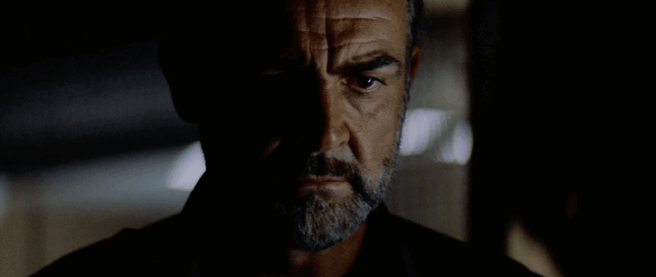
Instead of a slimy space creature, Outland borrows Alien’s blue collar, industrial view of space, as well as its affection for white hexagons and at least a little of its title treatment in order to tell a story that is often described as a space western. While the final reel is an almost direct lift of High Noon, however, the lead-up probably has more in common with a noir than a western, despite Sean Connery’s role as the new sheriff (or marshal, in this case) in town.
“I wanted to do a Western,” Hyams told Empire. “Everybody said, ‘You can’t do a Western; Westerns are dead; nobody will do a Western.’ I remember thinking it was weird that this genre that had endured for so long was just gone. But then I woke up and came to the conclusion – obviously after other people – that it was alive and well, but in outer space.”
The result is a modest but often visually impressive movie that is notable as one of the first to use a newly-developed front-projection process called Introvision that is responsible for many of the shots of people walking around on miniature sets. (Introvision was also used for the famous rolling boulder scene in Raiders of the Lost Ark the same year.) It’s also probably one of Peter Hyams’s best films which, given the rest of his filmography, may mostly be damning it with faint praise.
“By 2025, we knew we were in trouble…” – Red Planet (2000)
Red Planet, on the other hand, owes no meaningful debt to Alien but is, instead, an example of another kind of Hollywood phenomenon – the one where two movies with the same logline come out in the same year. In this case, eight months before Red Planet cursed movie screens with its presence, Brian De Palma’s Mission to Mars made its theatrical bow.
I’m pretty sure I saw both in theaters back in 2000, but I hadn’t seen either one since, and I had forgotten, before I sat down to write this, that Mission to Mars was based on a Disney theme park ride.
Was it any good? I don’t know. I didn’t like it twenty-five years ago, but it’s directed by De Palma, with a score by Ennio Morricone, so it seems like it ought to at least have a shot. Unfortunately, we’re not here to talk about Mission to Mars…
Besides the cast, I remembered roughly two things about Red Planet from my first and previously only viewing some quarter of a century ago: a scene with Terence Stamp that we’ll talk more about in a minute, and the fact that the film features a killer monkey robot that appears to know kung fu for some reason.
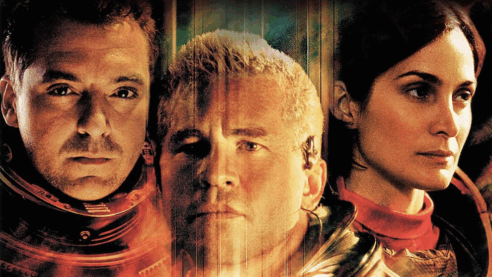
That sounds silly – and boy, Red Planet is very silly – but it also sounds fun, and Red Planet is not fun in the slightest. The cast includes something of a who’s who of the year 2000, with turns from Val Kilmer, an immediately-post-Matrix Carrie-Anne Moss, Tom Sizemore, Benjamin Bratt, Simon Baker, and the aforementioned Stamp. Unfortunately, every last one of them are saddled with some of the most inane dialogue you’ve ever seen in a movie, courtesy (one assumes) of screenwriter Chuck Pfarrer, whose other credits include Darkman, Hard Target, Barb Wire, Virus, and Navy Seals.
On Letterboxd, user Josh Gillam writes that, “Red Planet always feels as if it’s some sort of fake movie-within-a-movie (like that sci-fi film Julia Roberts and Alec Baldwin’s characters are shooting in Notting Hill) somehow padded out to feature length.” That’s the best description I’ve yet seen for how half-formed everything about Red Planet somehow feels, despite its obvious budget, early-2000s CGI, and star-studded cast. Even the bit with the kung fu monkey robot is actually barely in the movie, despite dominating the trailer.
The other part of Red Planet that I remembered is Terence Stamp’s character, who is a surgeon-cum-philosopher who tells Val Kilmer’s character that he gave up on science and started looking for God. “Who knows,” he says, “I may pick up a rock and it’ll say underneath, ‘Made by God.’”
When Stamp’s character is injured on their crash landing on the planet’s surface, he picks up a rock, sets it down next to him, and draws a circle around it in the dirt. Twenty-five years ago, it was a moment that stuck with me. Watching the film today, even that (already silly) moment actually takes place in a way that renders it sillier and less effective even than it sounds on paper – as fitting an epitaph for Red Planet as any I can think of.
———
Orrin Grey is a writer, editor, game designer, and amateur film scholar who loves to write about monsters, movies, and monster movies. He’s the author of several spooky books, including How to See Ghosts & Other Figments. You can find him online at orringrey.com.