Forgiving, and Forgetting, Bioshock

This column is a reprint from Unwinnable Monthly #192. If you like what you see, grab the magazine for less than ten dollars, or subscribe and get all future magazines for half price.
———
Finding digital grace.
———
Okay, no more jokes. We’re actually discussing Bioshock Infinite. Much as I’d like to keep putting it off – it’s been a very fun running gag – it’s best to rip off this Band-Aid now. Even if, by my own estimation, it is one of the most fundamentally frustrating games to talk about. I have spent the better part of a decade trying to make sense of Infinite, and I’m still trying to untangle its utter lack of tact and baffling creative choices.
Now, as we were discussing with Legion – folks sure enjoy writing their own Jesus into stories, don’t they? To heavily summarize the plot of the game for those unfamiliar: Nowhere does this Discount Jesus situation go more off the rails than Bioshock Infinite creative director Ken Levine’s M-rated Disney Princess pastiche, Elizabeth Comstock. We’re going to be focusing exclusively on her, because if I try to unpack everything else Infinite mishandles, it’d take more hours than is required for Final Fantasy XIII to “start.”
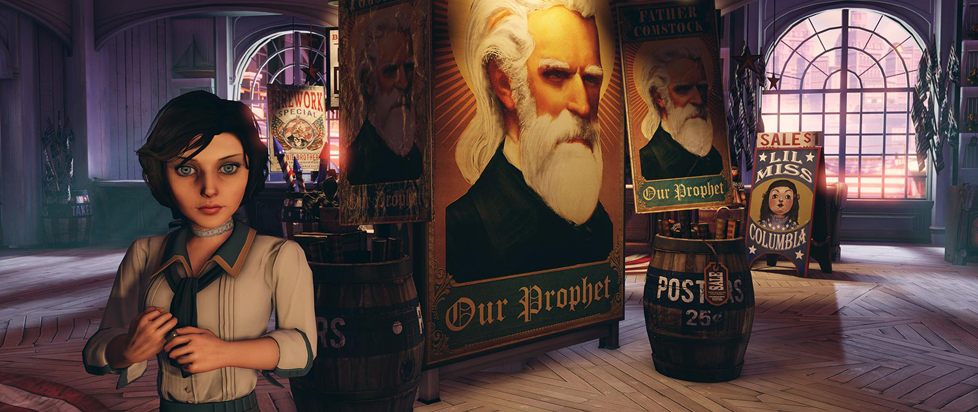
So, Elizabeth is, functionally, a messiah, just not in the usual sense. Her role in the entirety of Bioshock Infinite starts as a MacGuffin, but in short order goes from your goal to the driving force of the narrative. She is, for all intents, the actual protagonist, and the Christ-like allegory of her role in things is far from subtle. Her two father figures are her actual father, Booker DeWitt, and his multiversal opposite, Father Zachary Comstock. Each is unsubtly meant to embody the Devil and God of Christianity, respectively. Booker has a “mark of the beast” on his hand and always resorts to direct violence. Comstock’s entire appearance is clearly inspired by classical art depictions of God and works indirectly in how he handles matters.
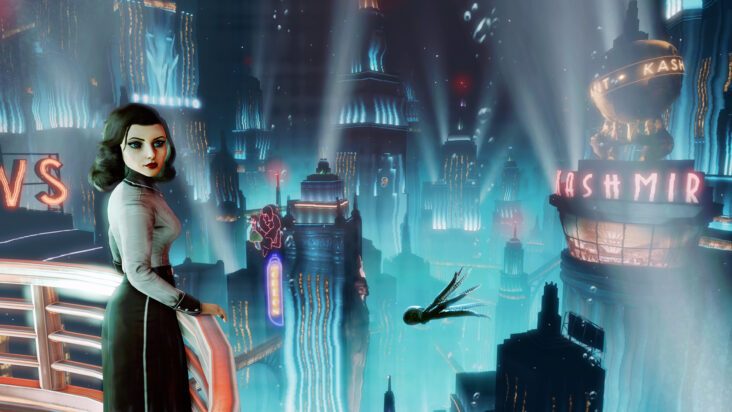
Elizabeth eventually ends up killing them both, among others. That’s the thing about Bioshock Infinite – if there is a talking point or character warranting nuance or empathy… it almost always finds a way to ruin them. When you really look at the story on paper, it is horrifyingly bleak at best. Everything that Booker or Comstock touches results in pain and misery. Elizabeth tries to spark joy, sees the best in the world for a time, but by the time of the Burial at Sea DLC set after her double-patricide, she is just as cold as her fathers. And when she tries to break from that, to be kind, it results in her death as well.
I’ve tried to discern what Ken Levine’s intent truly was, but I think the answer can be found in an old GameSpot interview. There’s also a handy summary by PCGamer you can read here, which thankfully transcribes several key quotes from Levine. Cheers to Tyler Winegarner and Omri Petitte for their hard work.
The short version is: An artist at Irrational was so offended by a (now deleted) scene from an earlier version of the game that he was ready to resign. All just to not be associated with something that offended him so deeply. So, Levine sat down with him and from the way Levine tells it? This was seemingly his first time talking to a seriously devout person to wrap his head around Christianity at the core of the game’s narrative and primary antagonist.
To be fair, it’s been established that the religious focus came later into development. And in this same interview, Levine goes on to explain that he had never felt a religious experience before, so, therefore, felt he didn’t know how to tackle religious themes. What we’re told is that this conversation did inform him in realizing forgiveness is a key tenet of Christianity that should be explored and leaned on. He says he tried to use that in his final version of Comstock. I can understand his struggles, but that’s why you consult someone before they’re ready to resign.
Yet that absence of comprehending the underpinning reason of it all helps explain some things. Not everything. Daisy’s murder by Elizabeth’s hand and the narrative mishandling of the Vox is still deeply upsetting for all the wrong reasons. The obsession with baptismal violence. The fundamental misunderstanding of how multiverse theory works. The framing of the world as nihilistic despite actually being deterministic. Yet so much of the game, for good or ill, can be summed up as a world in absentia of mercy and healing.
From the hatred of the city of Columbia’s citizens to Booker’s self-destructive tendencies to Comstock’s genocidal plans to destroy the world below Columbia, it all comes down to cruelty. Now, don’t get me wrong, Bioshock Infinite doesn’t really have much constructive to say about any of this. If anything, it worryingly seems to be taking the same stance as Andrew Ryan, insisting that selfishness is the only way to survive.
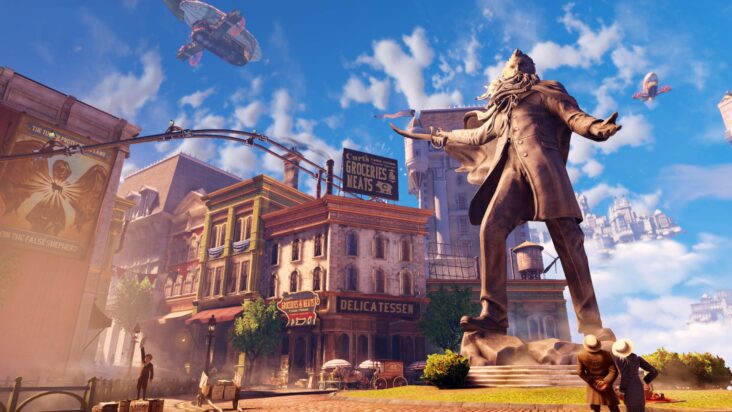
When Elizabeth strides out of her pampered prison into Columbia at large, she’s at first enamored. Her joy is a tabula rasa of someone who has only experienced life through books. She’s a short-haired answer to Tangled’s take on Rapunzel. Except, instead of a charming three-season TV show about stepping into adulthood and growing as a person, Elizabeth’s story from that point on is how she’s made to regret her own joy and compassion.
To be fair, this was, for some reason, a thing in 2013 gaming.
If you hesitate at an obvious ambush, she blames herself. When Booker lies to her, she runs away. When she tries to help push back against the corruption of the industrialist Fink (yes, that is actually his name), she ends up realizing her powers can do more harm than good. When she learns who her father truly is, and why she’s missing part of her pinky finger, she hardens. And in the end, she’s the one to drown out Booker, expecting to erase herself in the process. It’s a messianic sacrifice, a very bleak one.
There are a couple ways to read this. The edgiest would be that Levine is suggesting that the best thing a god of this world could do would be to snuff themselves out so as to not interfere with mortals anymore. Or it’s allegorical and itself trying to frame secularism as “growing up”, not unlike INDIKA – though INDIKA does a better job of it. A more generous reading is that, given that Elizabeth cancels out the old before putting herself in danger, and her death helping lead to the events of the original Bioshock, that it’s all some super convoluted and dark as hell reframing of the New Testament writ large across both games.
Except we know this wasn’t the original ending. A prototype level for the intended ending was even uncovered, though sadly it’s only partially playable, revealing a lighthouse like at the start of the game, this time nestled in the clouds. And as apparently offensive as that original ending was, I really want to know what the plan had been up to that point.
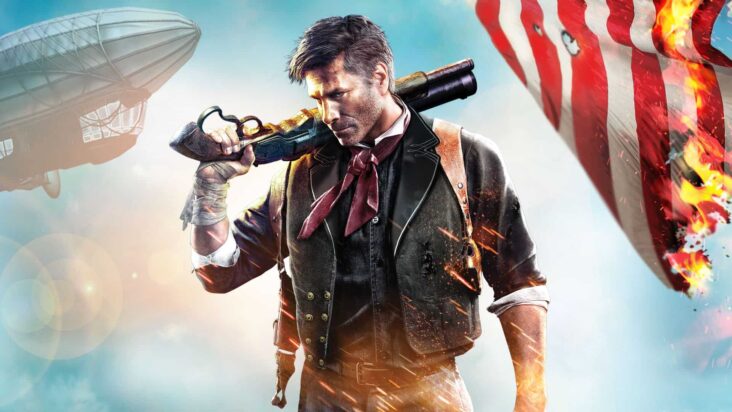
Multiple people at several levels at Irrational would’ve had to sign off on the story as it was. It was far enough along to be playable. So, what was it? Was it a His Dark Materials situation? Tasteless from some aesthetic or thematic standpoint? Something weirder? That rewrite led us to where we are, and I’m desperately, morbidly curious to understand. I don’t think all the baffling compromises are the result of an already deeply troubled development cycle pivoting one too many times, but some of them might be explained.
As for the story we received? There’s so much it fails to make sense of that it feels impossible to attribute what was intentional and what was simple human error. We will likely never know. There is one thing I can do, though. If there is one constructive lesson that can be learned from Bioshock Infinite, it’s the crucial, fundamental need for forgiveness. Not saying that what happened was okay or approving of what was done. Not even close – I am concerned at what Levine is cooking up next with Judas since it sounds more and more like a repeat of the mistakes made here.
However, Bolz-Weber once described forgiveness as being like bolt cutters that one uses to liberate themselves from the actions they object to from another party. Elizabeth kind of does this, even in the far more patricidal, edgy way that Bioshock Infinite is hell-bent on doing everything. So, after all this time… I forgive you, Bioshock Infinite. I don’t approve of the story you told, or how you handled your themes, but I also don’t need to understand you. I don’t have to think about you ever again. I hope against all my instincts that your creative director did actually learn something from all of this, but even if he didn’t? It’s not for me to solve.
I’m keeping Booker’s Skyhook though; this thing is cool. *Twirls*
———
Elijah Beahm is an author for Lost in Cult that Unwinnable graciously lets ramble about progressive religion and obscure media. When not consulting on indie games, he can be found on Bluesky and YouTube. He is still waiting for Dead Space 4.