The Strangling Fruit

This column is a reprint from Unwinnable Monthly #192. If you like what you see, grab the magazine for less than ten dollars, or subscribe and get all future magazines for half price.
———
Now this.
———
When we first bought our house, we knew it came with a highly manicured yard. The lines between lawn and garden flowed cleanly. Canna lilies danced alongside the bustling hedgerows, and large banana trees separated the view from the house with the rest of the yard. The cement patio outside almost felt like an intrusion, an artificial barrier between the lush foliage and the kitchen sink. I bought an electric lawn mower, a rake, a leaf blower, an aerator, a hedge clipper … the list goes on. I was ready to tend to my greenery!
Months wore on. As the man predicted, winter came. As did spring, and another summer, full of growth and beauty, and trimming and buffing, and planting and failing. Incursions became apparent. The clean lines from my original purchase were quickly blurring. A large tree stump sat in the middle of the lawn, playing home to a host of potentially friendly critters, who only occasionally dragged the trash from my can back to their dark holes and regularly chowed down on my decorative gourds. After the tree was chopped down, its unseen roots, once stretching beneath the majority of the lawn, had begun to rot, and the grass and dirt were eroding into its once hardened carapace. During the rainy season, water collected across this great depression, hosting fertile breeding grounds for endless hosts of mosquitos, ants, and assorted cooloola monsters.
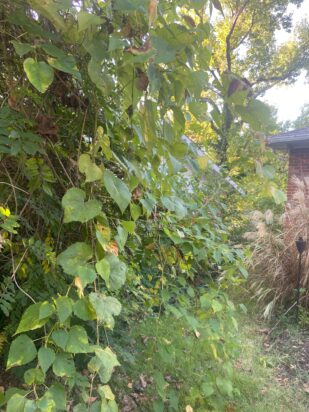
This water was meant to drain into the southeast corner of the yard where you could find a PVC pipe exiting the ground, dripping onto a small patch of pebbles. Beyond that stream lay a plot of land beyond my property, guarded by a copse of willow trees and dense thicket of roses that never seemed to bloom. This was public property, just beyond all the fence lines, in that liminal space owned by the government, but never attended to because it’s in the middle of a bunch of private property. Theoretically, a sewage drain lay behind those sharp spikes and lazy vines, but the branches were layered so deep, I could never be truly sure.
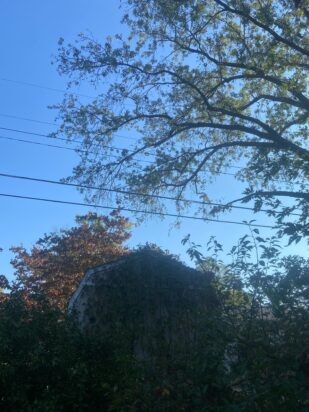
Grass grew, I mowed. Weeds sprouted, I pulled. Mosquitos multiplied, I swatted. And all that time, life pulsed, vibrating from that untended southeast plot, that plot where no one seemed to tread.
* * *
Then, one summer, we got a pool. To be clear, this was no Olympic-sized swimming pool. This was a smaller-than-average-tub full of water that was a blessing in the searing-hot July sun. We set it up on the patio, right in front of the foliage that separated us from the stump with the decomposing root system. One warm evening, as I wrapped the hose up in the nook of my arm, the stump pulsed. Not loudly, not noticeably even. But it pulsed. A green, velvet texture rippled across the yard, in all directions, but mostly towards the southeast corner.
And the corner waved back.
The overwhelming green of the landscape consumed me and I was enveloped in the scent of pine and whirling chaos. The stump melted into the grass into the flowers into the leaves into the soil, and it felt like I melted with it, disappearing into a green void, ushering me into its embrace. As I tumbled, vines seemed to stretch out from the dense thicket, reaching out to me, grasping at my ankles. I clung to the blue hose, fighting against the current, dragging myself away from the tendrils, towards anything else.
And then, as suddenly as the pulse started, it stopped. I was lying on my back on the patio, surrounded by warm, grey cement. I whipped my head around, hoping that any of my nosy neighbors were out in the warm sunset, but nobody came, and the pulse slowly faded. Nothing changed. Glancing over my shoulder, I returned inside. As I peered out of the window above my kitchen sink long after midnight, I thought I could still see the vegetation vibrating between the stump, southeast corner, and my eyes.
* * *
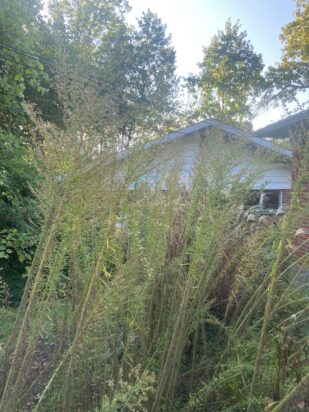
Not long after, I think my cat scratched me. This wasn’t unusual, (she wasn’t particularly affable) but I didn’t remember her catching me so deep. The day after, the scratch was worse, growing wider and deeper. Where once there was a faint line, a scratch, now there was an ever-evolving sequence of blisters, expanding down my arm like a band of marching pustules. As I stared at my right arm in horror, I quickly realized my left arm was suffering a similar fate. A progressive set of sores was slowly creeping up my forearm, bulging out of my skin and starting to ooze onto the floor. My forehead began to burn red with a patch of hives directly above my right eye, and my pinky toe grew to the size of a grape. A green glow menacingly raked through the venetian blinds in the back door. As the rash raced across my body, the verdant vibrations grew with it, feeding off my scratches and my itching, menacing as it fed on my tender flesh.
The doctors were dumbfounded. Clearly, a poisoned vine was the logical answer, but this didn’t explain what I had seen in my yard, or the inexplicable terror I felt about going back out there. Doctors couldn’t explain the pulse, or the green light, or that eerie, inexplicable aura emanating from the southeast corner of my yard. They couldn’t explain why nobody had entered that dense entanglement since May 25th, 1979.
* * *
I started bandaging myself before leaving the house. What would people think if a large man with open wounds started wandering around their children’s playgrounds? But maybe a large man with his arms and head wrapped in cotton like the invisible man was worse? Who’s to say.
As the bandaging grew, so did my paranoia. I found myself standing at my kitchen sink for hours at a time, staring off at the undergrowth, glowering against the dark, lost in thoughts of deep forests with glowing eyes peering out. My wife was becoming worried. My productivity at work had plummeted as the sores on my arms and legs constantly invaded my thoughts, circumscribing my vision with green intrusions.
When I did find myself in a mildly functional headspace, I turned my attention to ancient remedies that might afford some cure for my malady. I poured over historical archives, searching for anything that might offer insight into these fluorescent brainstorms. Some tomes mentioned an occult relic left by a holy man on some forgotten shore, and others noted a theosophist who wandered the deepest Coulees, pondering this exact question. After months of searching, I found the answer to my dilemma in an ancient book bound in the bark of a Manchineel tree, an answer so obvious, I felt a fool – poison.
* * *
Late one night, after the world had fallen asleep, and it was just me and the great green glow, I snuck down to my basement. I had a siphon brewer connected to a Bunsen burner and a graduated cylinder filled with the various chemicals, fruits, and spices prescribed in the recipe. As I stirred them together, a dim olive smoke, smelling of earth after a heavy rain, began to snake out of the beaker, and the liquid that dripped through the siphon turned a deep vermillion. I poured it into a lead-lined spray bottle. The toxin was ready.
I wasted no time. Despite the late hour, I donned my gloves and heavy cloak, and I headed out into the garden. The pastoral radiance from the southeast bloomed stronger than ever, seemingly pulling on my blisters through the wraps, reaching into me with its enveloping tendrils, dragging my green-tinted vision towards it. As I struggled to lift the bottle, my pinky toe popped, exploding with green ooze all over the long grass. It took all of my effort to squeeze the trigger.
Immediately, I felt the green burn with fury, pulling back. I squeezed again. And again. And again. And again. With each red blast, I could feel the bloom wither, fading back into the southeast corner. My vision was becoming clearer and my arms felt stronger. I squeezed again
I started searching, ravenously, for every leaf and blade I could find, spraying feverishly, honing in until I reached the edge. And there, in that southeastern corner, sat a lonely drain, leaking into a deep hole, and rooted on top sat a small black obelisk, a Manchineel tree, glowing unearthly green and bearing and cryptic inscription in some indecipherable dialect.
I emptied the last of my potion, and then I salted the earth.
* * *
After that night, things began to return to normal. I cleaned up all the death littering the backyard. My son started playing outside again. My wife and I sipped our afternoon cocktails in the warm October sun, watching him romp in the leaves and dancing fireflies. The southeast corner was silent – no more itchy eyes, no more green buzzing in my ears and into my veins. No more!
But it’s only a matter of time. I keep my brewing station ready, knowing that next spring, when the tulips start blooming, so will the stump, and the roots, and that southeast corner. This time, I’ll be ready.
———
Noah Springer is a writer and editor based in St. Louis. You can follow him on Bluesky @noahspringer.com.