Mildred Walker from The Excavation of Hob’s Barrow

This column is a reprint from Unwinnable Monthly #192. If you like what you see, grab the magazine for less than ten dollars, or subscribe and get all future magazines for half price.
———
Fictional companions and goth concerns.
———
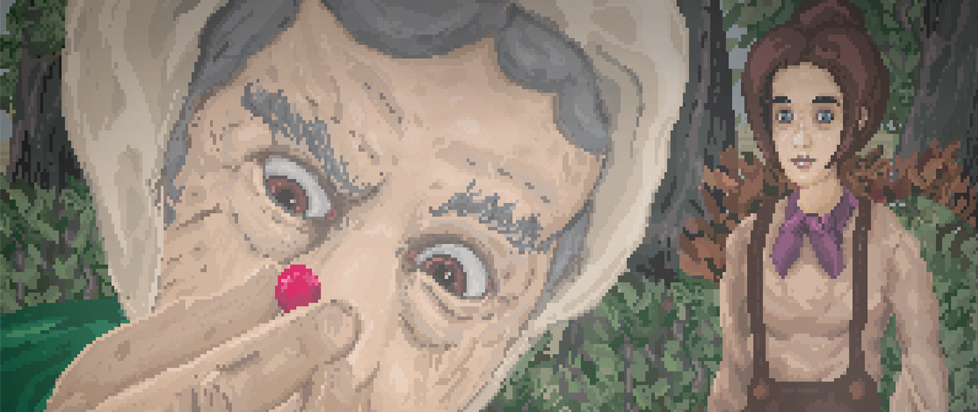
In the forest outside a Victorian village, a bonneted woman picks berries. Meet Mildred Walker, better known as Mother Mildred, the local wise woman considered by many to be a witch.
The Excavation of Hob’s Barrow (2022), a point-and-click adventure from Wadjet Eye Games, feels like a 1970s British folk horror film (obviously a compliment). Our story follows no-nonsense antiquarian Thomasina Bateman, a self-proclaimed woman of science who excavates British barrows (burial mounds) as research for her book. In Hob’s Barrow, Thomasina travels to a rural Yorkshire village, Bewlay, in a determined effort to excavate the titular barrow – an ancient mound that the townsfolk alternatively refuse to acknowledge and believe to be cursed.
Thomasina is a delightful protagonist (Wadjet Eye describes her personality as influenced by Lara Croft from Tomb Raider and Scully from The X-Files); I’d gladly play more games as Thomasina. But the minor character who really got my attention is the berry-picking Mother Mildred.
When Thomasina needs help deciphering symbols, she’s directed to Mother Mildred by the village drunkard. “Some think her a witch,” he says.
Ever the rationalist, Thomasina replies, “Why do people think Mother Mildred is a witch? Just because a woman lives alone in the woods doesn’t mean she flies about on a broomstick.”
“They say she lays with demons,” replies the drunkard.
“Hogwash!” (This is one of Thomasina’s favorite exclamations.)
“Some also go to her for potions and spells.”
“Will she burn at the stake sometime soon?”
“You might think us backward in Bewlay, Thomasina, but we’re not that backward!”
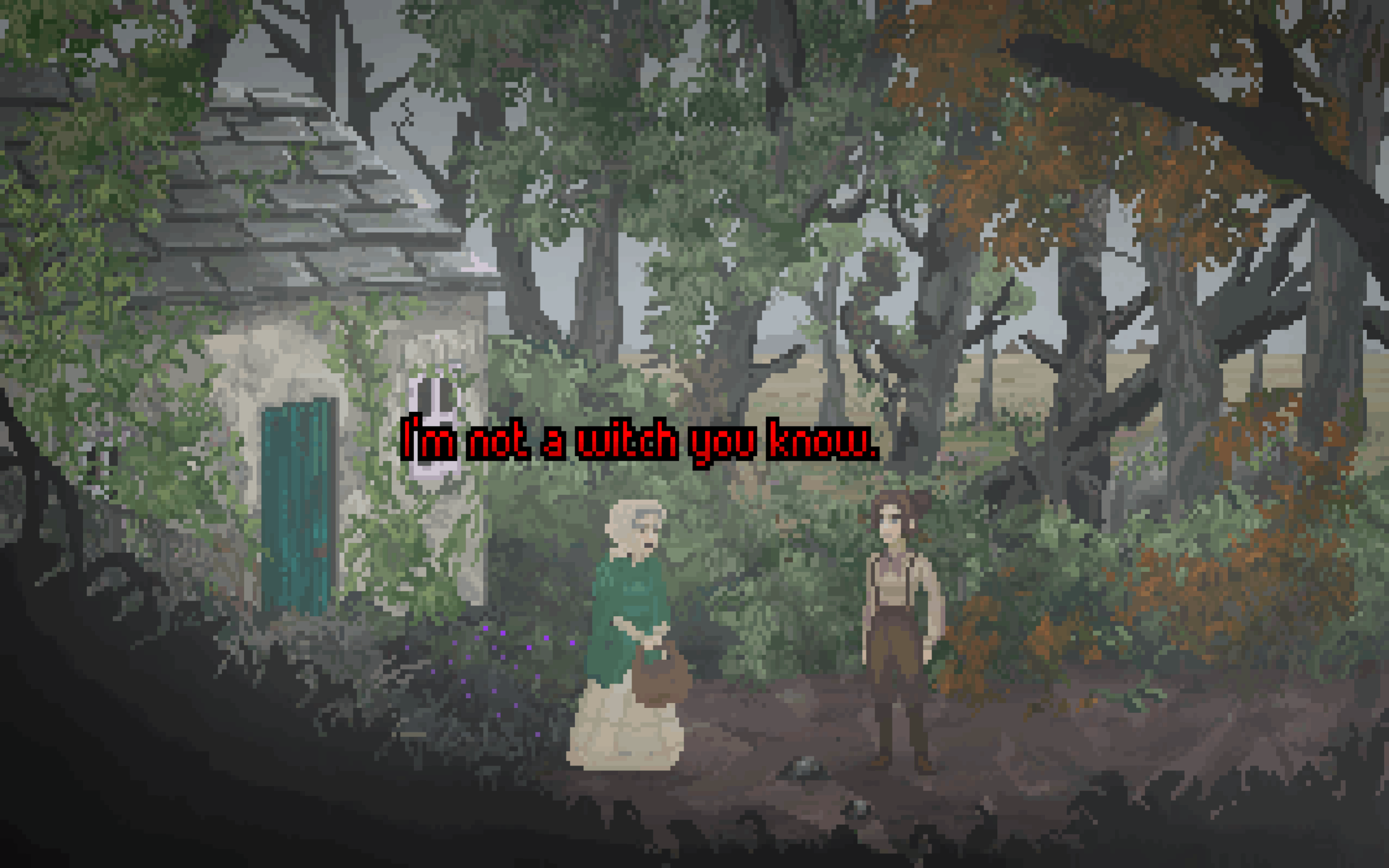
Thomasina thanks the drunkard for his information and soon finds Mother Mildred picking berries in her front yard. Very directly, Mother Mildred says that she prefers to be called Mildred Walker, “given as that’s my name.” She insists she knows nothing of magic, despite her knowledge of herbs and poultices (knowledge necessary for game progression). “I’m not a witch you know.”
In the twenty-first century, many herbalists embrace the title “witch.” But in the late nineteenth century, Britain’s witchcraft laws remained in place – if gentler than they were in centuries past. In 1541, The Act against Conjurations, Witchcraft, Sorcery and Enchantments declared it a felony to “use devise practise or exercise…any Invocations or conjurations of Sprites wichecraftes enchauntmentes or sorceries;” a conviction could lead to “suche paynes of deathe losse and forfaytures of their landes tentes goodes and Catalles.”
Several centuries and statues later, The Witchcraft Act of 1735 repealed the earlier acts and replaced them with a prohibition against the pretense of witchcraft: “if any Person shall…pretend to exercise or use any kind of Witchcraft, Sorcery, Inchantment, or Conjuration, or undertake to tell Fortunes…shall, for every such Offence, suffer Imprisonment by the Space of one whole Year.”
Mother Mildred probably wouldn’t want to be identified as a witch not only because she herself didn’t identify as one, but because she didn’t want to suffer Imprisonment by the Space of one whole Year.
Although Hob’s Barrow doesn’t give us a date, the setting is specified as being “Victorian,” placing the story between the years of 1837 and 1901, during which the 1735 Act would have been firmly in place. If the Bewlay townsfolk go to Mildred for “potions and spells,” this would doubtless have been adequate evidence against her in a court of law.
Fortunately for Mildred, Thomasina Bateman is a woman of science who has no interest in accusing innocent women of “hogwash.”
When Mildred warns Thomasina against investigating Hob’s Barrow (“There is something unnatural about that place”), Thomasina replies, “We must seek to understand the world by rational means, Ms. Walker. One cannot abandon reason.”
Unfortunately for Thomasina, even if Mildred isn’t a witch, she is wise. If Thomasina had heeded Mildred’s warning…well, I shouldn’t disclose any spoilers. It’s just hogwash, after all.
———
Deirdre Coyle is a goth living in the woods. Find her at deirdrecoyle.com or on Bluesky.

Sign up for the forthcoming weekly Unwinnable digest!