Silksong is for Speedrunners

This column is a reprint from Unwinnable Monthly #192. If you like what you see, grab the magazine for less than ten dollars, or subscribe and get all future magazines for half price.
———
What’s left when we’ve moved on.
———
When it comes to ultra-difficult games, we seem to understand that engaging with them on their terms is key for success. You wouldn’t dodge directly away in Dark Souls and you just have to learn the movement tech in platformers like Celeste, Super Meat Boy, and even Donkey Kong Country if you want to progress. UFO 50, a game I found unplayably difficult, received praise for its difficulty and lack of save points, I think because of the choice it offers between 50 not quite equally hard games for a frustrated player. (Foreshadowing is a literary technique that…)
Hollow Knight: Silksong, Team Cherry’s new sequel to the metroidvania Hollow Knight, has generated more frustration over its difficulty than many of these. In addition to very fair accessibility complaints, its difficulty has been seen as just excessive. I happen to disagree ardently with the latter. The seeds of this disagreement were planted well before Silksong came out, when I began watching Hollow Knight speedruns a few years ago for fun. Watching speedrunners learn routes and coming to understand how they moved through the game’s world taught me lessons which I took with me into Silksong. Both games have inbuilt achievements for speedrunning the game in under five hours (the non-assisted speedrun record for the first is around 30 minutes; leaderboards for the sequel haven’t opened at time of writing.)
Silksong is for speedrunners, in other words. What I don’t mean by that is that only speedrunners can play Silksong, but rather that through its moveset, level design and overall resource economy, Silksong teaches you, on your first journey through it, how to be a speedrunner. Let me explain.
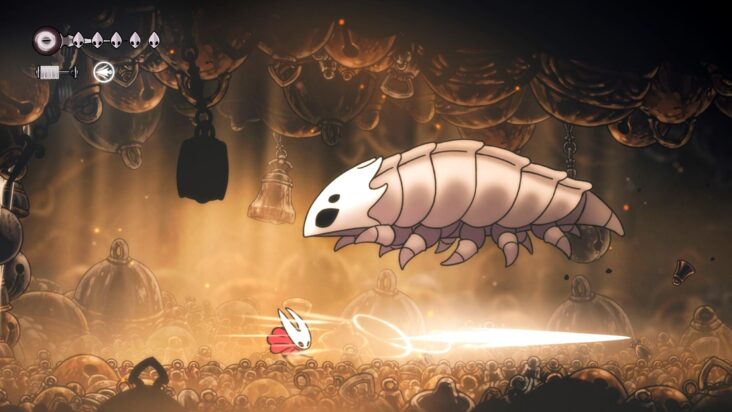
I played over one hundred hours of Hollow Knight but never achieved 112-percent completion. I would consider myself “good,” but not great, at Team Cherry’s games and perfectly average at soulslikes in general. But something I am experienced with is the expectations of these games. As Team Cherry themselves said a few weeks ago, “you have choices.” And I understand that not every optional thing is something that needs to be done, meaning that, for example, when I got to Hunter’s March in Silksong before I found the dash, I hit the bricks and came back later. Fluency with what the game expects, as well as with the controls, can be gained by playing the first one; as it stands, anyone who has gets an automatic head start. This is why, while I personally had a great experience with Act 1 of Silksong – it was basically everything I wanted – I can understand why others gave up at several specific points.
If it’s not already clear, I don’t have the credentials nor the desire to tell anyone they should just “get good” even when it comes to Silksong. Several times after failing a boss, I felt my heart rate spiking to unhealthy levels. I still have not finished the final act of the game. So, with that said, compared to the optional stuff and even to the main path in Hollow Knight, none of the ten-ish main story bosses are very difficult. (This is especially true if you get upgrades to your damage and collect tools, but then that means detouring into harder areas with more difficult bosses.) Silksong essentially would like you to choose whether you will be doing everything in the game, or only the main path. Based on your choice, the game will slide toward being easier or harder. Of course, no one starts off a metroidvania thinking they won’t try and get all the secrets (or I hope not, anyway) but knowing that you can ignore things is crucial to not burning yourself out on the game.
Here’s an example from Hollow Knight. The speedrun route (or what it was when I was watching speedruns in 2020) relies on you not getting any weapon upgrades, even though those let you take down enemies faster. The reason for this is a late-game boss whose health scales to your weapon damage. Upgrades mean more time lost in collecting, and also equal or more time lost to this boss. So speedrunners make the choice to ignore collectables and fight all the bosses with a less powerful tool, meaning more chances to get hit, get killed and lose 30 seconds to a minute getting back to where they were. The speedrun becomes much more dangerous, making you depend on only the bare minimum to get by. If you played Silksong, that might sound familiar.
This is another reason I believe Silksong wants you to become a speedrunner: its resource economy. This is an area that I felt mixed and even negatively on until I’d almost finished the game for the first time. Hornet has many tools that can make battles easier, and these tools are powered by a currency from dropped enemies called Shell Shards. When you run out of them, you can’t use your tools anymore.
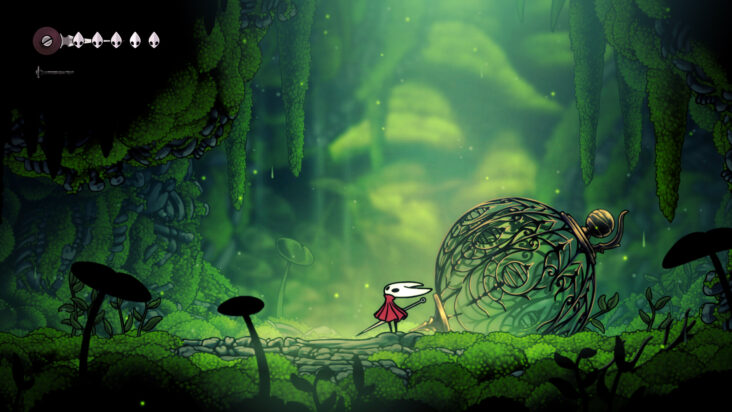
What I felt initially, faced with the Act 1 boss that was the most challenging thing I’d hit so far and totally out of shards, was that through this system the game was preventing me from playing it. It’s clear what Silksong wanted me to do at that point. Either go farm enemies for shards – preferably in an area I hadn’t explored fully yet, so I would be discovering new things while I did – or fight the boss over and over again, without tools. This is the speedrun vs. do everything mindset. I did the former in this case, and at first felt bitter that I needed to do this without the tools that would make this a fairer playing field. But depending only on Hornet’s needle as a source of damage, I had to learn each move and decide, sometimes even say out loud to myself, how I was going to respond to it. It took longer than the other option, probably, but I genuinely improved at the game and took those lessons into later fights.
Hornet’s movement is even more flexible than the Knight’s, incorporating a damaging midair dash, as well as the regular one, as well as a midair healing ability. Healing in general is much easier in this game than its predecessor even with how much it loves projectiles. Yussef Cole remarked that Silksong is an acrobatic test that wants you to “practice and grow familiar with Hornet’s every move” to the point of pixel-perfect precision, sometimes more precision than the game is even capable of. I agree; yet I disagree that this is a bad thing.
Silksong has a more legible and reasonable difficulty curve than Hollow Knight (again, not counting the many optional bosses who fall on all sides of it). The main story bosses, in addition to being easier than the optional ones, also feel better to fight. Lace, the Clockwork Dancers and Sister Splinter all approached the waltz-like mentality of the Mantis Lords from the first game. All of these have a rhythm that, while difficult to learn, once you do so you can’t un-learn it. And each time you do the long runback through a level to a boss, you optimize it a little; on returning later, you fly through it. Without telling you, Silksong has trained you to speedrun it.
This ethos of speed is a little ironic given that its difficulty is designed to be not too easy for Hollow Knight players. It doesn’t want you to chew through its world too quickly. For me, I was very happy to have an excuse to stay longer in Silksong, having waited for it for almost a decade. However, once you’ve run through it once, Silksong, like Hollow Knight, morphs into a parkour playground. This is what hard-won familiarity with its tunnels and caverns results in: the ability to laugh in the face of what was once dangerous.
———
Emily Price is a freelance writer and digital editor based in Brooklyn, New York, and holds a PhD in literature. You can find her on Bluesky.