Grave Goods: Sepulchre and the Game as Object
This is a feature excerpt from Unwinnable Monthly #192. If you like what you see, grab the magazine for less than ten dollars, or subscribe and get all future magazines for half price.
———
A friend once observed (and it was probably not an entirely original idea, even then) that board games actually encompass two distinct hobbies: There is the hobby of playing board games, and then there is the entirely separate hobby of buying board games.
In recent years, game makers have obviously cottoned on to this idea, which is the only real explanation for the proliferation of massive, costly, elaborate games that, for many of us, will likely never be played even, like, twice. This has also led to the rise of another type of game, however. The Game as Object.
I don’t actually know when we first started referring to [Thing] as Object, but I first saw it in relation to fancy collector’s editions of books. There, it was presented as the antithesis of buying a 99-cent ebook for your Kindle or whatever (and then forgetting you bought it and never reading it, because there wasn’t a physical copy lying around your house to shame you).
The idea of the [Thing] as Object is that there is more to the experience of a book, a movie, or, indeed, a board game than the experience of reading, or watching, or playing it. There is the physical package which houses that experience, and it has value, as well. Hence, movies packed in deluxe slipcases and accompanied by original artwork; books bound in faux leather with bookmark ribbons and the like.
What you appreciate in a [Thing] as Object will vary depending on your preferences, of course, but the idea is that the physical thing itself has some additional value to you – usually aesthetic, but sometimes also practical. Besides being able to read it, after all, a physical book has the added advantages of functioning as a doorstop, a paperweight or to prop up a table, in a pinch.
Unlike books and movies, board games haven’t really had to contend much with competition from electronic counterparts. Sure, videogames probably cut into the board game market in certain ways, and there are definitely “digital tabletops” that allow for online play of specific board games, but they are rarely a one-for-one equivalency.
To some extent, board games have always functioned as Objects. There is a tactile quality inherent in playing a board game that is frequently what people are searching for when they pick one up, in addition to its various social, strategic and time-wasting attributes. But there’s also no denying that many board games manufactured throughout the years have been cheaply made – pressed cardboard stamped with artwork, white d6s with black pips, cardboard standees or generic plastic pawns, you know the drill.
While the board games of the past were sometimes beautiful, that beauty often felt like an accident. The work of an ambitious or talented artist or designer, not necessarily a choice on the part of the game’s manufacturer. It has only been in the last few decades that many board games began to look expensive. (That said, I once saw an old, solid-wood version of Clue where the rooms were all recessed into the board and, I have to admit, that looked pretty damn expensive.)
These are what I’m talking about when I refer to the Game as Object, and Sepulchre, from designer Matt Johnson and Raven Portents, is a perfect example. Despite a suggested MSRP of only around $60, it is clearly a game that has been designed with aesthetics first in mind.
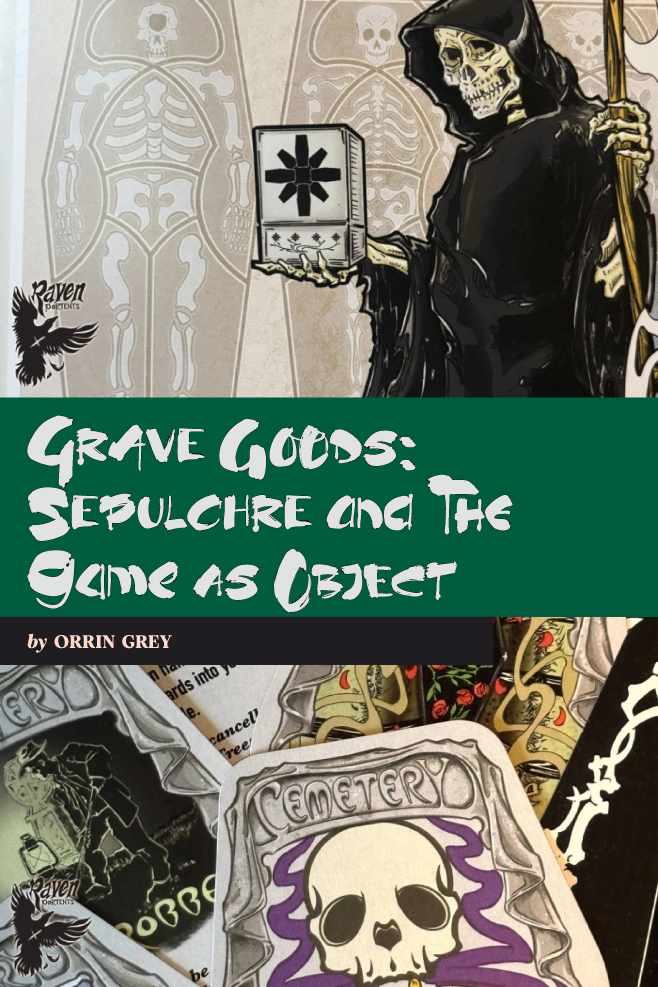
This begins as soon as you open the box, which is shaped like a monolith (or gravestone) rather than the typical flat game boxes we’re all accustomed to. Sliding the top of the monolith off reveals several coffin-shaped playing boards, which the game refers to as “graves,” where players will compete to build skeletons. These are standing upright inside the box and, when the game is played, are connected at the top to a “card crypt” and “discard plots” that link the whole shebang together into an asterisk-shaped playing board.
If that all sounds complicated… it’s really not. The way all the pieces fit together is fairly intuitive and, even if it wasn’t, the rules lay it all out clearly. The rest of the game is made up of skeleton pieces and a handsome deck of Skeleton, Decay, and Cemetery Cards.
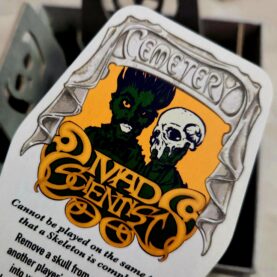
Skeleton Cards allow players to add pieces to their skeleton. Decay Cards allow you to nix pieces from other players’ skeletons. And Cemetery Cards have a variety of effects, from protecting your skeletons or blocking Decay Cards to stealing another player’s skeleton and much more.
Both the skeleton pieces themselves and the various cards come in their own coffin-shaped boxes – and the cards are coffin-shaped, as well. Sepulchre is, if nothing else, a game that knows its own brand identity.
The rulebook that accompanies the preproduction version of the game I received includes a couple of paragraphs fictionalizing the experience of opening the box, and giving you a solid insight into the vibes it intends to capture:
“You are exploring the attic of a Victorian mansion that once belonged to an old widow with a reputation for dabbling in the occult, witchcraft, and all things supernatural.”
That’s a pretty good start into what Sepulchre is selling.
———
Orrin Grey is a writer, editor, game designer, and amateur film scholar who loves to write about monsters, movies, and monster movies. He’s the author of several spooky books, including How to See Ghosts & Other Figments. You can find him online at orringrey.com.

Sign up for the forthcoming weekly Unwinnable digest!
You’ve been reading an excerpt from Unwinnable Monthly Issue 192.
To read the article in its entirety, please purchase the issue from the shop or sign up for a subscription to Unwinnable Monthly!