Ruins in Reverse

This column is a reprint from Unwinnable Monthly #191. If you like what you see, grab the magazine for less than ten dollars, or subscribe and get all future magazines for half price.
———
Architecture and games.
———
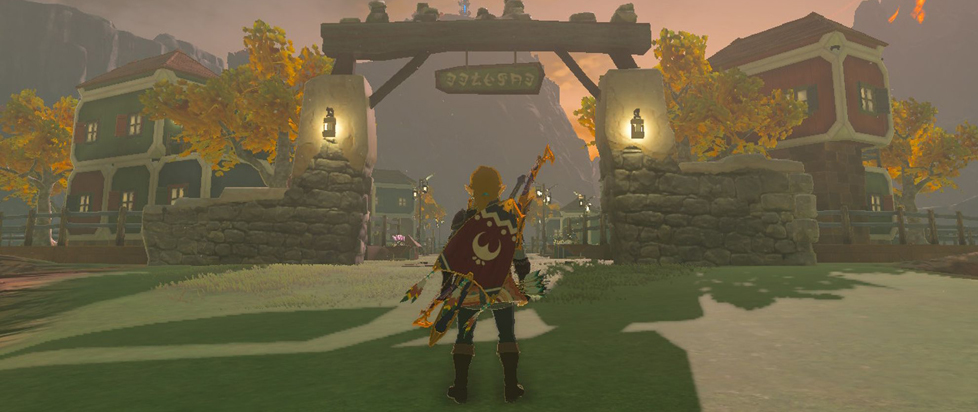
Most of us remember The Legend of Zelda: Breath of the Wild for its ruins. I even wrote about them. The game world, Hyrule, is marked by signs of collapse, whether broken down machines, crumbling castles or abandoned villages. The signs of survival and decay are a clear and consistent theme throughout the experience. Hidden within these remnants of catastrophe on the other hand is a rather strange and unusual quest, From the Ground Up. This tells the story of Tarrey Town, a place brought into being during the course of your own exploration, if you care enough to see matters through to completion.
The task at first appears to be nothing more than a typical diversion, effectively a fetch quest. There’s a carpenter named Hudson who sets out to start a new town in the Akkala region. They of course need a hand from the primary protagonist, Link. Simply put, you’re given the job of recruiting workers, and of course inhabitants.
When seen through the lens of labor theory, Tarrey Town is an interesting if not extraordinary place, tucked into the frankly overwhelming lore of The Legend of Zelda. Tarrey Town reveals the different stages or processes by which communities are created, in other words labor, migration, settlement and the transformation of materials into something resembling a society. From the Ground Up isn’t just about raising walls and putting up roofs. The quest is about the human effort which underpins every built environment.
Hudson can’t build Tarrey Town all by himself. Each and every stage of construction requires assistance in the form of additional workers with specialized skills including miners to supply stone, merchants to circulate goods and guards to protect the populace. You’re tasked with procuring all of these people, but the actual creation of the settlement as both space and place comes from the collective labor of the assembled workforce.
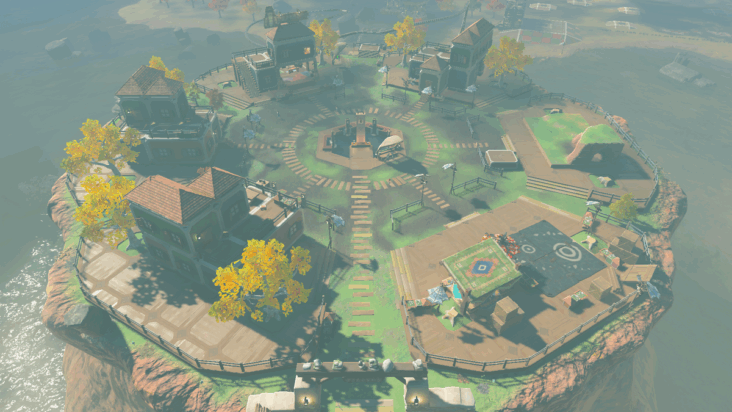
While monuments are typically attributed to powerful rulers and self-styled visionaries, their construction is in fact the product of countless individual hands. We could be considering the pyramids of ancient Egypt or the railways of contemporary Canada, but each one of these buildings emerged from the coordinated labor of mostly nameless workers. Tarrey Town simply makes this collective process visible.
There’s more to the story than first meets the eye in Breath of the Wild, at least when it comes to Tarrey Town. The game largely revolves around its ruins, regardless of whether we’re talking about the futility of resisting change or the invariability of time as a process of destruction. Tarrey Town however suggests that creating something new is nonetheless possible. The group of workers in question, brought together to pursue a common purpose, can potentially carve something lasting out of a broken, beaten down landscape, Hyrule. You can see how things ultimately turned out in Tears of the Kingdom.
The process of recruitment raises a critical question, labor mobility. Whether it’s a Goron stonemason, a Rito merchant or a Gerudo tailor, everyone brings not only their skills but their various cultural identities to the community. The settlement can be seen growing into a cross-section of society, similar to many cities around the world today.
When settlements are created, they typically depend upon precisely this type of movement. As you slowly establish Tarrey Town, you’ll see the place becoming relatively cosmopolitan, a reflection of not only the region but the entire game world. Despite the positivity of the narrative, the quest perhaps inadvertently reflects the promise but also the difficulty of diverse labor communities, in other words cooperation across cultural divides, in addition to the implicit tensions of dislocation. You have to convince people to make the move, and their considerations involve both push and pull factors, but also their long-term happiness and wellbeing. There’s no small amount of skepticism.
Perhaps the most powerful aspect of the quest is quite simply walking through Tarrey Town, while observing the growth of the community. There’s nothing but foundations at first, but with each batch of fresh faces, new homes appear, new shops open for business and the place truly comes to life, until a settlement stands where there used to be nothing but a rocky outcropping. Breath of the Wild allows you to see this construction unfold, story by literal story.
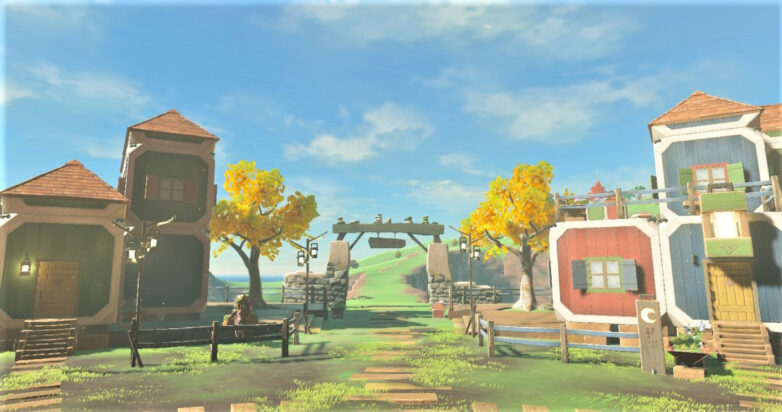
Built environments are often understood as fossilized labor. The medieval cathedral and the classical temple are more than just architecture, they’re examples of hard work left for posterity in the form of solid stone. Tarrey Town is more than just a vestige of the past, it’s a living artifact of ongoing effort. I can only assume that when Breath of the Wild was released, most of us quite simply passed through Tarrey Town, or perhaps even abandoned its construction. I won’t blame anyone, given that From the Ground Up is an optional and frankly tedious quest. I admit on the other hand that much of my interest comes from Tears of the Kingdom which assumes you put in the effort.
Structures generally do last for a long time. Whether we’re talking about roads, bridges, factories or individual homes, infrastructure of this variety tends to pass the test of time, and communities weather crises not simply through leadership or luck but the existence of previous work. The collective labor invested in Tarrey Town during Breath of the Wild allows the settlement to overcome the calamity, securing a place in the broader history of Hyrule.
Tarrey Town is no longer about construction in Tears of the Kingdom, it’s about reproduction and continuity. The creators of Tarrey Town in Breath of the Wild, Hudson and Rhondson, have a daughter named Mattison in Tears of the Kingdom. Tarrey Town provides a reminder that labor isn’t about building and producing but maintaining households, and raising future generations.
From the Ground Up remains one of the most compelling quests in the franchise, running all the way from The Legend of Zelda to Echoes of Wisdom. The quest invites you to think not only about fighting monsters or solving puzzles but how communities emerge from the collective labor of a community. From the Ground Up puts labor theory into perspective, including the mobilization of workers and the challenges of migration to the permanence of a built environment.
In a world covered with ruins, Tarrey Town offers a counter-narrative to the overall direction of the broader story in Breath of the Wild, and by extension Tears of the Kingdom. The settlement says that rebuilding is possible, and that collective labor can carve out spaces of resilience in the shadow of catastrophe, or in this case calamity. When people come together, communities come into creation, and physical or social structures can be sustained.
———
Justin Reeve is an archaeologist specializing in architecture, urbanism and spatial theory, but he can frequently be found writing about videogames, too.