What a Way to Live: Gary Sherman’s Eegah, aka Death Line (1972)
You feel compelled to support great writing…

“Mind you don’t become a missing person yourself.”
Gary Sherman’s Death Line is also known as Raw Meat – and both of those titles sound much more horrific than anything you’re going to get in this queasy British drama about the last surviving member of a group of workers who were lost while digging a tube station in 1892.
Yet, what else could you call Death Line but horror? The survivor, played by Hugh Armstrong and credited simply as the “Man,” definitely kills a few people, and his den beneath the London underground is a charnel house littered with decaying corpses, both of his own victims and those of his erstwhile clan, who have all been carefully laid to rest complete with rudimentary funerary rites.
From its opening credits, which play over shots of the exteriors of actual strip clubs, Death Line is a movie that feels coated in grime. That this grime is juxtaposed, almost immediately, with the genteel appearances of the British upper class is by no means accidental, though what it ultimately has to say on the subject is left to at least some degree of viewer interpretation.
Indeed, there are few easy answers to be had in Death Line. The “Man” is clearly the film’s monster, a source of both terror and pity to those who live on the surface, but he is also the picture’s greatest victim.
His forebears were abandoned underground because their employers went bankrupt and nobody could be bothered to dig them out, and for decades they lived there in the dark, their only resources the cans of oil and other accoutrements of their profession that had been left in their makeshift tomb with them – and, of course, their own bodies, when they perished.
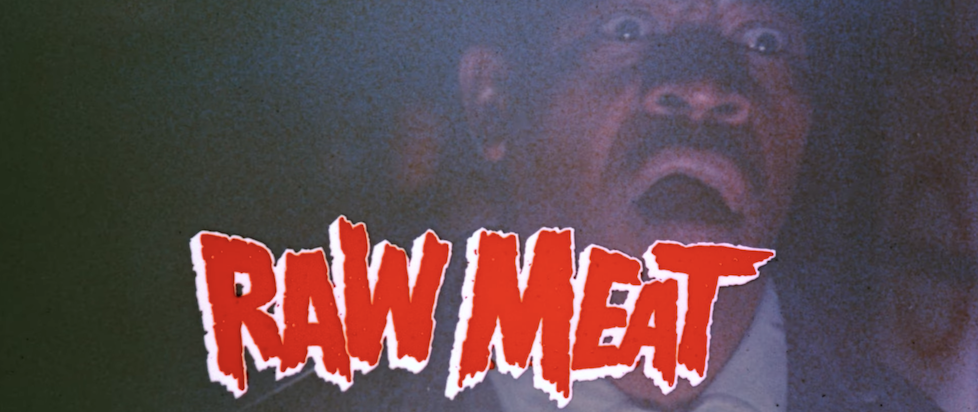
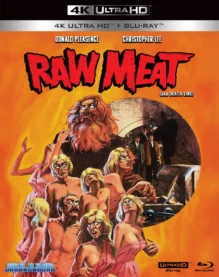
The cannibalism angle is played up in the alternate Raw Meat title – which is also the one stamped on this new 4k release from Blue Underground – but it’s not really a focus of the film, which seems to regard the tragic living conditions of the “Man” with more horror than it does his gruesome actions.
There are few heroes to be found here, either. Sharon Gurney as the idealistic student who wants to help the unfortunate but becomes trapped in the dark with our “monster” is the closest we come. Her American boyfriend may ultimately come to her rescue, but he initially has no interest in getting involved in the woes of anyone else. When the police inspector asks him if he often sees unconscious men in the subway, he says something to the effect that, “In New York, we consider it a holiday when we don’t.”
Though the two students are ostensibly our leads, it is with the police that we spend most of our time, notably a crabby and at least somewhat corrupt inspector played to the nines by Donald Pleasance.
Indeed, what most people know about Death Line is that both Donald Pleasance and Christopher Lee are in it. And the two make up some of the film’s most memorable elements, even if the latter is only present for a scene stealing couple of minutes.
Pleasance is around a lot more, however, and his police inspector forms the backbone of the movie. A working class bloke who gets the job done (more or less) but also abuses his petty authority – Pleasance makes him at once execrable and charmingly human, someone we enjoy watching, even (and maybe especially) when he’s being a piece of shit.
Immediately after watching it, I called it Gary Sherman’s “Midnight Meat Train” by way of Eegah, or maybe the other way around. It certainly has elements of both, but also never goes the same places as either. I kept expecting things to follow the same trajectory they took in Arch Hall’s caveman pic, but they never really did. Even when the “Man” does inevitably kidnap our final girl, his attempts at first calming her and then assaulting her are much more perfunctory, and much more traumatic.
Similarly, while some of the same themes are at play that are explored in Barker’s “Midnight Meat Train,” here they are buried under a sediment of British class politics, and the specifics of the “Man’s” plight as a human being – albeit a horrifically damaged one – rather than an avatar of some larger malaise.
Ultimately, Death Line is a surprisingly slow, quiet, talky movie, given its lurid subject matter and titles. But that deceptive quiet and slowness don’t make what’s happening on screen any less unsettling, and the film buries the viewer – as surely as the “Man’s” forebears were buried – in a suffocating atmosphere of grime and claustrophobia.
And you’ll never hear the phrase “Mind the doors” the same way again…
———
Orrin Grey is a writer, editor, game designer, and amateur film scholar who loves to write about monsters, movies, and monster movies. He’s the author of several spooky books, including How to See Ghosts & Other Figments. You can find him online at orringrey.com.