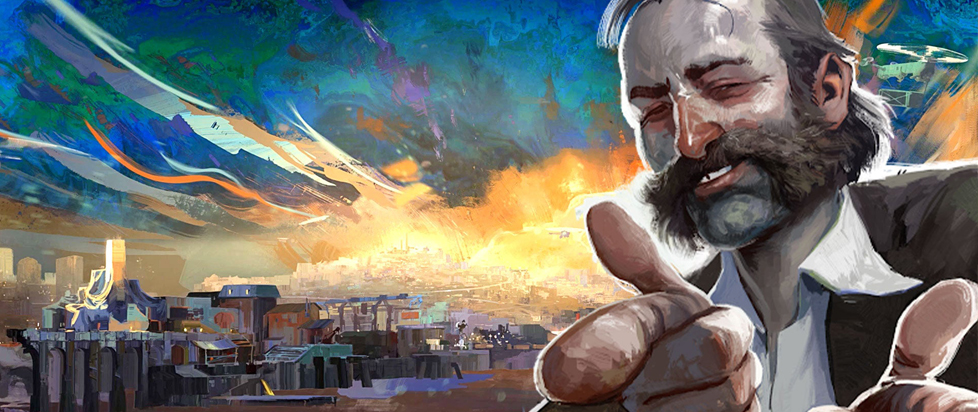
I Don’t Want to Be This Kind of Animal Anymore
This is a feature story from Unwinnable Monthly #191. If you like what you see, grab the magazine for less than ten dollars, or subscribe and get all future magazines for half price.
———
In the dark times, should the stars also go out?
Revachol is still. Silent. Decades of unrest, corruption and capital gain have reduced it to a shell of a city. And yet, under these sullen skies, a miracle is happening. The limbed and headed machine of pain and undignified suffering is firing up again.
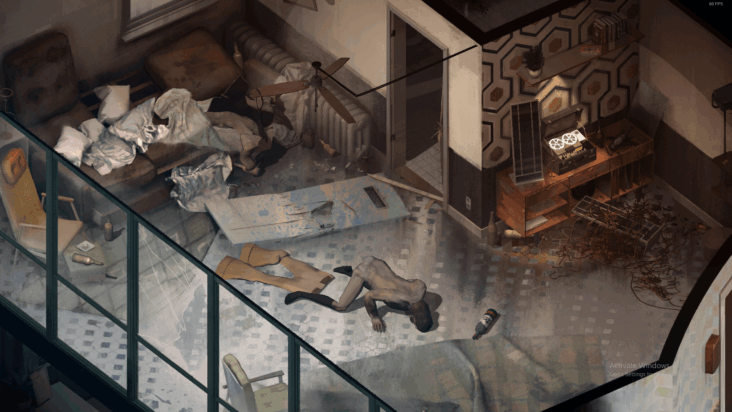
A man wakes up in a destroyed, endlessly lonely hotel room. He does not know his name, who he was or is, what led him to this wreck of residence or what he lives for. Following a streak of days staring directly into the bottle and having the bottle stare back, his life is a blank slate. A past existed, but not to his knowledge. At some point last night, echoing throughout the Whirling-In-Rags, a desperate scream erupted from his lips.
“I don’t want to be this kind of animal anymore!”
After incredible amounts of both literal and metaphorical searching, the animal rediscovers his name: Lieutenant Double-Yefreitor Harrier Du Bois. Stamped into a pristine RCM badge and, in some past life, scribbled onto the well-worn lanyard of a high school gym teacher. Harrier Du Bois is, undeniably, a person who has existed for many years. The darkened trail of struggle, mistake and heartbreak that precedes him, and ripples out to affect both those close to him and even those he had not yet met, will remain whether he remembers it or not. At some point he has to face the music; Lieutenant Du Bois cannot run from his past forever.
A life has happened to him previously. He does not have the luxury of choosing who he was. But he does, graciously, have the opportunity to choose who he will be. It is appropriate, then, that not only does Disco Elysium include the traditional roleplaying game elements of selecting dialogue and actions to create differing outcomes and either build or damage interpersonal relationships, but importantly, it grants you the freedom to create your own individualized version of the detective. Not by selecting the classic stats such as strength, wisdom and charisma, but by building out his very personhood.
Placing points into aspects of his personality such as empathy, volition and drama allows you to be the architect of this new person, deciding where his best qualities lie and his deepest flaws hide. The mechanical simplicity of gaining experience to level up these aspects – but crucially never gaining enough to make Harrier truly “rounded” – through literal life experiences and conversations excellently reinforces the simultaneous freedom and struggle of starting from square one. How else can we grow as people than by experiencing as much of life as we can, and taking the right or wrong lessons from these choices?
I do not aim to simply spell out the magic of Disco Elysium’s narrative structure, the incredible writing of Harrier Du Bois, and its unique adaptation of role-playing character stat sheets – I certainly could, but I would be far from the first to do so. Instead, I wish to explore a considerably more personal realization that I came to on what must have been my fourth or fifth playthrough, which hit me like a Kineema to center mass.
Harrier Du Bois’ life mirrors the transgender experience.
By that, I do not wish to refer to anything explicitly connected to queerness that Harrier encounters, such as his twenty-hour mind project to understand Lieutenant Kitsuragi’s sexuality, or his own flirting with the homosexual underground and eventual bisexual realizations. I don’t even mean his physical response to Klassje, with every single voice of his personality being compromised upon speaking to this beautiful woman – a wonderful accidental symbol for gender envy, if I may reach a little. Conversely, in a way absolutely not intended by the writers, Harrier’s life exists as a powerful parallel to a trans person’s process of self-discovery and change.
For many trans people, the self that existed before they realized who they are can be a formless blur of memories that always felt somewhat wrong: a life that happened, but to someone else. A new life begins upon that realization; it may not feel like it immediately, but the sheer degree of self-actualization that it allows for, if not requires, makes for an entirely novel living experience. The shivers of your past may still bounce around somewhere in your brain, your neurons unconsciously conjuring flashes of another person, but you are starting from scratch.
It may not take a multi-day bender destroying your car, body and soul – not that it’s uncommon for gender-adjacent realizations to come around while under the influence – but as with the lieutenant, it is up to you to decide from now on who you will be. You’ve been given the gift of a new life – do something with it. Now that you’re not floating through your present on autopilot, you can make choices that matter; from small things like eating well now that your body isn’t just a formless enemy, to bigger things such as changing your name everywhere you can.
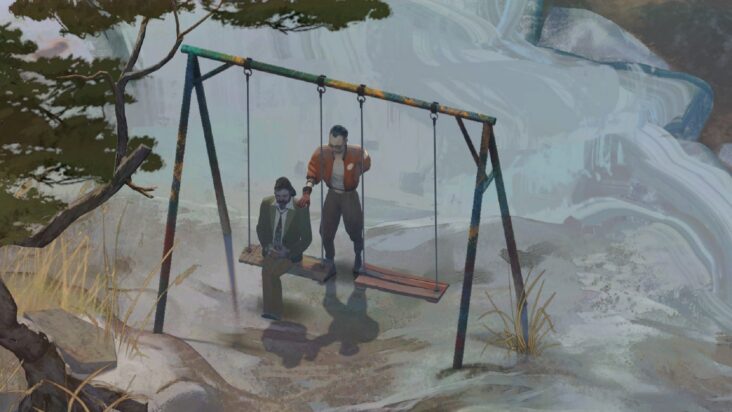
It’s a given to say that for trans people, a lot’s in a name, and Harrier himself is no stranger to them. Tequila Sunset. The Icebreaker. Raphael Ambrosius Costeau. They’re all him, yet simultaneously all someone else. It’s not hard to see why he’s so drawn to creating and borrowing all these new identities for himself: the alternative, his real name, is marred with too much history and horror for him to willingly comprehend. He may not permanently live under a new name, but after finding that badge, he strives to make the identity of Harrier Du Bois into a new man.
He spends much of both lives struggling to be truly understood and loved by the people around him, be they fellow officers, the people of Revachol or his former fiancée. As she reminds him in their fleeting conversation within his nightmares, he bears a vast soul, but his sadness and inability to talk like a normal person are just too much. There’s simply something wrong with him, too wrong to fix. He just can’t be normal.
After following the trail of the hanged man all the way out to the islet and finding only another bitter, aging man, Harrier’s job seems done. Alongside Lieutenant Kitsuragi, they’ve solved the case. They can arrest the elderly gunman and head back to the station. It’s all been for this.
Then, a colossal stick insect appears. A freak – no, a wonder of nature. A statistical impossibility whose existence goes against all known biology, yet it persists regardless. Harrier assumes he has finally lost it. No matter the progress he’s made, no matter the man he’s become, he’s still just a self-hating drunk, hallucinating monsters to avoid the painful reality sitting in front of him. God forbid the phasmid starts to telepathically speak to him.
Four words cut through the silence, in Lieutenant Kitsuragi’s hushed tone.
“I can see it.”
It’s real. After years, decades even, of believing there is something fundamentally wrong with him, Harrier has reached breaking point. It’s the final straw for his sanity. And yet, someone can finally see what he sees.
All this time, you were just waiting for someone who could understand. Someone who knows you didn’t ask to be born like this. Someone who knows you’re just trying to make it right.
You’re not crazy. You’re just different. You have a vast soul. This life is all you have, but it’s still something. You have to keep going.
Harrier tells the Phasmid, this loving improbability, that “You’re the type of animal I’d like to be.” An animal of hope. An animal that by many accounts is erased from biology, an animal that should not exist, but does. We can all choose just what kind of animal we want to be.
In the midst of writing this essay, the United Kingdom’s Supreme Court ruled that only cisgender women come under the legal definition of a woman due to their birth-given sex. Trans women, under the Equality Act 2010, are no longer legally considered women in the UK. The consequences this will have for trans rights in the UK are unimaginable, and are already rearing their terrifying head. As of early September, the EHRC’s code of practice claims trans people must be banned entirely from single-sex spaces, segregating us into non-existent “safe third spaces.” Persecution is not a far-off concern. It’s our reality.
Bigots rejoiced, the cis women among them too focused on their hatred to realize they would soon be next to suffer at the hands of hate. The sweetest, most courageous people in the world cried.
With every passing day, sinking under the ever-flowing tide of fascism sweeping across the earth, my existence feels more and more like a danger – a metaphorical red dot on my forehead as we drift into becoming a second class of citizen.
Yet with every passing day, with every milliliter of estradiol drawn into a needle and pierced through my skin, my continued existence also feels more and more like an improbable, immovable fact. They may not be 10-foot insectoids, but there are so many trans people that I see as miracles, that fill me with hope that I can survive through the suffering just as they have.
They have lived. I will live. If you are transgender, you have to live. Something beautiful is going to happen.
As the lieutenant says, a wry smile twisting his rugged lips in the cold Revacholian wind: “The night is always darkest before the dawn.”
———
Ashley Schofield is a freelance journalist and the author of VA-11 Hall-A: Design Works for Lost In Cult. You can read her words in VGC, Polygon, PLAY, EDGE, GamesRadar+, Into the Spine and many more publications. Find her on Bluesky, or more of her work at muckrack.com/ash-like-a-dragon.