See You in Hell: Watching Spawn (1997) in Ultra HD for Some Reason
You feel compelled to support great writing…
“Where you’re going, every day is Halloween.”
I was just getting into comics when the Image boom happened. For those who weren’t around (or spent their youth more wisely than I), Image Comics kicked off in 1992, when seven superstar artists left Marvel to start their own company.
Organized around the ideal of creator ownership, Image was supposed to change the comics industry forever. Whether it did or not is probably a matter for more serious debate, but there’s no denying that, in the early 90s, the comics world treated Image as the Next Big Thing.
Of these seven artists, Todd McFarlane was undoubtedly one of the biggest names at the time, and his flagship title at Image was Spawn, a story about a government assassin who dies, goes to Hell, and comes back as a prospective general in Hell’s army, only to subsequently struggle against his new bosses.
The first issue of Wizard magazine that I ever bought had Spawn on the cover, even though, at the time, I didn’t have any idea who or what a Spawn was. I just thought it looked cool as hell. In my defense, I would have been roughly eleven or twelve years old at the time, the perfect age to think any of this shit is cool as hell.
I went all in on Image during its early years, but Spawn was undoubtedly my favorite. At one time, I had an unbroken run of the first fifty issues of Spawn – also, it’s worth noting that it was probably one of the few early Image titles to actually make it to fifty issues.
Not everyone was eleven or twelve years old in 1992, though you wouldn’t know it looking around the media landscape at the time. Spawn fever caught quickly, and spread like the deadly biological weapon that makes up one of the handful of MacGuffins in the movie.
Within a few years, you could get all manner of Spawn t-shirts and other merchandise – most especially action figures. Indeed, McFarlane may have gotten his start as a comic book artist, but he probably left his biggest legacy in the form of his massive toy line, spinning his own action figure company off of his early Spawn toys.
Even after the comics stopped publishing, McFarlane Toys is still going strong, and has made figures of everything from dragons and classic monsters to Clive Barker’s twisted creations and real-world athletes, to name just a few. These days, McFarlane Toys has all kinds of licenses, and even makes toys of characters from Marvel and DC.
All of this goes perhaps some distance to explaining how a Spawn movie with a budget of roughly half-a-million dollars could hit screens within five years of the character’s first appearance, in a landscape where comic book movies were not yet the moneymaking juggernauts they are today.
In fact, the 1997 Spawn may be best understood for its spot in the history of cinematic superheroes. After all, let’s face it, this Spawn is… not generally regarded as very good, to put it mildly. (In a contemporary review, Salon.com’s Laura Miller states it more bluntly: “This movie sucks.”)
In ’97, the capes-and-tights movie formula had arguably yet to be cracked. There were big successes, of course, including Tim Burton’s Batman films, which had kicked off a franchise that was coming to an end the same year that Spawn hit screens. But for the most part, even the most successful comic book movies didn’t look or feel very much like their four-color counterparts, with movie studios often insisting upon sweeping changes to make the properties a (debatably) better fit for the big screen.
While Spawn certainly has its problems, though, this largely isn’t one of them. In fact, McFarlane sold the rights to New Line for only $1 on the condition that he maintain a bigger-than-usual amount of creative control (and also kept a hold of merchandising rights). The result is a film that hews surprisingly close to at least the letter of its subject matter, especially for a superhero movie from the late ‘90s.
To isolate Spawn’s problems, one needs to look at… almost anything else. The biggest standouts, for modern audiences, are likely to be the film’s digital effects. Many of the people behind the cameras for Spawn were special effects people, including first-time feature director Mark A. Z. Dippe, and it shows – but not always to the film’s benefit.
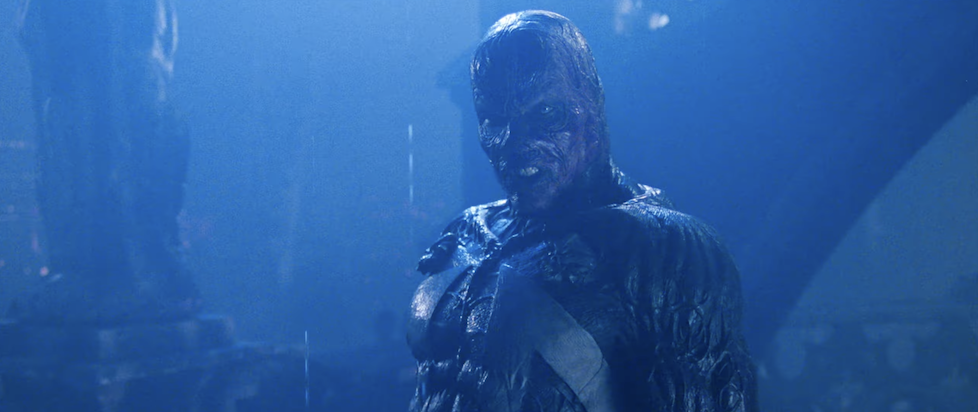
Spawn is loaded to the rafters with special effects. Its star spends the vast majority of the movie under heavy makeup and a shapeshifting suit brought to life via a combination of prosthetics and CGI. Techs from ILM and KNB EFX Group worked on the picture, including veterans from groundbreaking effects pictures like Jurassic Park.
The digital effects in Spawn, however… well, they don’t hold up as well. This is especially galling in the movie’s depictions of Hell, which look like a PC game demo reel. Unfortunate, given that a chunk of the film’s climax takes place there.
The other divisive (let’s say) element of Spawn is John Leguizamo as the “human” form of Spawn’s mentor/nemesis, Violator. Martin Sheen is in this movie, and its narration is provided by Nicol Williamson, who was once described as “the greatest actor since Marlon Brando.” Michael Jai White plays the title character. Yet, it is Leguizamo who receives top billing in the film’s opening credits.
Played under a heavy prosthetic “fat suit,” Leguizamo’s Clown (as the Violator’s “human” form is known) is a little like Robin Williams’ Genie from Aladdin, if he was the filthiest of late-night comedians. Every minute he is on screen, Leguizamo provides a rapid-fire barrage of non-stop scatological humor, sexual innuendo, and so on. “Every time someone farts, a demon gets its wings,” is a representative sample, delivered in a mock-imitation of Jimmy Stewart.
Leguizamo’s Clown is undeniably annoying and never remotely funny. For many, he’s the worst aspect of an already dismal film. But one can’t really argue that Leguizamo doesn’t give it his all, or that he doesn’t understand the assignment. His Clown is, after all, supposed to be annoying and scummy – the problem is, he often succeeds in annoying the audience, not just the film’s hero.
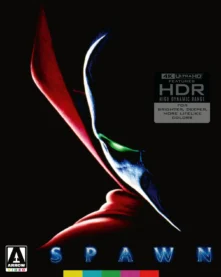
Arrow recently released Spawn in 4K UHD and Blu-ray editions, both of which contain both the original cut of the film and the slightly longer director’s cut. The director’s cut doesn’t alter the story in any meaningful sense, but it does add a couple of minutes to the runtime, while also changing a few scenes in minor ways. Mostly, this amounts to longer shots of gun violence, and more instances of the Clown’s sexual innuendo.
Whether this is a benefit or not is up to you.
———
Orrin Grey is a writer, editor, game designer, and amateur film scholar who loves to write about monsters, movies, and monster movies. He’s the author of several spooky books, including How to See Ghosts & Other Figments. You can find him online at orringrey.com.