It’s Not the Game, but the Terrain we Made Along the Way
You feel compelled to support great writing…

There I was, pouring some superglue to fill another gap between two pieces from an official Games Workshop Warhammer 40,000 terrain kit, when it hit me. A nagging feeling to immediately question the hundreds of dollars spent and potentially dozens of hours of work still before me. Am I actually enjoying this? Is it still fun?
“This” refers to building the kind of war-torn future landscape in miniature that I’d dreamed of since my middle school years. I recall getting the internet in 1997 and discovering a whole new world of tabletop gaming. Hours spent at my computer provided me with images of fantastical landscapes I yearned to one day construct myself. I vividly remember driving with my parents one time when, along the side of the highway, I saw a massive, brutalist concrete structure sitting oddly alone atop a well-manicured grassy hill and thinking how much it looked like a Warhammer table of the era.
It didn’t stop there either. Growing up in a rural area, the green, grassy tablescapes with odd points of interest from fantasy castles and landing pads to rocky-edged hills and trees didn’t feel entirely incongruent with my surroundings at the time. Compared to the distant urban realities of other fantastical worlds I enjoyed, like comic book superheroes, the grassy expanses felt relatable. I often thought how fun it would be on some fall day to set up a table outside, surrounded by skeletal trees in the background, and play a game of Undead against Britonnia.
Since I was very little, I had always loved toys that involved some sort of building and construction aspect. Miniatures obviously fit this interest, but terrain took it a step further. While creative conversions were a thing, terrain back then was pure imagination. The odd blocky shaped molded styrofoam pieces that protected electronics in their boxes from sliding around served as the beginning of the brutalist concrete structures mentioned earlier. Pink foam insulation was cut to make natural landscape features such as wells. Foamcore could be sliced up with a utility or hobby knife to make all sorts of buildings and ruins. For the first time in my life, a trip to the hardware store became fun as I urged my confused father to purchase me some pieces of pipe and other doo-dads I was envisioning as a futuristic refinery and a magical well, respectively.
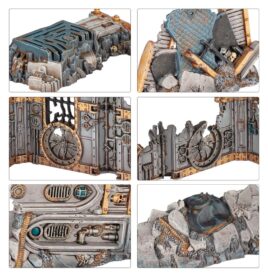
As the years went on, lack of space, time, and money led me away from the miniature gaming hobby, although I loved to poke in and see what was going on. I remember being blown away when I first noticed that Games Workshop was producing more plastic terrain kits, making intricately detailed 41st millennium hellscapes I could never have imagined producing myself back in the 90s. When I bought a house, had a child, and decided to not spend every night hanging out somewhere, miniature wargaming was right there to regain my attention.
A couple of years ago, my father handed me a binder of material I had printed from the internet back in those early days. There were army tactics, house rules for Warhammer Quest, and of course, terrain recipes. Flipping through the binder, the terrain recipes were the most exciting thing to look back over, reminding me of websites I had forgotten even existed, which I had once pored over for hours. Yet, having more plastic terrain kits than I could handle, the binder didn’t initiate any immediate plans and went into the storage space.
So, here I am, wondering if this progress is really progress. I amassed an expensive collection of fancy plastic, but I’m unsure if I’m having anywhere near the fun I did as a kid making things myself. Perhaps having plastic kits ready to go saves some time, but the work does feel much more tedious, and the whole process lacks the thrill of innovation and discovery. Don’t get me wrong, these buildings look cool! I’m going to continue working on some premade kits, but I think scrounging around for odds and ends, and seeing what I can imagine as items fallen out of a world that doesn’t exist, is essential for a creatively fulfilling hobby instead of pure mindless consumerism.
I’m fully aware that tons of people are still out there making their own terrain. It’s just that it seems to be a bit less prevalent than it was back when I began, at least to the official Games Workshop Warhammer hobbyist, but possibly across the board. There are tons of great options out there, but I think it’s time for me to dust off that old binder and build on those ideas with my own spin. I know my crafting and miniature-loving daughter will have a lot more fun this way, and I can’t wait to see what we can dream up together.
———
Ryan Whalen irregularly publishes the zine MDNTWVLF between his hodgepodge of research and writing gigs. He keeps an instagram open for MDNTWLF in hopes he’ll do another one after finishing the book he’s working on.