Stray and Notions of a Working Class Underworld
You feel compelled to support great writing…
The Ship of Theseus Problem asks us to consider when exactly change happens over a process of identical replacement. If our society remains identical, philosophically, over the course of decades of rot and patchwork replacements, is it the very same society? If a system is stagnant, does any other change make it something different?
BlueTwelve Studio’s Stray puts us as the player in the position of a prodigal kitty cat separated from his family and thrust into an entirely alien culture. At least, it is alien in setting: at least millions of years after humanity’s extinction, society continues somewhat in Walled City 99, where automatons have taken the role of the apex. Ideologically, though, the game’s underworld – and the Dante-like ascent back towards the purgatory of the warm sun – bears the same systemic follies as the world we inhabit today. Humanity is dead but we have scarred our descendants all the same.
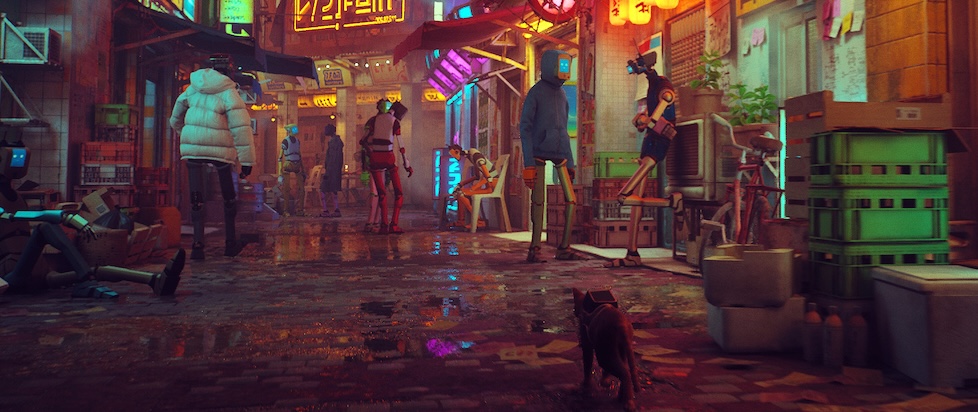
The cat’s first scramble to survival after a brief tutorial takes him and his robot-companion B-12 into the Slums of the walled city. Now the very edges of civilization barely holding on against the encroaching darkness, the Slums are a place of stagnation. Poverty shrouds the area, at least in a metaphorical sense. The robots we encounter are fearful, largely uncreative. While they’ve inherited humanity’s capacity for language, and some of our personalities, many of the metal bodies simply rot. Their parts are damaged and repaired only through the charitable recycling of others. A number of androids simply sleep persistently in the darkness, finding that preferable to the unwilling ascetic dread of poverty.
Walled City 99, we learn, was once inhabited by flesh-and-blood human beings, before they died out in a great sickness. They made the choice, to the last mini-bastions of life, to stratify their society based on wealth. Death claimed them all the same.
The robots maintain these systems, though. The Slums are separated from the pseudo-upper crust by long-abandoned sewers filled with Zurgs, little devourers made to recycle matter of all kinds. Each day the hungry things enter the slums more ravenously, ready to obliterate the last scarred capitalist hellscapes entirely.
The neon-lit Midtown, we find, is almost comically-better off, a cyberpunk place of art, clubbing, and human experiences translated into robotic minds and forms. The space is larger, less cramped. The heart of this different spirit, however, lies in ignorance: none of the Midtown-bots seem to understand the encroaching threat of the Zurgs. They’re too busy in an endless cycle of capitalist consumption. Some even work in a factory to produce single-minded bots that exist to maintain the status quo to afford more luxury.
Those bots, like most capitalist systems, are all too willing to court fascistic styles of governance to counter the slow simmering unrest that is concealed at every party’s end. The neon lights provide a meaningful distraction when backroom quislings betray would-be revolutionaries and idealistics to the autonomous police-state. Robots that break the status quo are arrested and thrown to decay in a prison. Our kitty cat, on account of his collusion with a small group hoping to one day see the sun, is detained all the same.
He is able to escape only because their programming is so rigid – the sentinels fail to realize that the cat can scamper past security and squeeze himself into tiny gaps they cannot reach. Their systems quite literally cannot comprehend a threat beyond that of an individual with the gall to dream of a different future.
The system, too, would be devoured without resistance by the Zurgs, should it come to that.
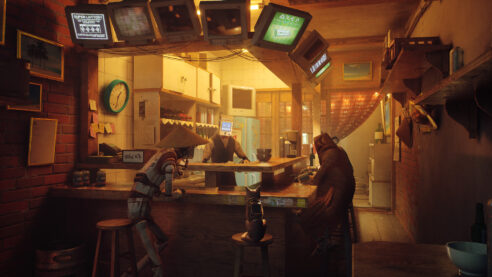
We cannot even attribute this to the rigidity of programming; a number of the automatons we’ve seen, particularly those in the slums, have given themselves new identities and new tasks to avoid the ever-encroaching boredom and purposelessness of a world without humans. All of the robots have developed a digital language of their own, processed for our sake only thanks to B-12.
The problem is a different sort of philosophical rigidity. The Ship of Theseus can be rebuilt and still be recognizable as the Ship of Theseus when those parts are identical, at least according to the most common interpretations of the problem (of course, the moment when it transitions into a neo-object is dependent on one’s worldview). What happens, then, when the bolts deep within the bowels of the ship have to be replaced with rusted, jury-rigged replacements? Even when not perceived – the powers that be hold tightly to the idea that changing one bolt eradicates the identity of the ship.
The parts that kept the old ship floating and sailing don’t exist anymore. Mankind cannot work out the kinks. All that those still here can do is make do with the rusting parts they have. If any singular part is repaired, then, the ship becomes entirely alien. It becomes terrifyingly strange, unwieldy, and thus meaningless.
When faced with two eventualities: some sort of reform that would allow the would-be Outsiders to open the iron dome that keeps Walled City 99 smothered in darkness, or oblivion…. The system is primed to choose the latter.
We might even call this death over deregulation.
When the cat finally breaks free, and manages to infiltrate the pristine, pristine stagnance that is the Walled City’s Control Center, we find Purgatory. Millions of years have not changed what lies within. The walls are pristine, unrusted chrome. Robots still obey their programming as mindless service drones piddle along without any sense of something being wrong – surely their human masters will return soon, and thus they must keep the status quo exactly as it is. In the control room itself, we find a massive glass window that lets us loom over the city as the insulated class who sealed it all away must have.
B-12 and the stray find the most bourgeois realm within the underworld to be entirely isolated, a different sort of ark. We find that the other drones out there have already breached their prime directive by developing some free will and productive independence out in the vast Dark. Any noble ideals of keeping things as they are is constructed on a nativist lie, one that suggests the system one was created in is the exact system that has always been, rigid and thus immutable.
To open the massive barrier, to let the sun in, requires B-12 to sacrifice the last bits of humanity that still persist in the Walled City. And doing so, I think, makes a wonderful statement about our oft-imperfect but nevertheless constant trudge towards something better. Humanity’s last gift to the Walled City is a mulligan – a chance to be warmed by the sun, to become part of the natural order out there without the overwhelming oppressiveness of our post-capitalist hellscape, to be free of the lingering classist bounds of their programming.
The Zurgs, too, are destroyed by ultraviolet radiation – the natural world has the power to cleanse the city of its endless lust for consumption. An ascent out of the Inferno is possible – perhaps, even, there is space in the world for its creatures to walk that slow and arduous path towards the divine.
———
J.M. Henson has been playing video games since Doom II at the age of four, and hasn’t shut up about them since. You can find them on Bluesky posting very occasionally.