Mountainhead

This column is a reprint from Unwinnable Monthly #188. If you like what you see, grab the magazine for less than ten dollars, or subscribe and get all future magazines for half price.
———
Elsewhere, here.
———
The following contains spoilers for the film Mountainhead.
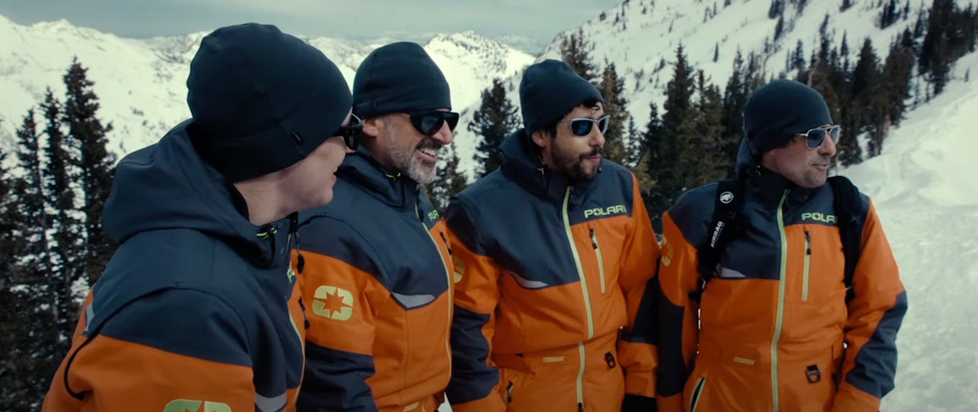
The bros up at Mountainhead are going to leave their bodies behind. It’s going to happen in like, ten years, man, tops, maybe five even if Jeff will stop being such a bitch and sell his AI so Ven can keep his own AI under control. When three billionaires and their lowly multi-millionaire weekend host plan a coup that begins in Argentina and ends in global rule it sounds – not possible exactly, but within the realm of plausibility if they could delegate effectively – but their attempts to exert similar domination over their own bodies are sweatier, less precise and a little panicked. The data is not helping. Despite all the steps counted, all the micro and macro nutrients tracked, and regular, tactical masturbation, Steve Carrell’s Randall “Papa Bear” Garrett is still dying from cancer.
The bodies of the other three in the frenemy cohort rebel as well. Jeff (Ramy Youssef) can’t keep ideologically cool when he thinks about his girlfriend, who is not attending a sex party, but is definitely attending a party where people will be having sex. Ven (Cory Michael Smith) pathetically fights a snowy tree in a moment of frustration, his flailing limbs looking more like the motions of his infant son than of a tall, young, muscular dude. Jason Schwartzman’s Hugo “Souper” Van Yalk can’t seem to help himself from preparing and serving food no one else wants. Their vocabulary is of the faux-hyperintellectualized terminally online technocrat (and writer Jesse Armstrong continues to have a great ear for these rhythms and verbiage): rationalize, IQ, position, quantify, essentially Hegalian, law. But as much as they try to live in a quantifiable world there are limits to the body’s obedience, and mystery in its hybrid of protein code and wild rogue expression, and so they are eager to simply leave it behind (except for Van, who declares they can all live inside of him when they achieve miniaturization).
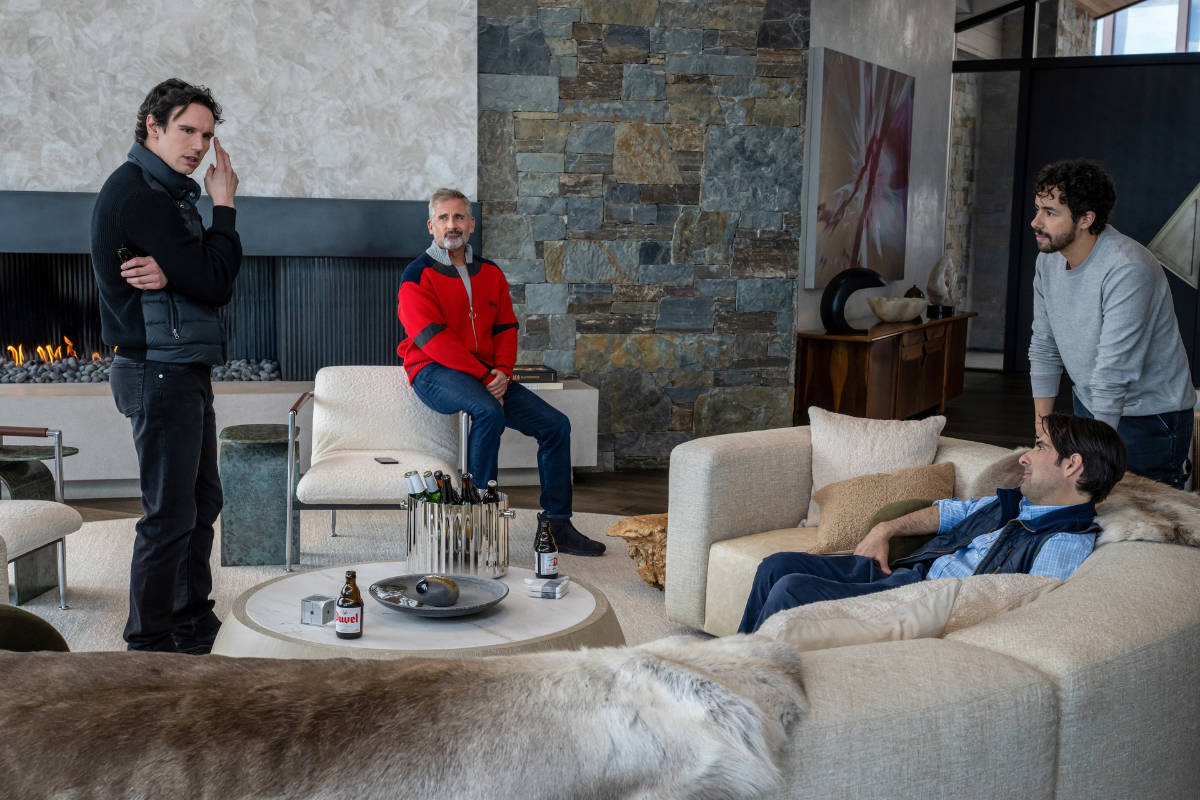
In order to make this happen they decide to murder Jeff, to get control of his software, a plot that hatches more than halfway through the film and, with telling irony, shifts the action from the icy verbal register of talky theater into heated, embodied madcap comedy (or Jackass). The conversation where they decide to kill Jeff begins in a theoretical, hypothetical mode, before their Socratic conversational style brings them around to the Dionysian and they realize that not only are they going to have to do it themselves, (rather than contract it out), but that they take some pleasure in the idea of doing so. Randall, who is older and self-styled as a philosopher wizard rather than an optimized bro-genius, stops offering smug, pat sentiments and instead starts (literally) screaming for blood, and brains, and breath.
Their incompetent blood-lust, and the comedy that accompanies it, energizes the movie as well. I didn’t laugh much for most of the runtime. Even as my brain recognized a line as technically clever, or even funny, the samey-sameyness of the chatting disconnected that knowledge from the embodied thing that makes laughing happen, especially as it lingered a little too long and too seriously on the violence Van’s AI was unleashing on the world. It lacked that collision with the ridiculous that made Succession so laugh-out-loud funny (think of Kendall rapping, or Wambsgam’s interview with a Nazi). As the stupid physicality of the murder attempts brings them into their bodies, however, it also brought me into mine and I began to cackle in earnest. I wish the film had gotten to the hijinks sooner, and stayed with it longer, but while it is the focus of the movie it makes as good of a case as any for sticking with the body, even if it does leave you vulnerable to murder-by-friendship.
———
Natasha Ochshorn is a PhD Candidate in English at CUNY, writing on fantasy texts and environmental grief. She’s lived in Brooklyn her whole life and makes music as Bunny Petite. Follow her on Instagram and Bluesky.