Tears of the Technocracy

This column is a reprint from Unwinnable Monthly #186. If you like what you see, grab the magazine for less than ten dollars, or subscribe and get all future magazines for half price.
———
Architecture and games.
———
Conversations about the role of technology are nothing new. People have been debating the use or even the nature of technology for centuries, mostly regarding its ability or perhaps inability to generate an overall positive social impact. While these debates go back to the beginnings of civilization, they took on renewed importance during the industrial revolution, as people had to face the lived reality of an economic equation which produced the greatest level of social disparity the world has ever known.
Technology has always been about freeing humanity from toil and moil, but the productive capacity has generally been monopolized by a handful of individuals. The process has been accelerating ever since our entry into modernity. You might call this a form of corruption, something which is most frequently defined as dishonestly, dissolution or a state of being somehow compromised, especially in terms of morality, although possibly physical condition. The debates by and large boil down to who benefits from a given set of circumstances.
In the most recent Zelda games, you as the primary protagonist, Link, are called upon to quite literally clear away corruption, restoring a series of technological devices to their true purpose of defending the different peoples of Hyrule. These are represented as the Divine Beasts in Breath of the Wild, showing up as the Fire, Water, Wind and Lighting Temples in Tears of the Kingdom. The structures have all been tainted by a malevolent force which has turned their incredible power towards a uniquely personal purpose: aggrandizement of the only real antagonist in the game, Ganon.
I personally found the Divine Beasts in Breath of the Wild rather more interesting than what you can find in Tears of the Kingdom, but the various temples definitely have their charm. I may also be somewhat nostalgic for this particular launch title. In any case, the Divine Beasts are basically massive machines in the form of animatronic animals, architectural marvels created by the Sheikah. This legendary culture has often been described in the lore as having made the decision to cast aside their technology, before going on to found Kakariko Village.
The reason for this dramatic lifestyle change isn’t exactly clear, but a hostile group known as the Yiga Clan remains intent on maintaining their former traditions, and their technology. This comes up during several significant side quests in Tears of the Kingdom. The biggest beneficiary of their work is of course Ganon, as you’d probably expect.
Starting with the most striking of the Divine Beats, Vah Medoh can be found soaring in the skies above the Hebra Mountains. Vah Medoh is effectively a giant bird, complete with all kinds of internal mechanisms. In order to beat the boss, you have to find your way onto the back of this bird, manipulating the previously mentioned internal mechanisms, most notably the wings. In much the same way, the Divine Beast Vah Rudania, located on Death Mountain, presents a series of puzzles that require you to rotate its body around its head, gaining access to certain hidden parts of the enormous lizard in the process.
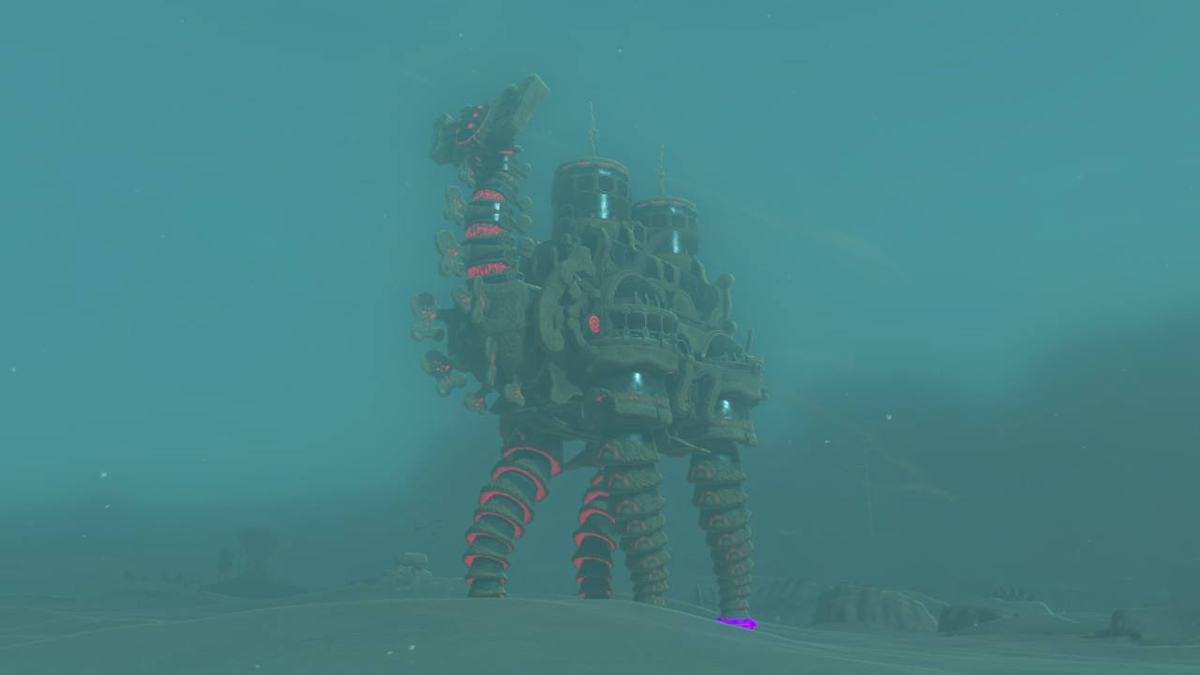
Vah Naboris trundles through the dunes of the Gerudo Desert, casting lightning attacks upon all who approach. Similar to the other Divine Beasts, Vah Naboris takes the form of a colossal camel, at least according to some opinions. I actually didn’t put this one together until recently. Whatever the case may be, once you’re able to board this crudely shaped creature, you’ll be faced with yet another puzzle, rotating the humps on its back to bring them into alignment with electrical circuits.
The most boring of the Divine Beasts would have to be Vah Ruta. I say this mostly just because I have bad memories of the Water Temple in Ocarina of Time. The animal appears in Breath of the Wild as an enormous elephant outside Zora’s Domain, standing in the middle of a lake with its tubular trunk trapped in the torrents. Attempting to save Zora’s Domain from the impending flood, Link has to move the aforementioned appendage up and of course down, working to redirect streams of water into mechanical wheels.
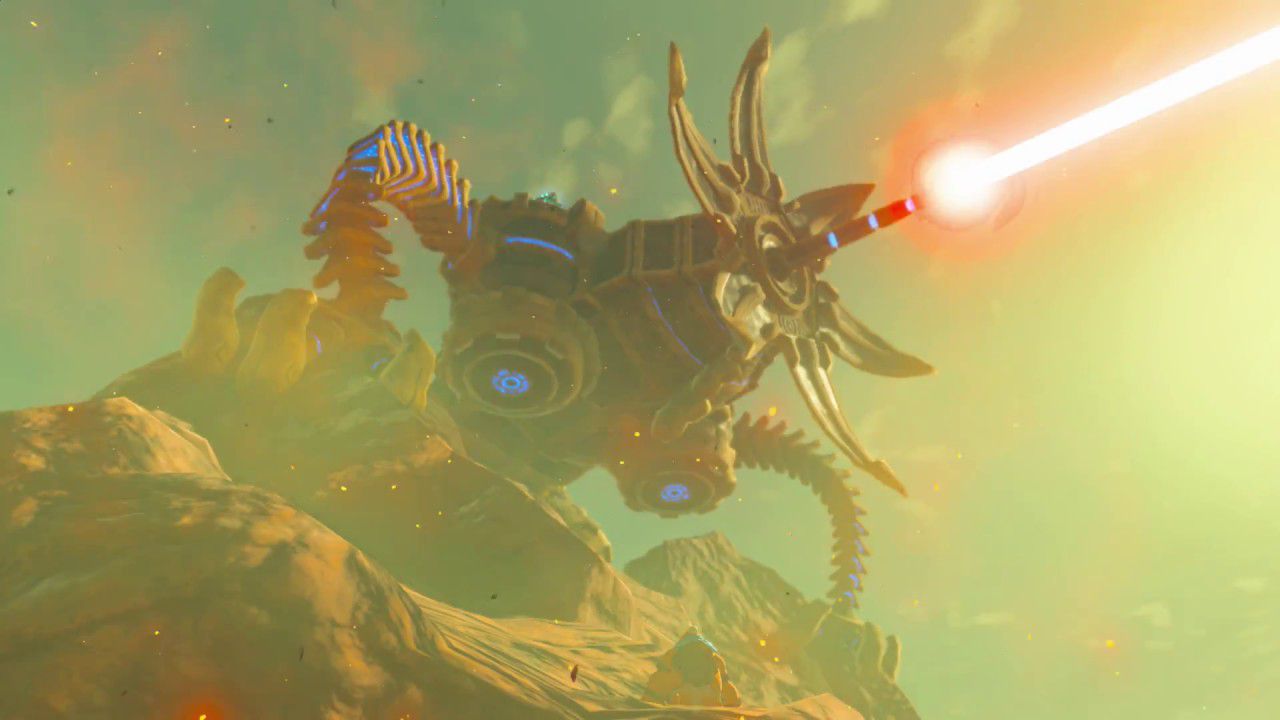
When you’ve beaten the bosses, minions of the much greater Ganon, which are ultimately responsible for corrupting the Divine Beasts, the massive mechanical marvels, perhaps monsters, will blast out beams of energy in the general direction of Hyrule Castle, weakening the brooding blaggard inside. The instruments of his own aggrandizement are turned against him, primarily to the advantage of you as the protagonist in your subsequent assault on the fortress, although by extension the countless inhabitants of Hyrule, naturally. I have no doubt this would be the canonical interpretation.
The overall process in Tears of the Kingdom is very much the same, but I’ll refrain from diving into the details through lengthy descriptions, because the structures are somewhat less interesting. This on the other hand consists of clearing out different sources of corruption from the Fire, Water, Wind and Lighting Temples, represented as black sludge. Tears of the Kingdom refers to the soul sucking substance as Gloom, Breath of the Wild preferring the much more malevolent moniker Malice.
The connection between technology and corruption found in Tears of the Kingdom and Breath of the Wild couldn’t be clearer. The question which I believe they both try to answer is the specific role of technology in terms of either benefiting the many or the mostly miniscule minority. The issue has never been about the usefulness of a particular process or a given device but rather how their productive capacity was actually deployed.
In the final analysis, what matters will always be the implementation, and the resulting impact or outcome. With some historical perspective, you’ll see that it’s usually the handful of individuals who disproportionately profit from innovation, reaping all the profits that were previously promised by a novel technology. The same could be said about artificial intelligence, only the latest in a long line of lovely looking lies. The corporations claim that our existence will be made easier if we come to rely more on computing. I’m sure that we’ll spend less time on drudgery, but that was never the crux of the matter in the first place. The problems with artificial intelligence are too many for me to enumerate, so I’ll have to focus on a small corner of the central concern, business. When people are able to benefit equally from this technology, working and worrying less while enjoying life more, I’ll be more than happy to welcome the introduction of artificial intelligence into society, but when it’s nothing but a few billionaires making more millions from their investments, I think we should all take a hard pass.
———
Justin Reeve is an archaeologist specializing in architecture, urbanism and spatial theory, but he can frequently be found writing about videogames, too.