What is Titanium Court About? An Investigation
Visit the MIT Press shop
This column is a reprint from Unwinnable Monthly #199. If you like what you see, grab the magazine for less than ten dollars, or subscribe and get all future magazines for half price.
———
What’s left when we’ve moved on.
———
This article contains spoilers for Titanium Court. A review key was provided by Fellow Traveler.
We have these deep terrible lingering fears about ourselves and the people we love. How is it no one sees how deeply afraid we were, last night, this morning? Is it something we all hide from each other, by mutual consent? Or do we share the same secret without knowing it? Wear the same disguise?
– Don Delillo, White Noise
Titanium Court received so much buzz around the Independent Games Festival that I went into it, though unspoiled, more or less ready for its twists. A lot has been said about the game’s match-3 elements, which involve sending faerie courtiers from a central court to match the threats of the board, and which is broken up by text-based exploration where you play as the human Queen of the Fairies trapped in a realm not her own. It’s a strategy game that creates breathing room between matches through other kinds of puzzles and a long to-do list.
When I reviewed Consume Me, which this game’s creator AP Thompson co-developed, I wrote that because of how its minigames mirrored the structure of helping protagonist Jenny “game out” her diet, it could only really work as a game. I feel the same way about Titanium Court. The game’s match-3 and battle elements feed into the narrative parts in a way that I can imaginatively compare to taking a break from reading a novel to do a sudoku, if the sudoku offered back insights to the novel. You can see a similar ethos that led to the minigames in Consume Me in the match-3 here, and it lends the rest of this game a similar thematic cohesion.
The thing I’ve seen praised about Titanium Court the most, besides the match-3 concept, is the writing. It’s technically competent, sharp, often funny and switches between serious topics and light ones not with a dancer’s grace but with the weight of a baseball thrown glove to glove.
However, the deeper I got into the game the more I discovered a critical problem: Titanium Court is too self-aware.
This doesn’t mean the writing is bad. Titanium Court punches above its weight in the medium humor-wise, and it has a good sense of comedic timing and ties its mechanics in with its humor. For example, one extended joke that involves a court member leaving to get his MBA at a literal cult of the economy – “M.A.R.K.E.T.” – leads to a scene where the MBA-haver reads you to death with statistics from the stock market, while you arrange resources on the same match-3 grid you use to do combat. The script has been run over with a fine-tooth comb. The effect of Titanium Court’s self-awareness was that I never felt a joke was off base or in poor taste.
The other effect, though, is that the writing rarely made me feel anything. Many of the screenshots I took, because I thought they were funny, seem on a second, ungenerous review to be sentences written to look good in a screenshot. This is not unique to Titanium Court at all. But I felt it through my whole playthrough: the sense that the game was observing me observing it, not to pull the rug from under me, but to ask, “did you like it?”
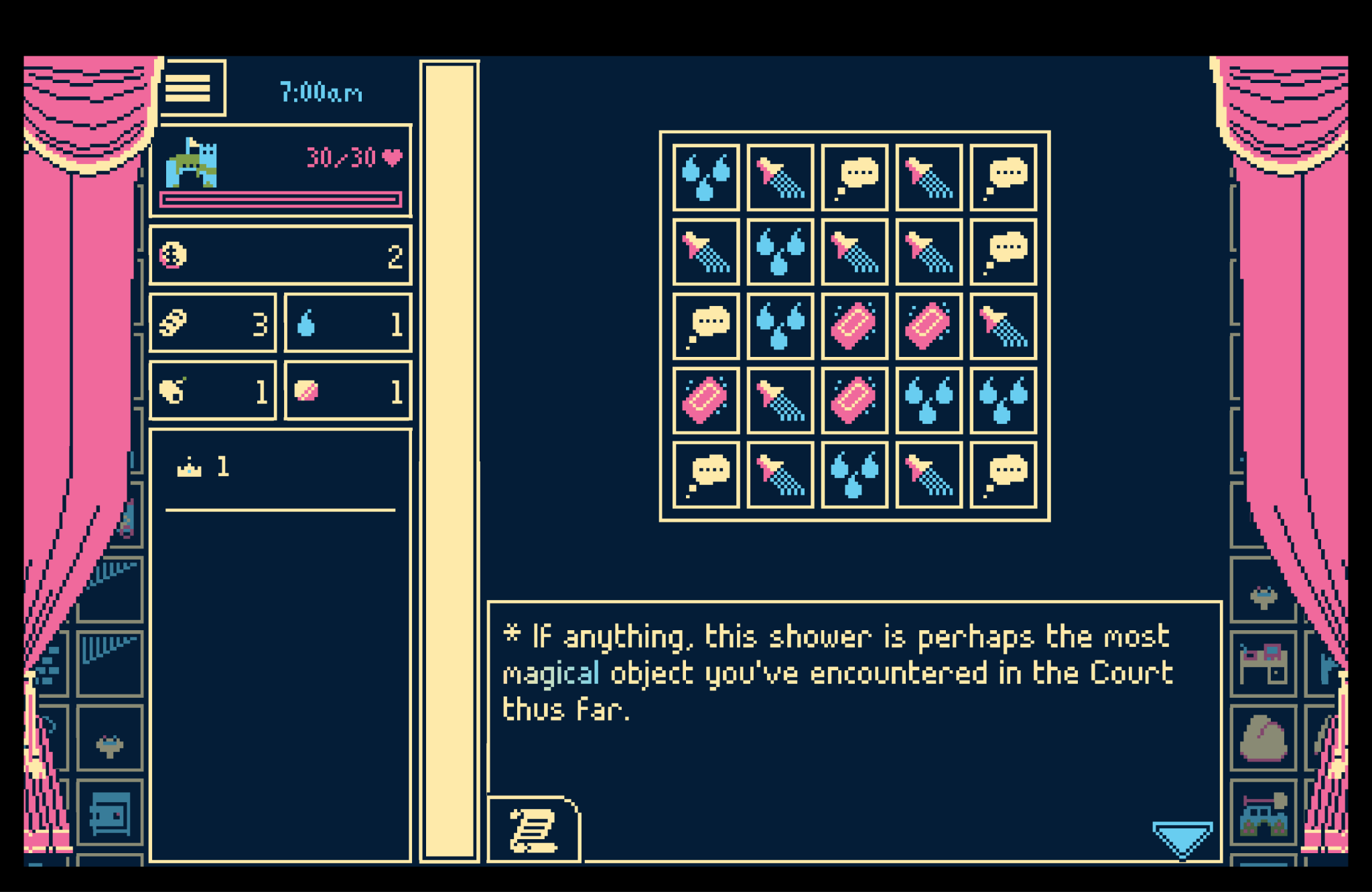
One example of the over-awareness is the shower scenes, wherein your character can take a shower and play some match-3 to have thoughts. These are optional and after you do a few of them you realize they’re for players who are having trouble with the game to get tips. Though my win/loss record certainly qualified me as “having trouble,” I only found a couple of these tips helpful. More often, I felt they were occasions for the game to explain a mechanical idea to me too fully, in the way a game designer might consider to themself: “ah! what if a player did this?”
Or, another example. The player turns into a mirror. Then the game dwells on what it means to be a mirror, already kind of a self-evident metaphor, in two scenes before musing for a bit on social anxiety, then undercutting its own seriousness by saying, “You’ve kinda always been a freaking mirror!”
Rebekah Valentine’s interview with AP Thompson reveals parts of the game are modeled after Thompson’s experiences, including the joke that cars aren’t real. Thompson himself appears in game in grainy footage to sing to you, for longer than is comfortable, about salmon sex. At the same time, Thompson has said the game isn’t a personal story. This left me curious about what’s with Titania Maincharacter, “abducted human person.” If she’s not a stand-in for Thompson, is she her own full person, or something else?
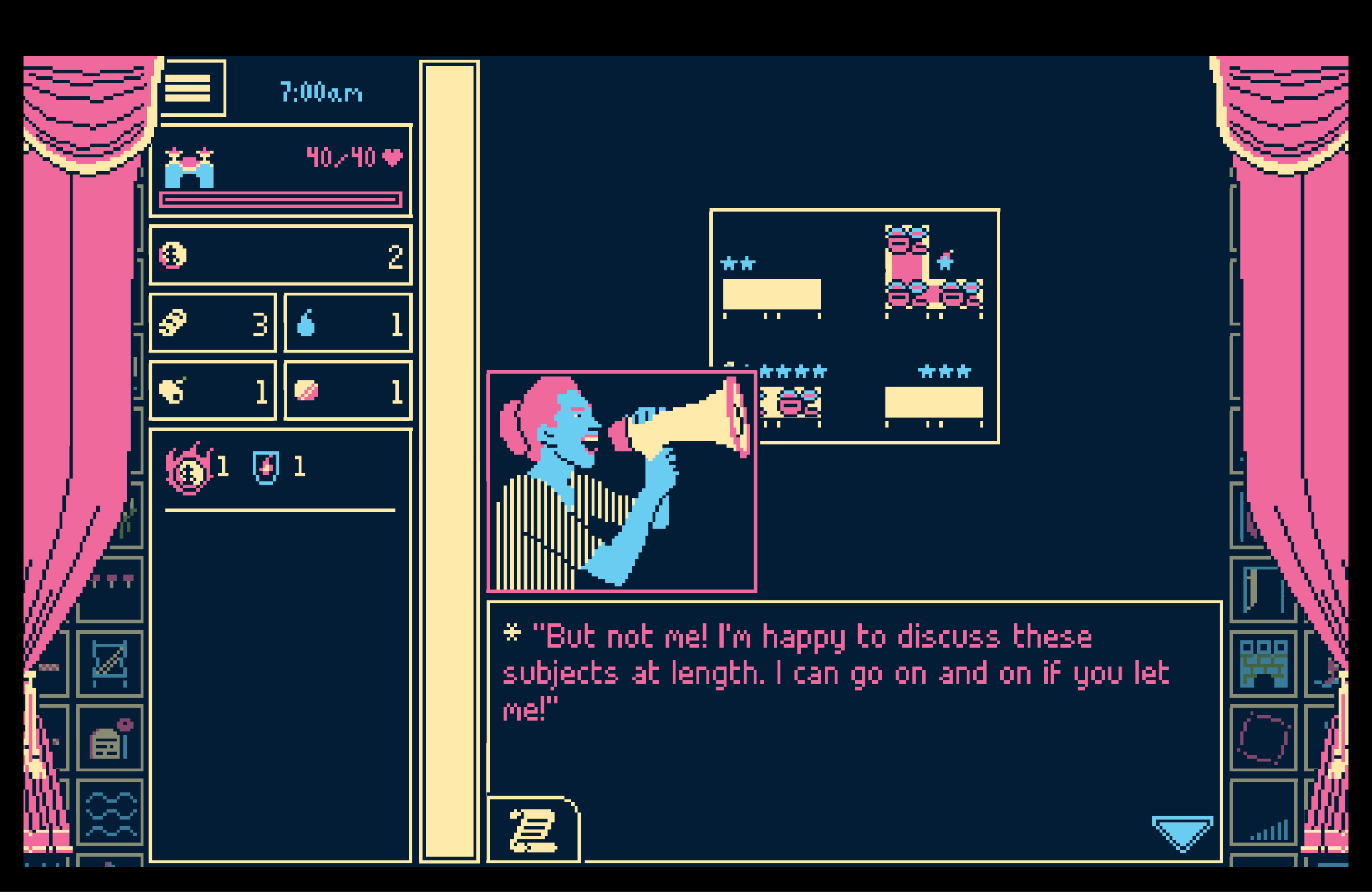
To me, beyond being an appropriately skeptical transplant to unreality, probably born in the 1980s, and liking a cigarette, the player character is no one, really. (Ok, she also turns into a giant squid monastery at night.) I thought the game wanted her to be a signifier of the player’s mysterious displacement and the strangeness of the faerie world, a normie with just enough quirks to make her seem like a person. So, it was funny to hear Thompson speak about her character development in that interview, particularly that at the beginning “the game wants you to think of them as this classic ultimate chosen one badass hero.” Then, he says, the actions of the main character imply a more complex and less motivated hero than we see at first; that in general, her actions “let the character tell you who they are.”
Well, I believe Thompson thinks the game does this, because he is saying so in this interview. But my view of the main character from the start was a figurehead in text and game both, reluctant from the start, and, if not a blank slate, not far from one either – and furthermore, I thought this was on purpose. I find it limiting, not surprising, that her attributes are mostly tied to game mechanics. To restate that: I and the game’s creator view the main character quite differently, as a nonspecific symbolic stand-in and a characterful, flawed hero, respectively. How did our opinions diverge so much?
In my opinion, it’s because of how most of the main character’s issues are discussed: they’re little jokes. The game will bring up serious topics and discuss them empathetically, but ultimately undercut their vulnerability. My most relevant example is the potion of liking baseball, which is introduced to the player as a remedy for the main character’s occasional violent intrusive thoughts. Magical CBT replaces them with thoughts of baseball. From that point on, the potion becomes a joke. I don’t need the Queen’s mental health to be vigorously discussed, but at the same time the scene felt like Titanium Court was easing up to some meaningful comment on the subject, then backed off. Anxiety is a tough topic; I get the sense a lot of artistic people want to represent it, yet doing so can feel raw and awkward. In this case, I wanted this real moment to linger and not be diffused by a humor break.
I don’t mean to suggest this distance was accidental or subconscious. In fact, it seems intentional. But the game’s humorous remove often came across as defensive, as though through shifting between seriousness and humor, the game was trying to control my experience, keep me happy, or maybe keep me away from something vulnerable. I can understand that, or at least the last part. But if you’re worried about getting too real, then why be vulnerable at all? I know this game can be sincere. That sincerity pops out from time to time. But it’s only given a moment; then it’s time for a joke.
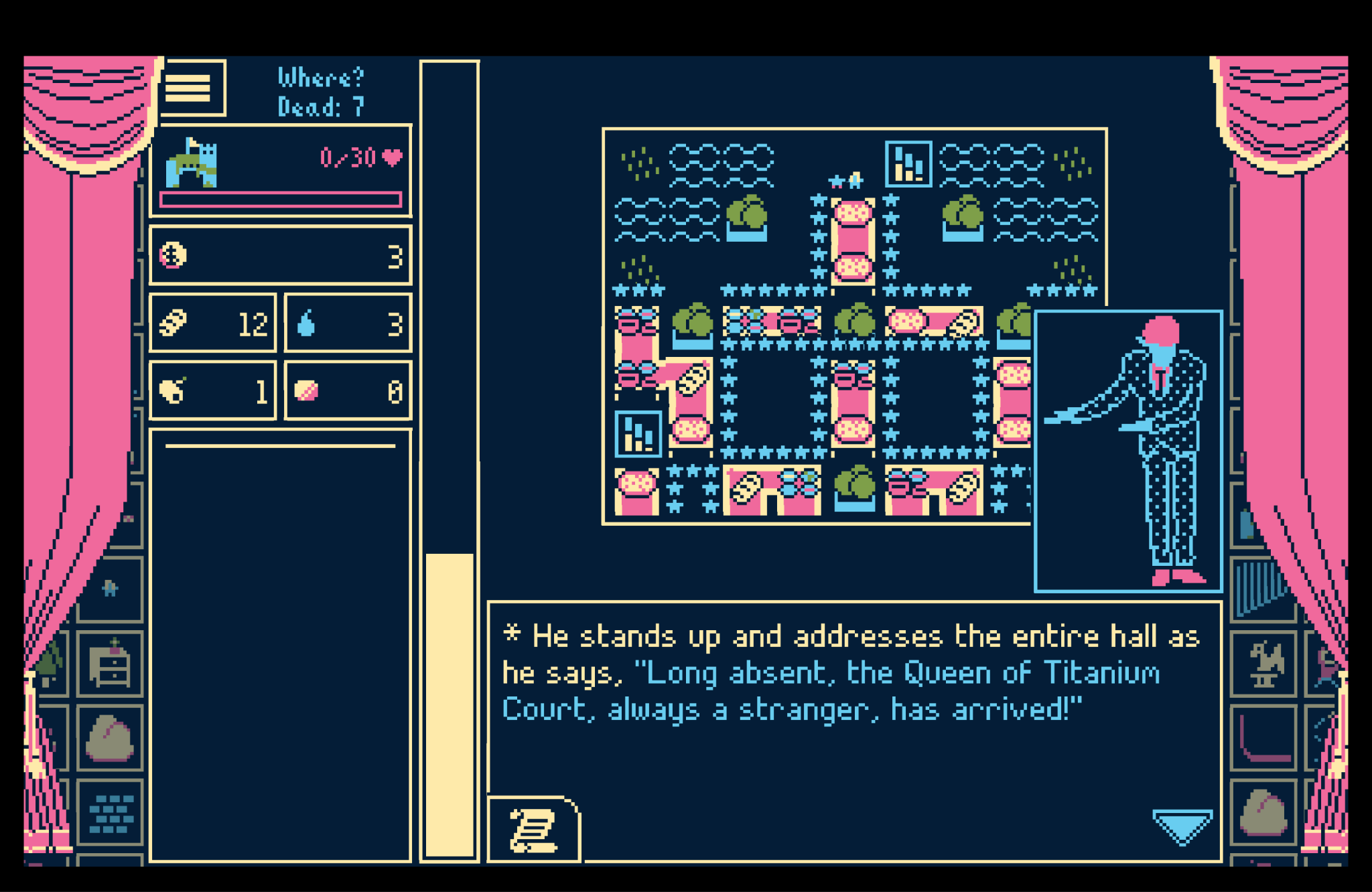
It’s untrue to say this game didn’t provoke any emotions in me. One emotion it provoked: terror. I felt genuinely afraid at several points while playing Titanium Court. But that feeling was provoked by the music, the pixel art and particularly the use of negative space, and the established restrictions of gameplay, not by the story. And in fact, learning about the story was counterproductive; it made me less interested and less emotional. I also loved, loved the text adventure exploration. It taught me more about the nitty gritty of faerie society, which was my favorite part of the writing, while leaving other parts of the world delightfully unexplained.
But unfortunately, a mid-game twist decides to limit this, a decision which I found frustratingly precocious. At some point, a character explains to you that your presence in the world is a malevolent force, that you (player and character) are draining the Court of its mystery and life. And with this, I felt my interest in the game similarly draining away. The twist is a commentary on the extractive attitude it’s common to take to games, which are supposed to be a player’s everything, infinitely playable and impossibly new. But to me, it also felt reactive to an imagined opinion of what someone playing the game might think: a fear that a player might get bored with the gameplay and that by narrativizing the inevitable slide into repetitiveness of a roguelite, you could get ahead of that potential critique. I found the twist defensive, as though the game were daring me to find some part of it repetitive or bland. “See!” I can imagine a pastel faerie face saying, “this is all part of the plan!” Unfortunately, I rejected the lesson.
The game overexplains in many cases. It does it in the shower scenes, in the occasional jokes that go on too long, and in this narrative twist that pulled me out and never pulled me back in. And one could call this part of the intention— an advantage of building your game around a twist that inversely relates how long you spend in the world and how much you “get out of it.” Except that when you structure your game with the intent that it will slowly degrade and become less vibrant, the player still has to play that game, and the cracks might show much earlier than you’d like them to.
Titanium Court is very good at evoking imagery and associations that provoke strong feelings. Any game alluding to, without retelling, a Shakespeare play has to be. It’s also good at reflecting what the critical press values: skilled writing, introspection and unique gameplay concepts. But the original narrative that fills the associative gaps works less well than what surrounds it. It lives in the world of signs it depicts, its players lit for an instant by the flash photography of genuineness, then plunged back into walking shadows.
———
Emily Price is a freelance writer and digital editor based in Brooklyn, New York, and holds a PhD in literature. You can find her on Bluesky.