The Weight of Starting
Visit the MIT Press shop
A Heavy Morning does not ask you to overcome anything. It asks you to begin.
That distinction matters. Many games about mental health reach towards metaphor – the platformer where anxiety is a mountain, the puzzle where depression is a labyrinth. They give invisible experiences a shape, a structure, a way to be held. The experience gains a shape it never had. Eventually, it becomes winnable.
Creator Mays Dweiri thought about this problem before she made a single level. A Heavy Morning started as an animation. She abandoned it early. “I quickly realized I needed that core element of interactivity,” she told me. “Giving the viewer agency brings so much more to this specific story than leaving them as a passive spectator.” The interactivity was not a feature. It was the argument.
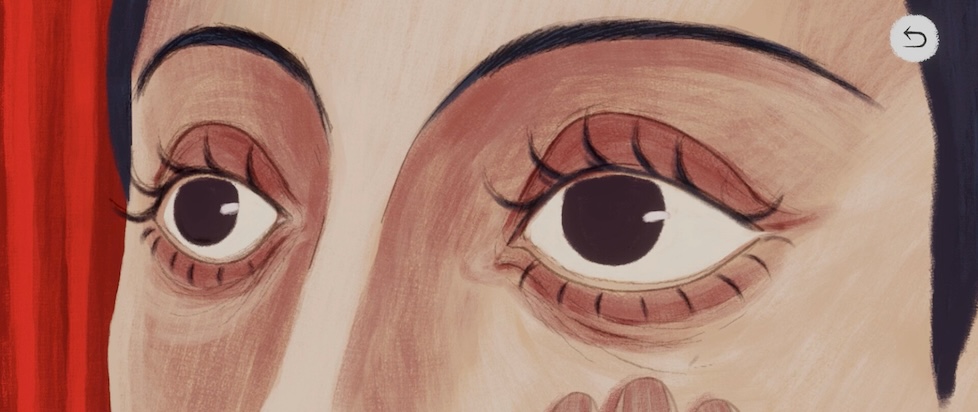
The design reflects that clarity. Dweiri separates the literal from the metaphorical into two distinct spaces. Reality is grounded and mundane – getting out of bed, brushing teeth, crossing a room. No abstraction until the Ghost intrudes. The Mind Space is an abstract environment where distorted thoughts can be reordered by hand. The boundary between them is the design. Keeping them separate is what prevents either from betraying the other. “Mental health struggles are incredibly real, but they are also completely invisible,” Dweiri said. “Our guiding challenge was figuring out how to make the invisible seen, without ever falling into the trap of stereotyping or romanticizing mental illness.”
Other games have approached this differently. Getting Over It with Bennett Foddy builds its entire structure around frustration. Progress is possible but never stable – each movement carries the risk of undoing everything. The game does not explain what frustration feels like. It manufactures it, directly, through the hands. There is no metaphor mediating the experience. The player is not reading about someone who cannot move forward. They are the person who cannot move forward.
Celeste takes a different route. Its platforming is precise and demanding, framed around a character’s anxiety and self-doubt. Failure repeats, but the game absorbs it – each attempt is immediate, the checkpoint is close. Falling does not send you back into despair. It sends you back to try the same moment again, with the same tools, until the body learns what the mind resists. Struggle becomes repetition. Repetition becomes discipline. Both games make internal states playable by containing them within systems that eventually yield.
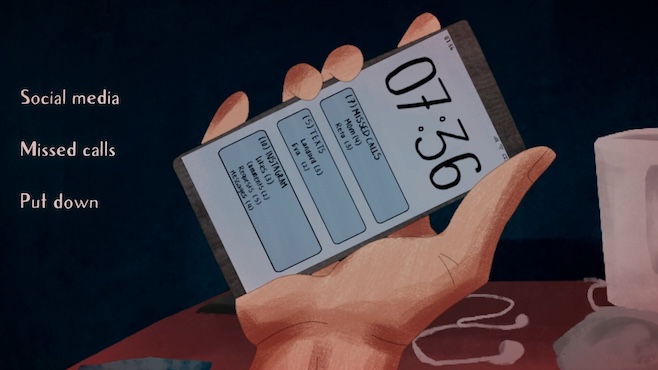
A Heavy Morning refuses that yield. Where Getting Over It weaponizes frustration and Celeste transforms it into momentum, Dweiri’s game stays inside the feeling without redirecting it. “You can’t speed-run or optimize a heavy mental state,” she told me. The reward system follows that logic. “Mental health doesn’t work like that – you don’t just complete one breathing exercise and instantly cure your mood.” Going back to bed is not failure. It is trying again. “True failure only occurs if the player loses motivation and quits the game entirely.”
That redefinition is not a design conceit. It is the point. Mental health does not follow game logic – no clean progression, no moment where you get good at it. A Heavy Morning stops pretending otherwise. Progress here is not mastery. It is the fact of still being inside the experience.
What A Heavy Morning reveals is not a limitation of games as a medium. It reveals a limitation of what we expect games to do with difficulty. We are trained to expect that systems produce growth, that friction eventually yields. This game builds its structure around the possibility that it will not – that the morning takes everything and leaves you where you started. That is not a broken promise. It is an honest one.
Each player’s repetitions make a different film, Dweiri told me. The piece only becomes complete once it is fully played.
That is not metaphor. It is what it means to begin again.
———
A Heavy Morning is currently in development. This piece is based on an interview with its creator, Mays Dweiri.
———
Filipe Urriça is a games critic and columnist based in Portugal. He writes about videogames, culture and the spaces between them at Artesanato da Diversão. Find him on Bluesky at @filipeurrica.bsky.social.