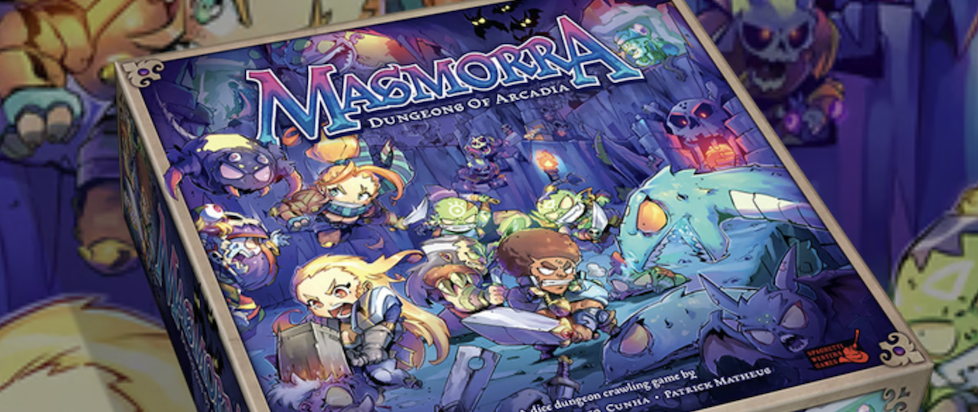
Roll With It: Kicking Monsters and Taking XP in the Dungeons of Masmorra
Visit the MIT Press shop
I see board games in the store and they always look so cool and then I buy them and bring them home, I’m so excited to open them, and then I play them, like, twice… This column is dedicated to the love of games for those of us whose eyes may be bigger than our stomachs when it comes to playing, and the joy that we can all take from games, even if we don’t play them very often.
———
In the column that introduced the concept of Versus Mode here at I Played It, Like, Twice, I covered Arcadia Quest, a 2014 game from column regular CMON. But Arcadia Quest isn’t the only game that CMON put out using that same universe – or that same art style.
Anyone who, like myself, is addicted to at least the idea of the dungeon crawl board game will have run into the core problems inherent in such games. One is that they’re usually expensive, being held in large boxes and often crammed to the gills with board tiles and miniatures – especially when you’re talking about a game from CMON, who seem to be a constant race to see how many minis can be packed into a box without breaking the shelves at your friendly local gaming store.
Another is that they’re simply too complicated. Setting up a dungeon crawl board game can often take upwards of an hour, and actually playing one frequently takes much longer than that.
As such, in the years since the advent of games like HeroQuest and its various descendants, a number of attempts have been made to, in various ways, streamline the dungeon crawl. Indeed, the earliest of these, 1975’s Dungeon!, actually predates HeroQuest by more than a decade, and a variation on the theme is still in print today.
These streamlined approaches have enjoyed… let’s say varying amounts of success, and have explored just about every conceivable permutation of simplifying the cumbersome format of the bog-standard dungeon crawler. In almost every case, this begins with an elimination of at least some of the miniatures and other gewgaws, which helps to make for smaller boxes and, with them, commensurately smaller price tags.
But anyone who has played even a really excellent dungeon crawler knows that the rules in those things aren’t exactly friendly to a casual game night, either. Like the RPGs they set out to ape, they demand a certain amount of commitment.
Hence, these streamlined games usually do more than jettison bits and bobs. They also tend to simplify the rules, which often means rendering the mechanics of the dungeon crawl down to its fundamentals, in one way or another.
In Dungeon!, this mostly means eliminating much of a pretension toward plot and simply making the game a race to collect as much treasure as possible and get out of the dungeon alive – the essence of a dungeon crawl, if ever there was such a thing.
In Masmorra, treasure is replaced with XP. Since it’s a spin-off of Arcadia Quest, Masmorra does more than merely crib from that game’s aesthetics and jokey tone, it also borrows the player-versus-player “Guild” dynamic that is probably the feature that most sets Arcadia Quest apart from a sea of similar dungeon crawlers.
Here, however, you have some choices. Basically, there are two (and a half, really) ways to play Masmorra. In the “standard” version, each player chooses a hero, a hand-picked representative of one of the aforementioned “Guilds,” who is venturing into the eponymous dungeon beneath the city of Arcadia in order to gather as much XP as they possibly can. Like Dungeon! before it, this version of Masmorra is, in essence, little more than a race to collect a resource – treasure in that case, XP in this one.
There is still treasure in Masmorra – where would a dungeon crawl be without it, after all – but it primarily takes the form of a variety of cards that execute specific effects, usually to trip up opposing players. And that’s the first key difference between Masmorra and many other games of its type: there’s nothing remotely co-op about the standard mode. Sure, you’re all down there in the dungeon together, fighting monsters, but what you’re really up against are the other players, as you try to race them to collect the most XP.
However, Masmorra has a second gameplay option: “Alliance” mode, in which you all team up and try to stop an evil wizard who has taken over the dungeon beneath the city. This version plays more like a classic dungeon crawler and uses its own deck of less-antagonistic treasure cards. XP is still important, though, as you use it to go up in level and unlock new abilities for each character.
Alliance mode is the only way to play Masmorra solo, either controlling several characters at once or simply taking one and delving into the various rooms and hoping for the best. But wait, I mentioned two-and-a-half ways to play, right? That half is for those who want a bit of both worlds.
“Epic” mode allows you to go head-to-head against the other players, vying for XP and using traps and treasures against one another, while also trying to take out the big boss at the bottom of the dungeon.
Alliance and Epic play a lot alike, except that in Alliance, if even one character kicks the bucket, the game is over. In either Epic or standard versions, players who die basically just lose a turn, so that everyone can get back to conniving and back-stabbing their way through all the traps and monsters that litter the dungeon.
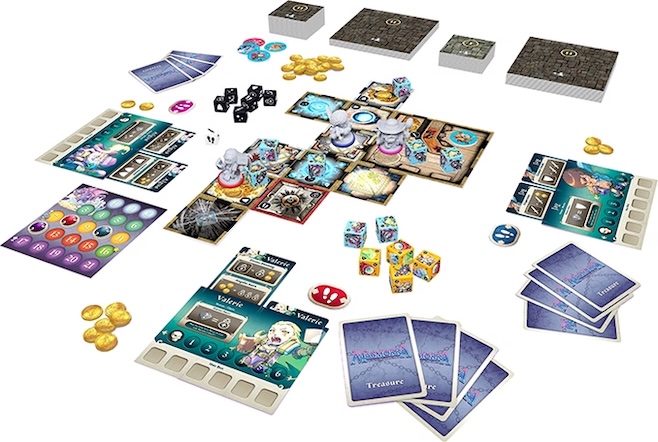
The monsters are the other big place where Masmorra stands out. Like most of these games, everything in Masmorra is about dice, but you don’t roll dice to fight your enemies, or disarm traps, or anything like that. Instead, you roll a set of six-sided dice with proprietary symbols on all the sides. Whatever you roll is essentially the arsenal of symbols you have available to complete whatever actions you’re going to try to accomplish that turn – not dissimilar to how dice work in Massive Darkness, another dungeon crawler from CMON.
Combat symbols can be used to fight monsters, while shield symbols help to defend against them. But opening treasure chests, disarming traps, and activating your hero’s special abilities also require specific symbols. That’s not the monster part, though. The monsters don’t roll dice at all. Instead, they are dice.
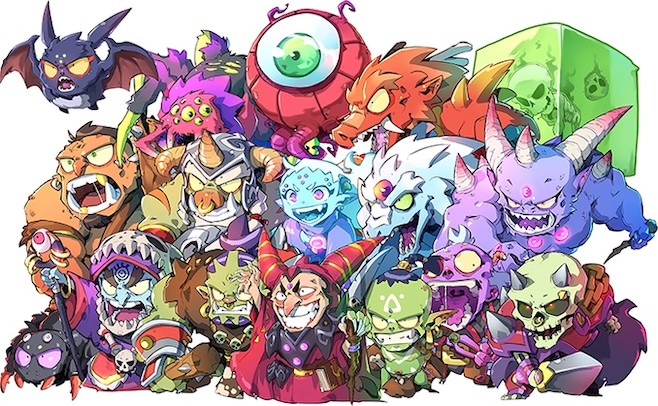
Whenever you enter a room with a monster spawn symbol, you roll a monster die. The monster dice are also six-sided, with each side representing a different monster. Whatever monster comes up, that’s what spawns in the room.
The art of the monsters is done in the same exaggerated, cartoony style as the art from Arcadia Quest, but it works better for me here, for whatever reason. This may be as simple as because it is hardly ever drawing people in this case and is, instead, usually illustrating Beholder-alikes, gelatinous cubes, and other popular dungeon denizens.
When it comes to ways to streamline the dungeon crawl into something a bit more manageable, Masmorra works perhaps surprisingly well, and I actually liked it quite a bit better than its more ambitious sibling.
Also, those monster dice are adorable.
———
Orrin Grey is a writer, editor, game designer, and amateur film scholar who loves to write about monsters, movies, and monster movies. He’s the author of several spooky books, including How to See Ghosts & Other Figments. You can find him online at orringrey.com.