Strategy and Predetermination with the Bangaa in Ivalice
Visit the MIT Press shop
This column is a reprint from Unwinnable Monthly #198. If you like what you see, grab the magazine for less than ten dollars, or subscribe and get all future magazines for half price.
———
Thoughts about being something else.
———
Honestly, I remember focusing more on building up a fighting clan of bangaa, viera, moogles and nu mou than trying to follow the story of Marche and the other human children like him in Final Fantasy Tactics Advance. Sure, I was also a human kid like Marche when I played the game, but there was a plethora of way more interesting nonhuman character options to explore. Every bangaa, viera, moogle and nu mou living in Ivalice sparked my imagination more than most of the drama with Marche. Their visual design is endearing and whimsical whether drawn out as lines or rendered in pixels. Now I’ve learned that the FF Wiki credits FFTA’s character design to Ry?ma It?, backed by a whole host of other art team members in animation and other areas.
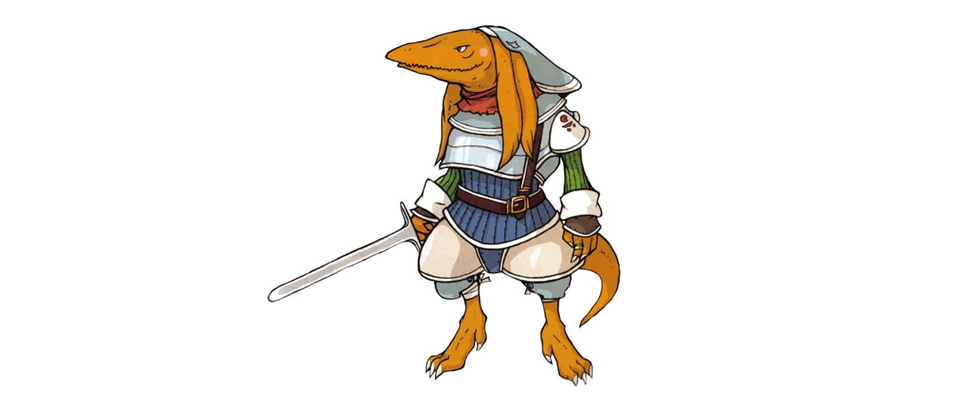
Out of all the nonhuman options in FFTA, I favored the bangaa the most. While recognizably reptilian – already a plus – I found that there was something delightfully different in how they approached a reptilian design. I’m not used to reptilian characters having something like visible ears, but they had long, vaguely frill-like ears hanging down that drew my attention. The particular way the shape of their snout rounded out felt new to me. In retrospect, the curve of their snout reminds me a little of a bull terrier dog. Some fans have expressed how they miss the reptilian bangaa in the games. Though ironically, direct comparisons to lizards are apparently seen as an insult to them. But perhaps it depends on context in Ivalice. There could be a difference between neutrally observing that they look reptilian, and calling them lizard as if it were a bad name.
While I built my clan with an eye toward nonhuman aesthetics, I also thought about – partial title drop – each character’s tactics. Generally, FFTA has bangaa as the brawlers, nu mou on magic, moogles for dexterity, viera even quicker. At first, FFTA seems to do the thing that’s in plenty of media, like other digital games, tabletop RPGs, books, television, etc. – fictional races are made, and then they’re made to essentially be one thing. Like elves are quick, dwarves are tough, orcs are even tougher. But FFTA does offer a bit more with their bangaa, viera, moogles and nu mou (along with giving them more unique designs). Even if they’re weighted toward a specific style of tactics, they don’t all have to exclusively follow one path. Still, it’s slight wiggle room compared to character boundaries that remain strict, particularly since some of the game’s lore reinforces this division. This is actually text from FFTA’s sequel, but the gist of summarizing the bangaa is pretty much the same as in the original: “Scales cover the bodies of this reptilian race. Muscled and powerful, bangaa are physically imposing. Their rough, bellicose temperament leads them to pursue warrior-like jobs.”
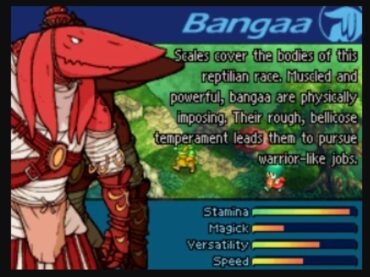
The description of the bangaa in Final Fantasy Tactics A2: Grimoire of the Rift
While that lore seems set in stone, in FFTA’s gameplay, bangaa can actually pursue a more magic-driven vocation; it’s not impossible for them. All the races in FFTA have access to only some jobs at first, but as they level up, they can unlock new job options. A bangaa can be a warrior, white monk, bishop, defender, dragoon, gladiator, or a templar. And if you want a bangaa to really specialize in magic instead, there’s one path they can pursue later – the bishop job. As a bishop, a bangaa focuses on casting magic to heal, attack and defend.
It’s not just the bangaa. Featuring a rabbit-like redesign that I personally find more appealing than their usual look, moogles in FFTA are physically the smallest of the playable characters, with the FF Wiki stating that their smaller size makes them more skilled in dexterity-based jobs like thief and gadgeteer. But if you want your moogle to pick up a sword and fight on the frontlines instead, they can become a mog knight. And while the nu mou are framed as the most specialized for magic, their potential job as a morpher offers some chance at diverging into more close-quarters combat. A nu mou morpher still wields magic, but uses it to shapeshift into a monster and fight as one. Viera – actually, viera have some more versatility built into them from the start. Their first jobs roughly break down into picking up either a rapier, a bow and its quiver of arrows or a magical staff – meaning they can do close-quarters melee, ranged, or magical combat. They’re the only characters to get a third level of job options (summoner and assassin), while the others stop at two.
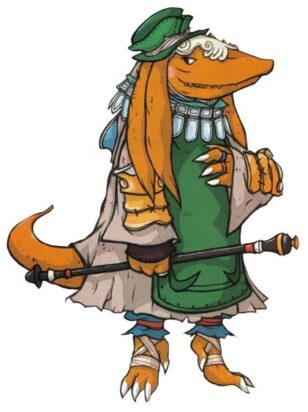
Bishop is the only job a bangaa can get to truly focus on using magic in FFTA.
While FFTA seems to aim for variety in character options, why do the viera apparently get this much more than the others? Perhaps it lies with their design on a subconscious level. Despite the rabbit ears, the viera are still the most humanoid of the nonhuman races – and humans still have the most job choices in the game, even more than the viera. (Humans may stop at two levels of job options, but their total number of possible jobs is still higher.) And when comparing the viera to the also rabbit-like moogles, the moogles push the rabbit aesthetic more with the size and shape of their body. On top of that, their smaller size is used as rationale to dictate some of the jobs they can take, even if their possible role as a mog knight exists as a point of divergence.
Humans start and max out with the most job options, while viera and moogles and the others have less, but there’s no tie at the bottom — at the bottom there’s only the bangaa, with the least amount of job paths. FFTA has exactly two points representing the top and bottom in terms of job growth, human and bangaa. Fictional anthropocentric vibes are here. But why are the bangaa the lowest, why aren’t they even tied with any other race for the smallest number of jobs? Perhaps a remnant from old tales of humans slaying dragons, of defeating the monstrous and “the ugly,” of distrusting lizards and snakes and the like. The draconic, reptilian bangaa may be playable, but apparently can’t be on entirely even ground with the others, those traditionally cute moogles, traditionally gentle nu mou, and traditionally beautiful viera. (Even though in the actual story campaign, a nu mou is one of the antagonists.)
FFTA doesn’t actually assign strict moral alignments to their fantasy races, which is nice – and yet it almost feels like the bangaa are treated as if they might’ve been seen as “the always nasty race” before, and that despite current efforts at neutrality, more subtle hints are still made to dismiss them. And while the bangaa may use magic as a bishop, the FF Wiki asserts that they’re not as strong as magic casters from other races. The bangaa can do magic, but apparently, they’ll always be the weakest in it. According to the FF Wiki, it’s said that their “rough vocal cords make it hard for them to chant spells.” Still, FFTA chose to make that part of the bangaa. It didn’t have to be that way.
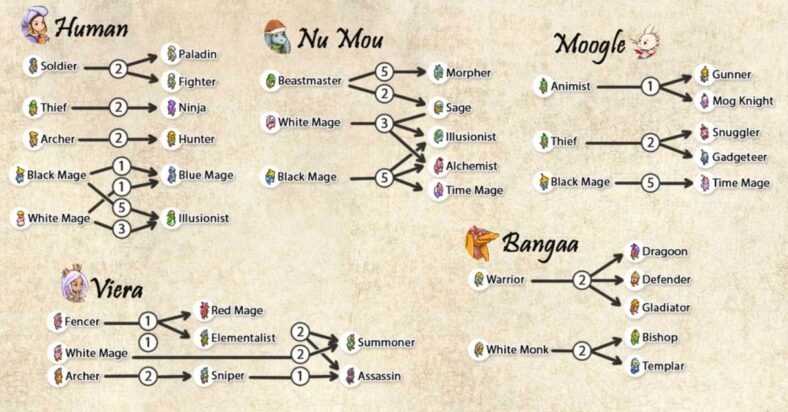
An infographic of the game’s job tree from an FF Wiki.
Regardless, the bangaa get a chance at magic. They don’t have to only be the warrior all the time. They can push back even a little at the in-game text that says their size and strength strictly dictate their temperament and job opportunities, as well as the in-game systems that mostly reflect that description. The slight exception in the bishop class that lets the bangaa challenge what’s written about them. It’s a small divergence, but it’s there. And it’s untapped potential for exploring something more. Because even with this, it looks like the bangaa still get the short end of the stick in FFTA. But their potential remains. (And maybe it’s explored more in later games like FF12 – but that’s another topic while this one will remain with looking back on FFTA.)
And in a way, the bangaa can be reframed in FFTA too. Less jobs? Less choice paralysis in a game, easier to make a decision, harder to be overwhelmed by a large number of options. Again, they at least have the role as the magical bishop if you want them to be something other than a martial fighter. And I’ve gotta admit, I like the tough warrior archetype in fiction. I like reptilian and draconic characters. I like combining those concepts into one character; I like a tough warrior lizard. But to have that be the only option for reptilian characters or any fantasy race? It’s limiting. Allowing for the exploration of more things is also just more fun.
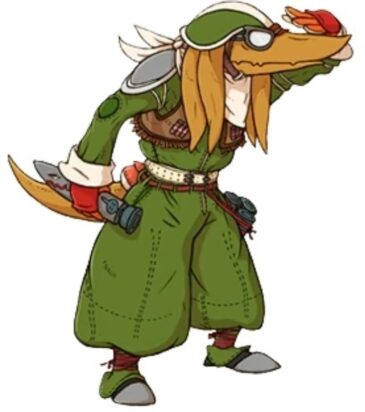
The bangaa get some new jobs like Cannoneer in FFTA2.
The game’s sequel, Final Fantasy Tactics A2: Grimoire of the Rift, does actually make some improvements in this. The bangaa, viera, moogles and nu mou now all get two levels of job options. The bangaa can fill more roles: trickster and cannoneer, with master monk as an upgrade of the bangaa’s white monk job in FFTA. Bangaa tricksters seem to offer another avenue to some magic use and the bangaa cannoneer is the only gunner class outside of moogles, who often monopolize that job. But FFTA2 also adds new character options with the pig-like seeq and vaguely dragon-like gria, and they both have the least number of jobs within the second game. This might be due to a combination of wanting to offer more but still dealing with technological limits. But it also unfortunately comes across as the various fantasy races still being on less even ground with each other. If it’s not the bangaa at the bottom, it’s someone else (though at least the seeq and the gria tie for the bottom).
Despite having some nuance with bangaa bishops, moogle mog knights, nu mou morphers, and more, FFTA and FFTA2 still ultimately draw strict lines between these fantasy races – and as mentioned before, they’re not the only ones. Dungeons & Dragons has a history of this. And looking back, FFTA’s miniature characters and gridded battlefield do look like a pixelated, more colorful version of a D&D session with physical miniatures on grid paper or even more intricate terrain. It’s fitting for a JRPG franchise that drew some inspiration from D&D and other games it inspired, like Wizardry and Ultima.
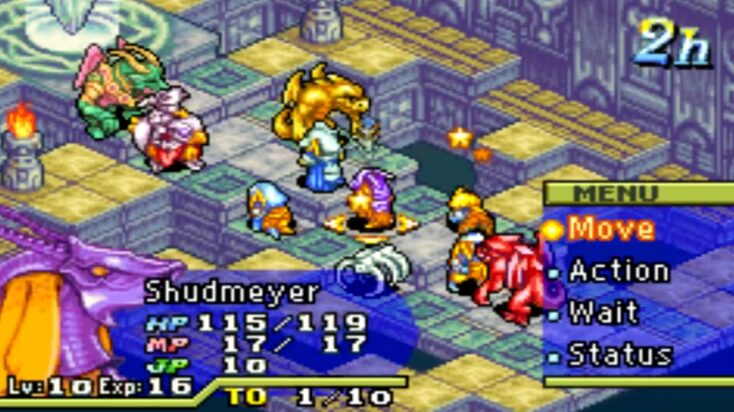
Some people have even played the game in bangaa-only challenges (though it looks like Marche has to be included).
And actually, I find that initially there’s something neat about looking at the different profiles of fantasy races in games and other media. Like perusing the sections about animals in illustrated encyclopedias. I suspect that some interest in animal taxonomy is a factor, and that nonhuman characters in fiction – especially those with animal-like traits – inspire thoughts of building something similar to those animal taxonomies for them, whether subconsciously or consciously. And nonhumans with animal-like features can inspire thoughts of how varied physical biology can really be. For instance, an elephant is just physically stronger than a mouse. What if there were differences like that among sentient fantasy races? What if one fantasy race was simply that much physically stronger than another fantasy race? What if there was a fantasy race with the strength of elephants while another one had the strength of mice?
But there’s also a difference between fantasy races meant to be sentient groups and fantasy creatures meant to be non-sapient animals. Final Fantasy’s viera archer is different from the game franchise’s chocobo mount in terms of sentience and society. So sentient fantasy races shouldn’t get too boxed into strict taxonomies. (And even individual differences among non-sapient animals could exist to a greater degree, but that’s also a different topic.) If there’s a fantasy race, there’s the expectation that they have their own fantasy culture. And culture is important. And culture isn’t and shouldn’t be literally tied to biology. They are different things.
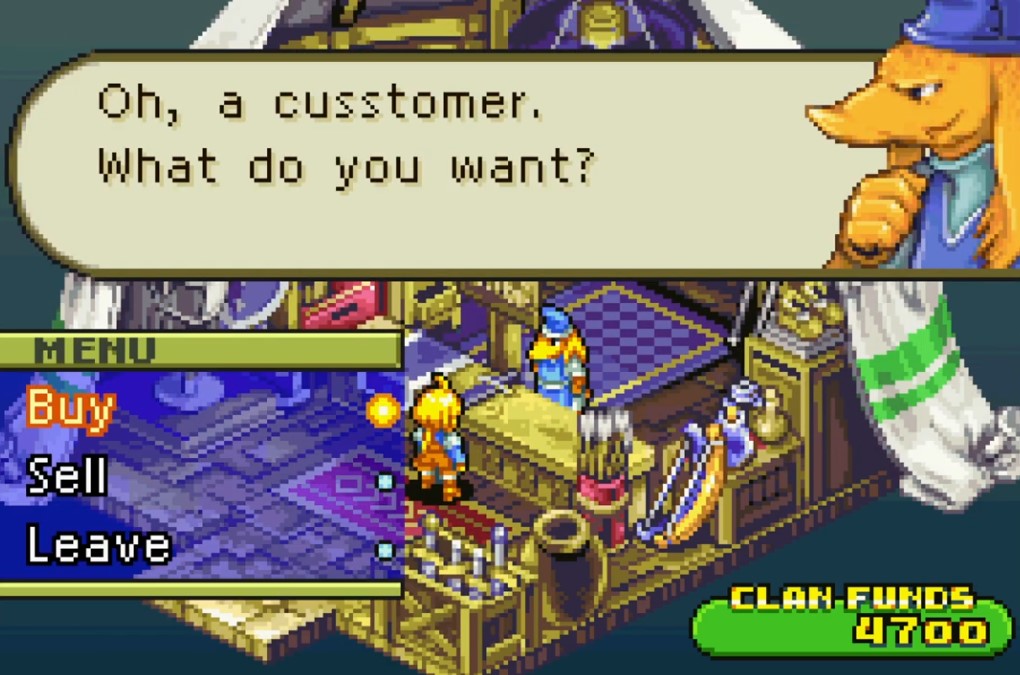
In another bit of some nuance, there’s an NPC bangaa shopkeeper in FFTA. (Regarding “cusstomer” in the dialogue box — according to FF Wiki, the bangaa elongate the sound of the letter “s” when they speak, in a clear reference to a snake, another reptile.)
D&D has grappled with this. Other newer TTRPGs have taken this into consideration from the start, like Land of Eem. Arcanist Press made an indie supplement for D&D that aimed to recognize that division, separating those elements in character creation for a publication straightforwardly named Ancestry & Culture: An Alternative to Race in 5e. This separation was their attempt to make character creation more flexible and open in D&D. Its main developer, Eugene Marshall, elaborates on the catalyst behind this supplement in an interview for the podcast Snyder’s Return:
“Well, I think at the root, the issue that a lot of people had with the way fantasy races work, and not just Dungeons & Dragons but many games, is that they ascribe things that really aren’t biological to people’s race. […] ‘Oh, because you have a parent from this part of the world, you must be savage, or you must be extra-smart,’ or you must be this sort of thing, very skilled in that or whatever. But those are just inaccurate, because how one might fight, or what languages one speaks, or what skills one has are quite clearly taught by a culture, not anything to do with race or ethnicity or parentage.”
People might say that they’re fantasy races. If it’s all made-up, what does it matter? But as indicated earlier, on one level, it’s just boring to have a fantasy race only ever be one thing. Shouldn’t something made for fantasy be fun? Where’s the sense of exploration into multiple experiences? Where’s some good old maximalist hijinks, where more is possible? And there can generally be more appeal in fantasy races that blend the imagination with some emotional truth. A draconic group like the bangaa looks cool; it’s even more cool to envision the different interpersonal dynamics they might have among each other, what their culture is like, and how that could all differ for each of them as individuals.
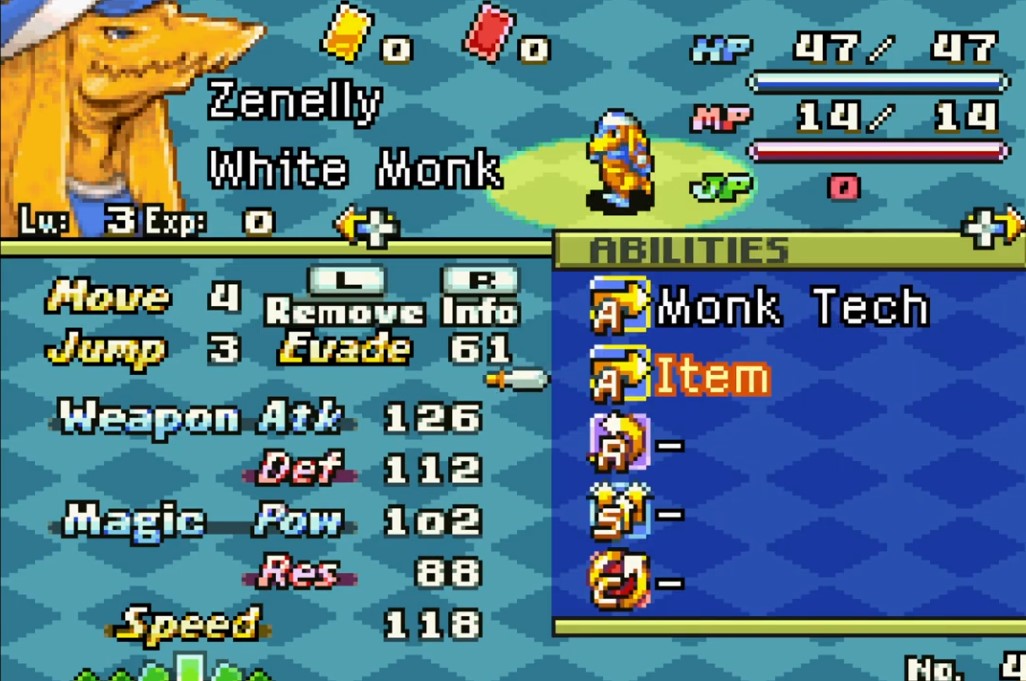
Granted, I sometimes just want to see a fictional warrior culture – where exploring that more action-oriented philosophy in fiction is the point – and I’m not necessarily interested in seeing someone like an office worker pop up from there (outside of the genres of comedy and parody). Yet even then, more nuance and layers to a fictional warrior culture like the bangaa could make it more interesting. What variety can be found in a warrior culture, what boundaries can be pushed, how do philosophical ideals and practical truths interact? There may be those who don’t want to fight, but is martial training still just the baseline for them, as commonplace as walking can be?
And yes – this topic and this perspective on FFTA’s bangaa are also tied to discussions of subconscious bioessentialism and prejudice infiltrating fiction unchallenged. These elements can sneak in, not even to tell a hard story with damning conclusions and the hope for something better, but to instead act as if they’re the accepted norm, whether the creators realize it or not. Bioessentialism can try to hide in speculative metaphor. This can happen subconsciously, unconsciously, without deliberation, without someone realizing since such discrimination has been systemically embedded before and passed off as normal.
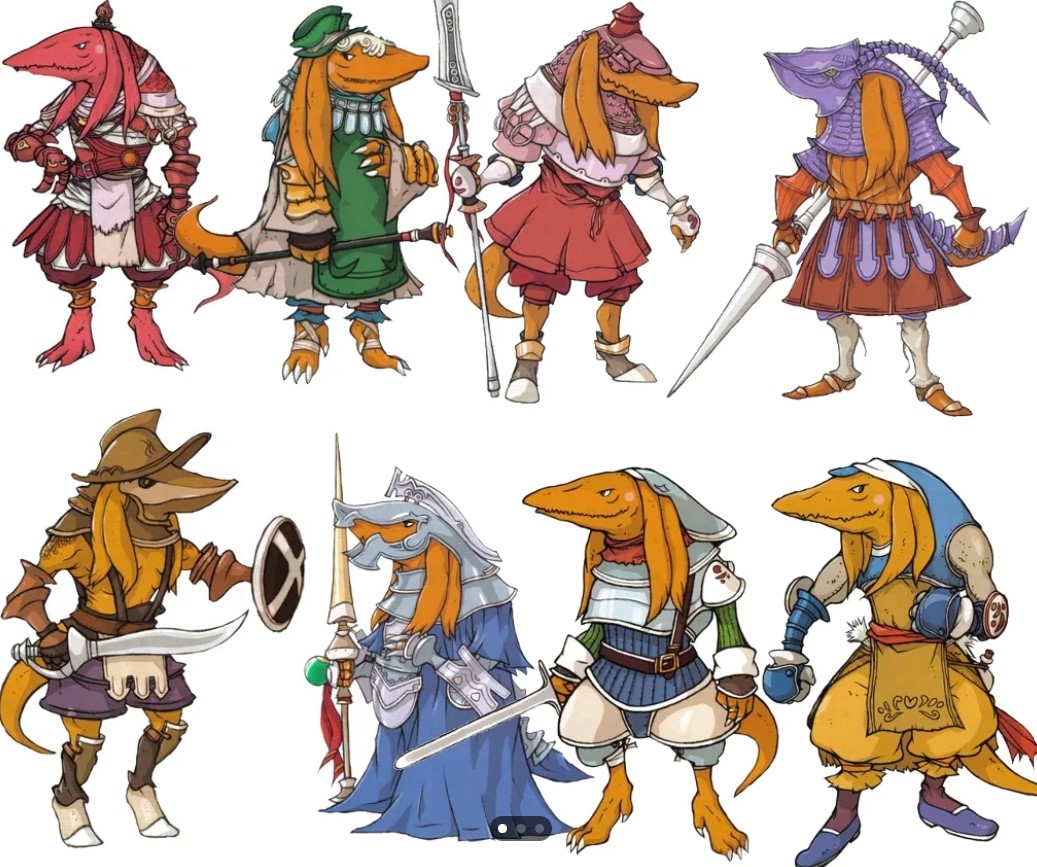
But again, the point can also be made that on the level of narrative entertainment, this narrow-minded approach is just a bore. Or that is also the case with bioessentialism and prejudice; besides the critical harm it causes, it’s also just…boring. It’s boring to think of people as only one thing all the time. Unsurprisingly, an older study concluded that racial essentialism diminishes creativity. A video essay by Extra Credits observes how “broad moral generalizations about species or culture not only doesn’t make internal sense, but it also leads to less evocative, less rewarding worlds in games,” and how that can be addressed with “creative instincts to diversify, deepen, and complicate” the formation of fantasy worlds and their characters, encouraging players to “investigate, explore, and learn.” Instead, a more open mind (and even some compassion) can lead to more interesting things in stories, including the ones in games.
FFTA is not a tabletop RPG, it’s a digital JRPG with more technological constraints, also dependent on when it was developed. Even though its sequel made some improvements with the bangaa, it kept similar issues with the seeq and the gria instead. And still, it seems like FFTA could’ve built in more job options for the bangaa from the start. They could’ve at least started with three jobs, just like the other nonhuman races. They didn’t have to be on the bottom rung alone. And even just tweaks to their in-game lore would’ve been nice. Maybe they’d be just small changes to the text, but they could’ve had a big impact. There could’ve been more creative nuance made more explicit, instead of only gameplay challenging the text a little. Just a few words could’ve presented the idea that the bangaa’s large size and strength didn’t automatically make them rough and bellicose, or prone to quarreling; it didn’t have to automatically make them warriors. A few words could’ve given some indication that perhaps they usually had a warrior culture to go along with their strength. Perhaps a few words could’ve even left the idea that a world treating them with suspicion and fear for their size and strength made them rougher around the edges. Perhaps the world of Ivalice only ever wanted the bangaa to fight on the frontlines.
———
Alyssa Wejebe likes that in Final Fantasy you can ride a giant flightless bird instead of a horse. She also wants to know when the bangaa show up in another game.