Making Jazz out of La La Land
Visit the MIT Press shop
The City of Stars was not built – or written, directed, rehearsed, recorded, and edited – in a day. The almost visceral, emotional gut-punch of seeing two beloved characters draw great compromises for their uniquely distant ambitions through song in Damien Chazelle’s La La Land is a moment covered in the fingerprints of authorial hands and a rich artistic vision. The film, only a decade old, already has a profound legacy with a great deal of critical analysis and intellectual discussion around it. However, my (and my fiancé’s) version of the musical film is tragically underdiscussed, as we bore witness to the disjointed Ruin of Stars, or at least a different city.
Unfortunately (or fortunately) Chazelle’s authorial hands were ripped away from his work, and his directorial vision was blinded when my local independent cinema showed a corrupted viewing of La La Land for Valentine’s Day. This was my first viewing, and I was left assuming that the absence of some scenes and the nonlinear narrative was the intention, presenting a film that was more avant-garde than I had been led to expect by its mainstream success. I attempted to puzzle the film together and delighted in doing so. Afterwards, I found out that I watched a different La La Land than the one that took the world by storm ten years ago, and I had a full refund forced upon me.
Having now seen the film on a perfectly functional DVD at home, I can say that it typically indulges the fluidity and impulsivity of jazz throughout its cinematography, soundtrack, and narrative themes. At numerous points in the film’s opening, the unformed relationship between our protagonists, Sebastian and Mia, is being excruciatingly tested as they fail many chances at formal introductions and create friction with one another before they’re even dating. Justin Hurwitz, and Pasek and Paul compose an enticing and varied rhythm to draw viewers in and sometimes push them away, complimenting the tension and erraticism of these scenes. Whilst Sebastain’s interest in jazz is often dorkily explained by him to amused or tired viewers, the film itself is far more indulgent. The audience is frequently presented with alternatives to the events on screen, leaving an emotional viewer to resolve what-ifs for themselves and decide whether the ending we received was a good one after the credits rolled.
In an inimitable moment, my entire experience with La La Land was unique to me (and my fiancé, of course), and fate had slapped away Chazelle’s meddling hands from the viewing. Early into the screening, Mia expressed a great deal of disinterest in attending a party in the evening after a bad job interview, and then the film cut to her being present at a daytime pool party. This striking cut corresponded with the mundanity and repetition of her everyday, wherein Mia’s friends dragging her to events that she didn’t want to attend was a common occurrence. I didn’t yet know that another version of the film existed, depicting both parties separately and an entire musical sequence to justify Mia’s decision to attend as the right one, and not something that was unjustly thrust upon her.
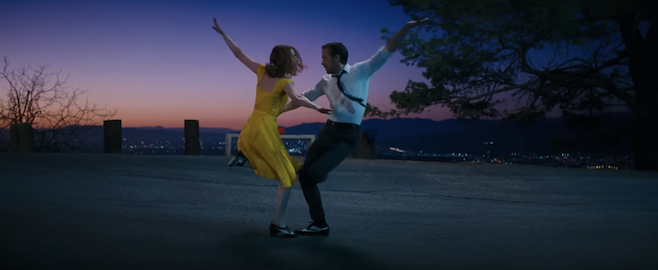
Sebastian and Mia’s relationship was rendered non-chronologically, and the heights of their conflict were interspersed throughout their more comfortable lows. This, to me, felt extremely human. I thought that Chazelle had decisively duct taped me to my seat and held my eyes open, demanding my attention. Where did their problems start? Where do they end? The film’s focal relationship was complicated and untethered by a traditional cinematic structure split into three acts. The characters’ abilities to present intimacy and romance after disruption and stress gave the film a unique grounding in reality, evoking the sense that their relationship was an ongoing source of joy and immediate attention. Our corrupted viewing’s removal of the iconic observatory scene entirely also cemented the tethers that grounded La La Land, holding it close to the floor and tangible reality.
True jazz is unreplicable, as talented musicians make decisive choices in the moment, they guide you through your environment and how to feel about it, grounding you in a single instance. Recording a jazz band’s performance, whilst allowing you to hear excellent music again, removes a significant part of the context that was that singular moment in space and time. Hearing similar jazz performed live again can only be different – not better or worse, per se – as it reflects a unique context to before. Comparison could be the enemy of appreciating my experience, where comparing sandbox games to linear ones, improv comedy to scripted shows, or live music to vinyl are all contrasts that arbitrarily dismiss the powerful invocations of intent craft and irregular experience. I can’t say whether the La La Land that Chazelle intended for me to watch was better than what I got, but I can appreciate the experience for what it was, as a film that I can never watch again.
Missing context for so many key moments had me conjuring up what-ifs for myself, imagining the story I didn’t know. I pondered why Chazelle had chosen to portray some consequences before their corresponding actions, believing that it consolidated the ideas of second-guessing one’s choices and the future they create, and I thought these artistic decisions were incredible.
In a once-in-a-lifetime opportunity, my fiancé and I saw a what-if of the film itself on a date for Valentine’s Day. Jazz was made from La La Land itself, and I was compelled to share our experience with you.
———
Jay Weaver is a freelance journalist and writer looking to go full-time who is constantly looking for new opportunities to write, the products of which can all be found on Linktree. They are a graduate of Biological Sciences at Exeter, and a strong believer that Rain World, Twin Peaks: The Return, Goodnight Punpun, Rango and Mob Psycho 100 are the crowns of all art and humanity’s best achievements.