The Oxford English Dictionary
Visit the MIT Press shop
 This is a reprint of the Books essay from Issue #98 of Exploits, our collaborative cultural diary in magazine form. If you like what you see, buy it now for $2, or subscribe to never miss an issue (note: Exploits is always free for subscribers of Unwinnable Monthly).
———
I’m a bit of a hoarder. Power cables, boxes, books read and unread. My journals are filled with ephemera: ticket stubs, fortune cookie slips, a hospital visitor badge from the last time I saw my mom.
But mostly what I hoard are words. Some I’ve never even used in a sentence: aerumnous, slaunchwise, psithurism.
Words have always been worth hoarding. Saxon poets make up clever metaphors called kennings by combining words in unexpected ways. “Battle-sweat” means blood. The body was a “bone-house.” The sea, a “whale-road.”
One of my favorite kennings is “word-hoard” itself.
When Beowulf needed to convince the Danes he was not an enemy, he first had to unlock his word-hoard. Who hasn’t felt the frustration of fumbling to unlock their voice, or experienced the turn-key epiphany of suddenly knowing exactly what to say?
Just as Beowulf’s words could befriend the Danes, so can ours console a loved-one, wound an enemy or conjure a pizza. Words are worth hoarding because words are magic.
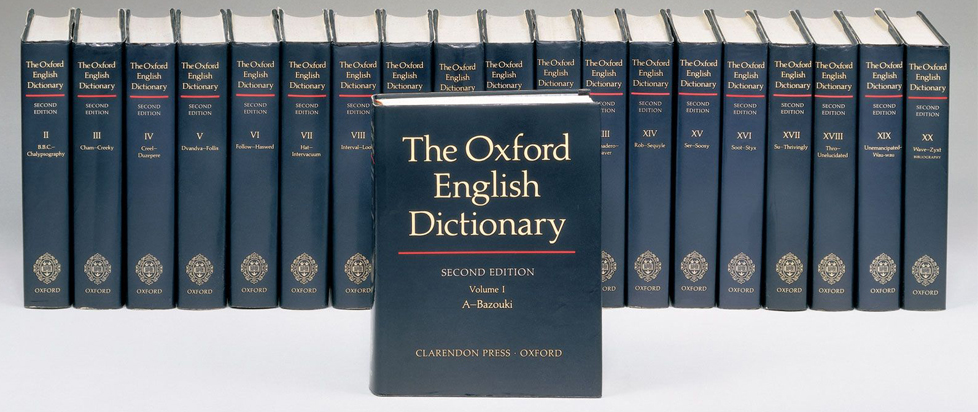
For my last birthday, a friend gave me a two-volume Oxford English Dictionary, complete with the magnifying glass. Even beyond its definitions, the OED’s extensive etymologies deepen words’ shades of meaning.
Have you ever felt distraught? Derived from an archaic past participle of stretch, it means to be pulled in different directions. I picture one of those medieval torture devices, ratcheting some poor soul limb from limb.
If words are magic, then dictionaries are spellbooks.
Thesauruses are even more arcane. From an ancient Greek word meaning treasury or storehouse, a true thesaurus is arranged not alphabetically, but by idea: space, matter, volition, time. From the introduction to my crumbling Roget’s 1946 pocket edition, a thesaurus “is the opposite of a dictionary. You turn to it when you have the meaning already but don’t yet have the word.”
(Don’t get me started on the abomination of a thesaurus in dictionary form. No one has ever needed a more pretentious word for red, or a seventh way to call something important that isn’t.)
Sometimes I go to my thesaurus seeking a word stuck on the tip of my tongue. More often, though, I just flip through its yellowed pages, wandering the halls of the little paperback word-hoard like a burglar until I find something worth stealing.