The Good Cop is a Heretic
This is a feature story from Unwinnable Monthly #198. If you like what you see, grab the magazine for less than ten dollars, or subscribe and get all future magazines for half price.
———
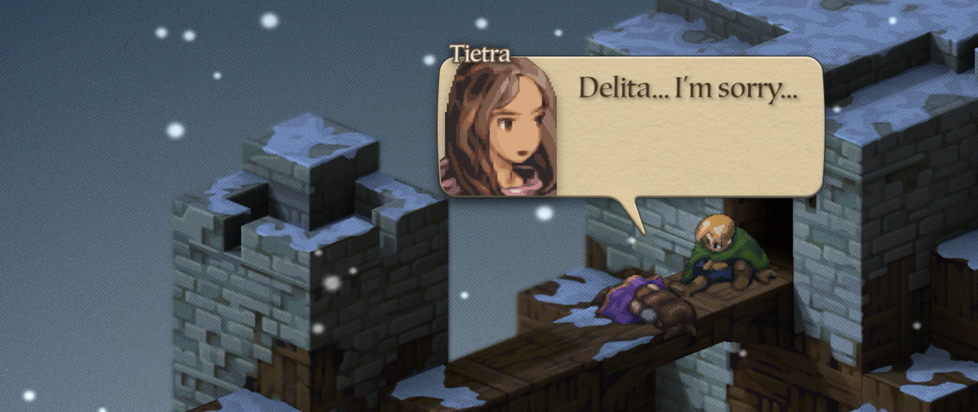
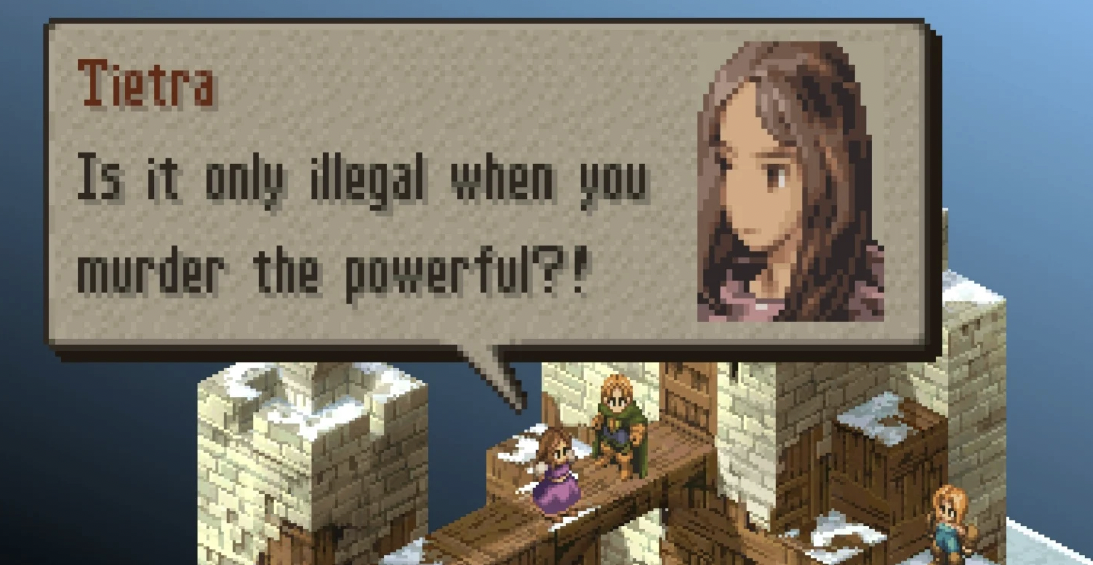
A young woman lay on a stone bridge, painting the snow below in drops of crimson.
The man who loosed a bolt into her chest did so merely so her life couldn’t be used as a bargaining chip by an opposition who had more or less already lost. Their base was surrounded, their leadership scattered and their kidnapping a desperate move against the wishes of people in command.
The woman’s name is Tietra, and she was a commoner. As a commoner, her life had no value, so it meant nothing to the man holding the crossbow to simply kill her as the first step to killing the man who held her captive.
Ramza Beoulve could do little but watch as his brother gave the order that ended her life, and listen to the anguished cries of his best friend as his sister fell to the ground, bleeding into the snow. An order that crushed the life of an innocent hostage in order to lower the risk of death by knights who already had the stronghold surrounded.
For Ramza, this was a moment that shattered his life apart. He watched a member of his family be party to the murder of his best friend’s sister, in service of refusing to negotiate with an opposition that had already lost. No one won any ground, but the ground was painted all of the same. Ramza lost his best friend to a tragedy, and his faith in the actual nobility of his family. Not the title, but the belief in behaving nobly, honorably, in service of justice.
Ramza had been warned, throughout his campaign up to this point, that this was the nature of nobility. That nobles see no inherent value in commoners, that given the opportunity the nobility would discard any agreement or humanity in service of maintaining their power and their prestige. That the system was unfairly and impossibly stacked against anyone who would fight for the commons. That the only way out would be to tear down the system and everyone keeping it together, because the powers that be will just as readily tear them and theirs down, without remorse or care. Ramza doubted it. And in response, his brother issued the order to kill Tietra.

This is the system working as intended, however unfortunate the outcome. That the responsibility one has with a name of merit, with nobility, is to make decisions with others’ lives in service of a greater justice. A greater good. An appropriate use of authority and power. Because the people with that power are the ones who are allowed to decide what is actually “good,” even if it means murdering someone. Even if it’s for a bad reason. Even if it’s someone you care about. Even if it’s unjust.
Ramza moves on from this tragedy by abandoning his name and offering his services as a mercenary, ready to abdicate personal responsibility for his actions by trading death for coin to the very nobles he renounced. If not for luck putting him in the same place as another kidnapping, he may have remained a mercenary. But when the princess he’s contracted to protect is kidnapped by someone he recognizes as his former best friend, he joins the knight company protecting her to get her back, pitting him once again against the coin and callousness of the unjust nobility.
Or, perhaps another coincidence would’ve put him on a collision path with another “noble” injustice. Because over the course of rescuing the princess, he runs against countless bandits, brewing armies, deserters, and scheming heads of the church. His insistence on acting just and for the betterment of man leads to his campaign to resist every party in a growing war, until his family denounces him, his list of allies shrinks to the men and women already at his side, and the church brands him a heretic.
A heresy that makes him valuable to any sword willing to kill him.
This is the system working as intended, however unfortunate the outcome. That the people in power decide what is just is exactly why goodness can’t thrive in a system that’s broken. Ramza exclusively acts on his sense of justice, time and again putting him at odds with people who are willing to sacrifice as many lives as they need to in order to see their system come to fruition. They accuse Ramza of being naive, that trying to do the right thing for every single person makes what’s good for everyone impossible. So, they shut him out, accuse him of heresy and continue to build their power no matter how many lives must be tossed aside to achieve a “greater” good, a better world.
At his father’s death bed, Ramza promised he would never lose sight of justice, and would grow to honor the Beoulve name. Ramza believed in doing good with his power, and that any injustice – no matter how slight or unvalued – is still unjust, and any “justice” that comes from it is poisoned at the root and will bear equally poisoned fruit.
In short, Ramza is a good cop.
Good cops don’t survive corrupt police stations. They don’t sit by when their commanding officers trash police abuse reports, or allow their fellow officers to plant evidence, or prosecute innocent people so the arrest numbers never go down. The system will not bear someone building a better system within it. The same indifference to justice that puts the corrupt in power will be the north star of any system that they run, and gives them an active interest in stamping out anything that threatens that power. No good cop will be complicit in that sort of power structure, so any good cop in a bad system will be shunned, fired or killed.
Ramza was, by name, given privilege and capability to do good and strove to do so. The moment doing good conflicted with the others in power, doing good became a liability. Justice became friction, and the pledge to protect and serve became an imposition rather than a guiding principle. So, he was stripped of access, ostracized from support and, when all else failed, made to become collateral in an ongoing conflict.
Whether or not Ramza’s view of justice is theoretically possible in a world with other nobles, the nobility will make it impossible to practically coexist. His version of justice cannot have the civilian casualties that their plans require. His version of justice cannot have nobility acquiring power simply so the people who might oppose them would be too powerless to do so. Even if he lacked the power to enforce his justice, which he does with unflinching regularity, the other nobles continue to put themselves directly in his path. That his version of justice even exists is an affront to everything they are doing, and must be crushed.
The good cop is made a heretic.
In the end, even with all of his ambition and the defeat of the enemies that put themselves in his path, Ramza does not meaningfully change the system. From the very beginning of the game, the tale of Ramza Beoulve is told as a long-suppressed and mostly forgotten piece of history. Ramza’s journey ends as a footnote in history, his fight against injustice on a grand scale was ultimately unsuccessful despite the failure of those attempting to stop him. Nobility remained, rewarding the underhanded machinations that happened around his fight against injustice. The very papers that explain the history of Ramza had its author branded a heretic and executed, and the papers suppressed until forgotten by the very church that suppressed them.
This is the system working as intended, however unfortunate the outcome. Blood dripping onto the snow, an empty grave, and a series of lies and backhanded deals that gave a commoner a path to nobility, at the expense of all of the corpses that marked the path there.
———
Taylor Hidalgo is a freelance writer, editor, and enthusiast. They hope to make more words, more friends, and a kinder world for their efforts. You can find their posts on BlueSky, and their words on their website.