Who Owns Brigsby Bear?
Visit the MIT Press shop
Rarely do we choose the objects and stories that stick with us from our childhood. What amounts to a forced choice – latching on to what was made available – feels both natural and counter-intuitive given our lack of control and the outsized sense of ownership we feel. Some things just speak to us. Despite being distributed to millions of other children, there is a sort of universal feeling of being uniquely addressed by your favorite show, game world, or character. The social acceptability of expressing this interior attachment often depends on whether others in our sphere share similar cultural touchstones. Our varied preferences stratify us amongst our peers and, accidental or otherwise, a degree of interpersonal anxiety coincides with how we exhibit our interests.
Honing in on our subjective experience, is there not also an element of alienation or otherness present in this process of identification, between you and your favorite piece of media? Something you did not discover or create, but defines part of your development and shapes your growth? For many of you reading, videogames – either a specific franchise or the medium in general – occupies that position: a passion generated from a uniquely interactive aesthetic form that is inherently personal, yet shared both between you and the developers and between you and other players.
Most of us take for granted the possibility that others will recognize the media we identify with, but the scenario crafted by the collaborators behind 2017’s Brigsby Bear challenges us to see ourselves in James, played by SNL alum Kyle Mooney, an enthusiastic audience of one. The film’s idiosyncrasy and irreverent comedy allows us to approach what is objectively a dark premise, and in doing so uncover some of the unwritten rules about our own experiences of fandom while subverting traditional notions of creativity, control, and their impacts on finding community.
A Captive Audience
Growing up in a world of mass media, the iconography of our cultural milieu is transposed onto lunchboxes, apparel, and so on. James is no different. His room is adorned with collectibles and memorabilia of his favorite show and its star, the namesake of the film, Brigsby Bear. Amongst the familiar signs appearing on screen (a family sharing a meal, reminders to finish studies and chores before leisure) and the unfamiliar signs (the household powering down each night, animatronic animals outside), James engages with his fandom in recognizable ways. He posts episode recaps on the Brigsby Bear forum, presents theories for the show’s next arc to his parents, and gazes at his poster of one of the Smile Sisters by flashlight. Similar to other middle class suburban children, the main tension between James and his parents revolves around his desire to be immersed in his favorite fictitious world and the need to keep focused on his education and obligations.
In a moment of reflection atop their bunker, James sees a chromatic alternation of red and blue glinting in the distance. If the display of James’ family’s condition and routine were meant to evoke a somber disquiet, the next scene shifts into disorienting chaos akin to horror as James is forcibly removed from the compound where he has spent his entire life. The rupture of his (ab)normal is condensed into thirty seconds as he is whisked into his new reality.
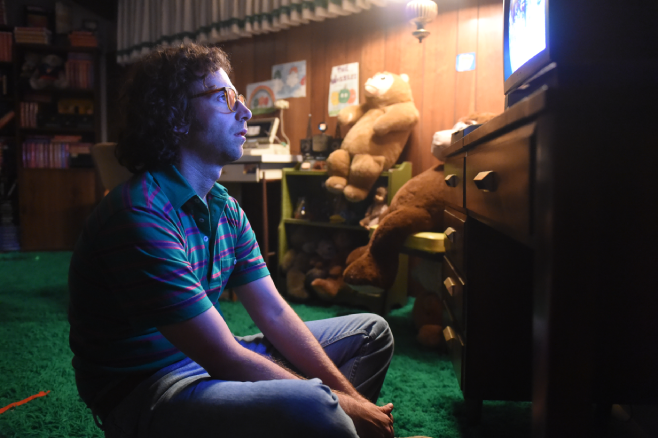
James learns that he was kidnapped as an infant and the rituals and practices he grew up with were a means to facilitate his captivity. But the most earth-shattering revelation for James comes when he learns something new about Brigsby: that the show was made by his “father” and that he is the only one who had ever seen it. Throughout his slow adjustment, James speaks through the signs of an effectively extinct language. While the grammatical structure of his passion is comprehensible to those not fluent in Brigsby, the symbols of meaning are singular and specific to him alone.
What the show’s universe and its protagonist mean for James, as his only reference point or place of stability, is juxtaposed with its objective function in his isolation – past and present. The uniqueness of James’ situation complicates a long intellectual tradition of asserting the coercive function of mass media and popular culture through a supposed homogenization of thought. The fear of societies becoming claustrophobic in their uniformity as a result of the nature of telecommunication, opposed to authentic communication, does not sufficiently explain James’ struggle. His inability to instantly make meaningful connections when reunited with his biological family is a result not of mass media distraction and devolution but of being engrossed solely in the specific language of his passionate identification, with no attempt on their part to enter his world. The elements of alienation and imaginary connection that are part and parcel of subjective life are operative whether engulfed by sameness or engrossed in unique particularity. James, for all his quirks and naivety about the world, accurately diagnoses the real element of exploitation within creative production. By asking if anyone can make a movie, he gets at the root of the injustice central to capitalist reproduction – who owns the means to tell and share their stories.
Passion & Community
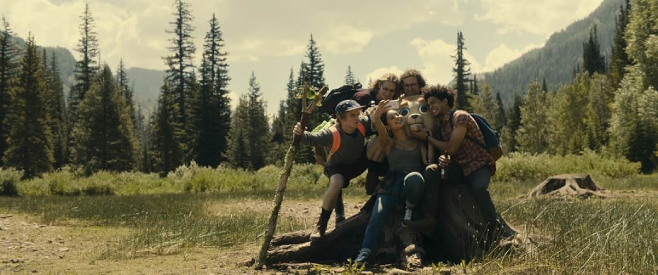
James, now intent on bringing Brigsby’s adventures to the big screen, is confronted with the challenges of navigating a world he has almost no familiarity with. Under the advice of a therapist, James’ new-old parents try to minimize his proximity to Brigsby Bear – which they see only as a tool of his captors – choosing instead to prioritize his integration into the world that he was deprived of. Understandably concerned about his ability to relate to potential peers if his only interest remains something only he knows about – they “encourage” Aubrey, James’ sister, to bring him along to an outing with her friends. In way over his head at a house party, and after a few bashful attempts at small talk, James is extended a hand by one of Aubrey’s friends to talk about his own interests – or rather, interest. What was perceived as an obstacle by the authorities involved in James’ reintegration ends up being the foundation for demonstrating his authenticity through his unbridled enthusiasm. James’ earnestness, his vivid sincerity surrounding plans for a Brigsby movie is what bridges the immense gap between Aubrey’s friends’ life experiences and his own.
Despite, and in part because of, the isolation of his upbringing, James has a genuine passion for self-expression that extends beyond his own. Seeing his host, Spencer, tool around with animation on his laptop, James doesn’t hesitate to express admiration and provide encouragement, and loans him some of the VHS tapes of Brigsby. Beginning to experience connection through fandom, and now that the artifice of his fellow forum posters has been shattered, James realizes what it is like to make a friend. Spencer uploads some of the episodes online, providing James with new opportunities to express the joy and purpose he found in Brigsby Bear now that it exists for people other than himself. This externalization is crucial for him to be able to recognize the abject horror and absurdity of the show’s production while holding on to the part of him which was nourished in spite of his deprivation.
The supposed distinction between understanding media as an escape from the harshness of reality or as a vehicle to explicitly reflect the tensions of social life doesn’t hold up when considering James’ situation. Naturally, we can assume his life in that isolated compound required a bit of color – a reprieve from the monotony – while also acknowledging how the show’s often instructional content makes visible the conditions of its production – a learning tool obfuscated by sci-fi abstraction to placate and distract. And yet there exists another layer to the way James relates to this arcane universe. The content, form, and function do not add up to the meaning he imbues it with. His subjective identification with the show’s rules and symbols are a way of comprehending the humanity both present and lacking in Brigsby’s, and his own, circumstances.
James’ ability to find camaraderie in Spencer through a shared desire for self-expression makes visible the role of media in forming bonds which transcend their origin. Like James in his quest to continue and resolve the adventures of Brigsby, many creators in different fields of art begin by riffing on established franchises. Through this repurposing and technical practice, artists learn to take what molded them – often commercial products – and forge new ways to communicate their feelings of belonging and wonder not limited by original copyright. And in doing so, they create works that inspire the next generation of storytellers. The community formed around that identification as fans cannot be reduced to a happy byproduct of a piece of media, but rather is an inevitable part of growing from audience and spectator to chorus and narrator.
Owning Our Stories
Entire industries exist whose purpose is to manufacture and merchandise the fads, sensations, and durable forms that ignite childhood imagination and joy. In this way, storytelling and its necessary reciprocal, an engaged audience, provides a skeleton for understanding our world and our relation to it. We grow into fans, creators, workers, and producers grounded in the oscillation between narrating and listening, giving and receiving. The worlds that captivate our interests are made in the context of a struggle or tension. On one side are the adults who have received the stories of their forebears and want to express that ecstasy of communication to the next generation. On the other, the culture industry which flattens and squeezes creativity into a universal commodity to be packaged, sold, managed, and controlled.
Isolation is a cruelty no one should have to endure. But James’ reconnection – to himself and to the world – happens not when he is rescued from that compound of lies and coercion, but when the people around him recognize the importance of him telling his own story to make sense of the unthinkable. Through what seems like an extreme example, Brigsby Bear succeeds in communicating the irreducibility of subjective identification, and the joy in making meaning and memories with others, in a disarming, relatable way.
The emotions that punctuate James’ journey are no stranger to a young nerd whose social anxiety led to a reflexive association between enthusiastic fandom and shame, nor to any of us who want to exercise our creative muscle and attempt to communicate the personal qualities of universal mediums. To find one’s own voice, even if speaking through a language exclusive to you, means to be true to yourself. And it is through this fragile, scary process, without guarantee of an audience, where we find the most human stories.
———
Christopher Spina enjoys playing philosopher and taking play seriously. He has called Toronto home for over a decade. Keep up with his work via quiltedpoints.net or on Bluesky.