What Knights of the Old Republic Taught Me About Wanting Too Much
You feel compelled to support great writing…

Eighteen hours into a road trip, I had exhausted every form of entertainment I brought with me when I saw that Knights of the Old Republic was on sale for $5 on the Nintendo Switch. I didn’t know anything about Star Wars, and I had only started gaming earlier that year, so the games I had played so far were very different in the way they looked or felt. I wasn’t very thrilled with the idea of playing a game almost as old as me, but its legacy as one of the greatest RPGs ever made, combined with my boredom and the $5 price tag, convinced me to give it a try.
The first few hours were rough. The graphics felt flat, the controls were clunky, and the static cutscenes were extremely underwhelming. Up until now, every other game I had played had been easy to navigate as someone new to RPG mechanics. KOTOR felt like homework.
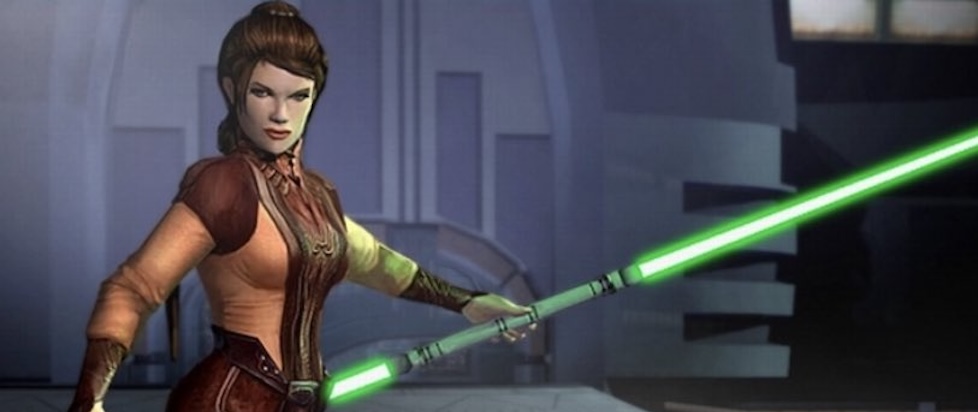
I was resisting the urge to quit, trying to convince myself that I would be rewarded for sticking with it when I got the mission to rescue the young Jedi Bastila Shan. She was described as a prodigy, gifted with the rare force power of battle meditation. I knew Bastila was one of the companions so the mission itself wasn’t surprising, but the emphasis placed on her over my character was. I was the main character in the story, and from the moment she was mentioned, it felt like I had taken a back seat. I had to know more about this extraordinary Jedi.
The mission was straightforward: find and rescue her. I spent hours running around, struggling to understand the map and how to reach her. I followed every lead, fighting my way through every encounter, and I finally found her inside a cage being held by the Black Vulkars. So I freed her and waited for my hard-earned payoff.
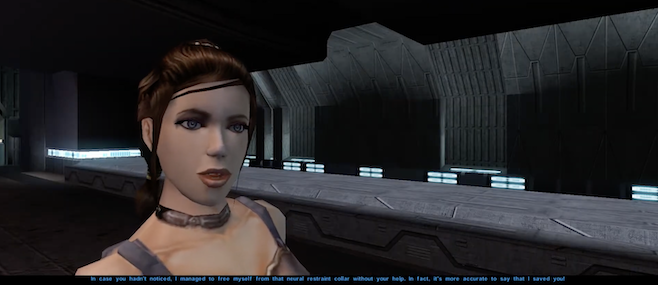
I recognized the pattern. When you first meet Shadowheart in Baldur’s Gate 3, the first thing she does is thank you for rescuing her, if that’s what you choose to do. When V and Jackie rescue Sandra Dorsett in Cyberpunk 2077‘s prologue, you get rewarded with eddies from your fixer. You do what the game asks you to do, and you get rewarded. It’s an emotional transaction, and it’s deeply satisfying. So I waited for her to thank me. Instead, Bastila not only did not thank me but also completely dismissed me. She said, “You’re lucky I was here to get you out of this mess.” I was stunned and intrigued. She had just broken the pattern I was used to, and I had no idea what to do with that.
Her reaction did not push me away though – it pulled me in. I wanted to understand why she wasn’t reacting how I had expected, and why the world wasn’t placing me at its center. She seemed to exist independently of me before I arrived to this universe, and would continue to after I moved on.
As players, we’re trained to expect the world to bend around us. We expect to be centered and rewarded, and many games work hard in delivering this satisfaction as efficiently as possible. But when every interaction is designed to affirm the player, it starts feeling more like a transaction rather than a meaningful connection. Refusal disrupts that pattern. When a game withholds the gratification we’ve come to expect, it creates distance, and that distance makes the world feel real. That independence opens up space for curiosity, tension and engagement that can’t be manufactured by instant reward.
I notice it everywhere now. Once that expectation is broken, it gradually becomes harder not to see how often games are built around our satisfaction. KOTOR changed how I’m programmed to interact with games, not in what they give me, but in what they withhold.
———
Mer Mora is an arts writer and communications professional based in New York. She started playing RPGs in 2025 and has been thinking too hard about them ever since. You can also find her on Bluesky.