Sitting Down with Sam Eng
You feel compelled to support great writing…
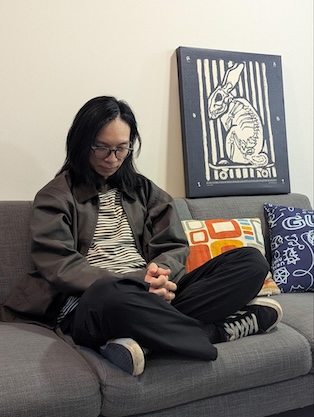
While visiting Brooklyn and the greater New York area in early March, I was fortunate enough to sit down with the wonderful Sam Eng, solo developer of Skate Story and co-founder of non-profit game developer co-working space Gumbo, where this very interview took place. We discussed the long development of Skate Story, his personal understanding of the culture and self-progression of skateboarding, and his warm feelings towards New York City itself – including the notion that “all the cool people are in Bushwick”, which is true. It was a joy to steal two hours of Sam’s precious time.
What made you want to start making games at all?
Well actually, I didn’t know I could make games before, right? When you’re growing up you don’t really know that. Game development isn’t a real thing because you just play games made in the ether, and it’s more like “Oh cool, it’s Nintendo or EA or some vague company that made this” – I didn’t consider them as people.
But yeah, I didn’t actually know for a long time. But then, when I started playing free independent games online, those would be more personal, right? And so I kind of credit this developer Increpare. They made games like Steven’s Sausage Roll, English Country Tune and ouef. I love their work and would play a lot of them, and then I realized like, “If they’re pumping these out, it can’t be that hard, right?” I mean, they’re very tiny games, and this was back in 2011 or 2012, before the huge [indie] surge.
I was interested in 3D games and I saw that some of theirs were made in Unity. It’s a Mac friendly engine, which was all I had at the time, so I started trying to make stuff. I thought “This is cool. I could maybe do something with that.” I remember when Hotline Miami first started to take off, there was a Rock Paper Shotgun feature I read about it, and since it was almost a flash game, I thought I could do this, and maybe this could be a living.
Skate Story is wonderfully far away from the Pro Skater and Skate series, entirely off doing its own thing – true as that is, which mechanics or ideas did you feel were worth borrowing from those titles, and which weren’t a fit for Skate Story?
The problem is that the main idea of skating games is Tony Hawk’s Pro Skater, and maybe Skate if you’re more cultured in that space. But yeah, people were like, “Oh, skateboard game, you’re making Tony Hawk” and, well, no, I’m not making Tony Hawk. It’s really hard to do anything in that space without being next to it. I think I used to be a little more annoyed when I was in development, but then I realized that’s just culture. That has taken up all the air in the room, so no matter what you do, we’ll be in comparison. If you mention the words skateboarding and video game, it has to be in relation to Tony Hawk. So obviously I loved Pro Skater, it was one of my favorite games growing up and my first Playstation game, and it must have subconsciously entered my brain many times, so, I cannot say it didn’t influence me. But I didn’t specifically think “I must do this thing like Tony Hawk, and this other thing not like Tony Hawk.” I just followed my natural inclination and then I would see that the differences are.
I would have to explain to people that it’s not Tony Hawk, but it’s also the aesthetic of a FromSoft game, right? It’s the aesthetic of Elden Ring, but it’s a Tony Hawk game. So I didn’t necessarily go for making it different, but I would use some mechanics as a reference point, because it’s a data point for what people expect: they expect score chasing, it’s a very proven gameplay model. I wasn’t trying to copy word for word, but it’s a question of “What did it do well in its gameplay model, and what do I want for mine?”
It’s funny you mention the Souls games, going off the comment you made about things being pitted against each other, because one of the things I dislike about games journalism is how many headlines are “This new game being made by X Indie Studio is X Game meets X Game”; it always has to be in reference to something else because something cannot exist on its own. I remember seeing a few articles in November previewing Skate Story that were like this: “Skate Story is Tony Hawk meets… I can’t remember exactly.”
Journey, or whatever.
I remember seeing those, they were completely fine previews, but I remember feeling let down by the apparent need in games journalism to worry ‘How can we possibly describe this new thing without comparing?
It’s weird because other media doesn’t do that nearly as often. “This is Taylor Swift meets Drake!” No one says that.
You’re describing Post Malone, kinda. But no, it really is games specific. The view from sites is that you can’t trust gamers to give any thought other than “It’s like the thing I know! Maybe I’ll pay ten dollars because it’s like the thing I know!”
It’s frustrating because you just want to judge something on its own merits. Games are always in comparison with each other.
You’ve mentioned wanting Skate Story to feel more like actual skating, as the examples given border on the absurdist aspect of an “extreme sport”, doing flips and shit, whereas Skate Story is built around essentially variations on an Ollie. What was important to you in making it feel more grounded in actual skating?
I wanted to make it grounded because that’s what I know; I wanted to have a game that’s more like how I see skateboarding, and I can’t do crazy Tony Hawk tricks. I’m not a vert [vertical] skater, which is why that’s not really in the game. I know about it, I just don’t have personal experience, but I do with street skating, which is what the game is about. There’s still a lot of things in the game you can do that I cannot do – it’s still a video game – but I wanted to lean more to groundedness and still find that fun. As somebody who doesn’t fly fifty feet in the air, doesn’t grind on power lines, doesn’t do all these fantastical things, I still find it fun, and I wanted to find the fun in that simple thing. I’m very interested in the idea of liking or loving the most mundane things, because it’s very easy to be excited by the biggest dragon and the most world-ending catastrophe, but it’s not relatable to me, right? I love fantasy and sci-fi, but for this project I wanted to focus on the smaller, nice things that I find.
For skateboarding, I wanted to ask the question of “Why is it still fun for me to just ride a skateboard without doing all the crazy things we think of?” You think of Jackass, Tony Hawk, tricks over a helicopter – I love those so much and the insanity is what makes it fun, but I’m still just skating on the street, and I still find it fun when I’m not doing any of that. Skate Story is trying to get to that answer.
What’s interesting about Skate Story is that it’s the mundane in the act of skating set against the background of the not mundane, the underworld. I’m gonna compare again, sorry.
You’re good, that’s all language.
In those, you play as a regular guy or celebrity, and you’re doing these completely fantastical tricks. It’s the mundane skater against the fantastical skating. Skate Story is the opposite of that: you have this very fantastical skater and setting, and you’re doing regular street skating. I’m sure, again, it wasn’t a thought of ‘I’m gonna do the opposite of Tony Hawk’.
It is kind of the opposite! I wanted the contrast of the mundane, normal skateboard: there’s no magic in the skateboard, no magic in the physics – I mean, it’s a video game, obviously it’s not real physics – but there’s not the ability to do all of these crazy things that don’t physically make sense. What makes Tony Hawk so cool is the fantastical element of when you grind on power lines, drive the car, knock guys over, do these crazy lines. In that, you’re doing this in the context of the regular world, which makes it so funny and cool. But in mine, you need the contrast to push against, so mine is a realistic skateboard in a fantastical world. It is kind of the opposite, I like that.
The scene that stuck with me the most in Skate Story is the fourth wall break of the Unity window showing up. It’s a game that isn’t really concerned with the meta for the most part, it’s entirely set within its own world. But then, at the climax of the skater recovering themselves, they form again and in being reborn, find themselves in a Unity development window. How the hell did that come about?
I don’t remember the actual genesis of it, I assume the idea just came one day and I thought “Oh, that makes sense.” The last two chapters were changed and rearranged many many times, even in the last year of development, and all these pieces were different. The Unity window originally was an entire chapter inside of Unity. You were talking to the First Primitives. The idea was that you would find who created you, so for me, it made sense for things to break down when you’re in the belly of the centipede. That concept of being inside the infinite worm has been there for a long time… for infinity, right? So you go inside, into oblivion. I wanted everything to strip down, so it made sense to me that you enter the prototype land, where there’s nothing – you lose your brain. One thing that stuck with me when I was a kid was this one Chinese animation, Monkey King I think, where they would go to the end of the universe and find primitive shapes. That’s kind of a trope, just finding the most platonic ideals, so I took that trope and thought about the platonic ideal of the skater, so bringing in the fourth wall made sense.
In this sequence, the goal is to swallow the first Moon, but the Moon is just a Unity sphere now. When you open Unity, it’s the primordial soup of development stretched out to infinity. All that came together eventually, and in the last year, I realised where to put it and cut almost all the Unity stuff – the story in that is gone, and it used to be even more meta, in that you’d skate on a bridge made of the game’s script stating everything you’ve done. But now, there’s just that hard cut when you finish the boss fight. I really wanted that shocking hard cut, which was difficult from a technical standpoint, but it was definitely worth it. I wanted it to feel like a story.
I really hope the strapline of this interview is “When you open Unity, it’s the primordial soup of development stretched out to infinity”. That’s an amazing line.
What led to the decision of the game closing with the slug-based denouement?
Well, I always knew that the skater’s soul would be in a different form. You change a couple times, like in the beginning you’re smoky wire, then you metamorphose to a glass being, but I always knew that each familiar of the demons would take on different forms. There’s truer forms and less true forms, but they’re all true forms; it just depends where in the story you’re in. Early on, I knew the rabbit was a rat. “You’re following a rabbit, but there’s no rats in New York. So why are you following a rabbit? Well, it’s a rat.” So, what is the true form of the skater? And for some reason, it had to be a slug. I also realised that at the end of Bloodborne, you’re also revealed to be a slug, even though I never got that true ending. So, it was perfect, and with Bloodborne being one of my favorite games, I wanted to also reference that a little.
Were New Game Plus and Photo Mode originally intended for launch and cut for time, or were they added due to player requests, and can you say anything about those “secretive things” mentioned in the Devil’s Patch?
Honestly, there were a lot of things cut for launch. As a solo developer, it’s hard to get everything done. In the last year, I realised I had to pause on the photo mode and the New Game Plus, I just couldn’t do them right now, so they were out. There’s some more challenges in that patch that some people have probably found; there’s an “eternal mode”, which is essentially a free skate mode, which I’m working on now. That’ll come out soon, I’ll do a beta, but that’s actually new content. The last patch was mainly a bug fix, and also two new features. I’m just still kinda slow on it since I’m still tired. The next patch should be cool!
Skate Story’s underworld literally puts forward New York as the underworld – did it start out as New York or the underworld, and what led to the entwining of both?
The underworld definitely came first, because one of the first ideas was a fantastical skate game. One of the most fun things about skateboarding is going downhill, so why not go down into hell? It made sense. It’s very loosely based on Orpheus going down into Hell and Dante’s Inferno and various underworld-based things. It’s not necessarily Hell, though, it’s explicitly the underworld with more of a purgatory type thing. There’s not even much torture going on, it’s more like all the demons have a lot of ennui; there’s no whippings and lashings in the game. The demons are more like “Aw man, this kinda sucks. I have to do this forever.” It’s kinda friendly. So it was specifically the underworld, and as for the city of New York, it’s where I wanted it to take place for the street skating part, but it’s not explicitly New York. It’s this twisted version of it that includes various aspects of the city.
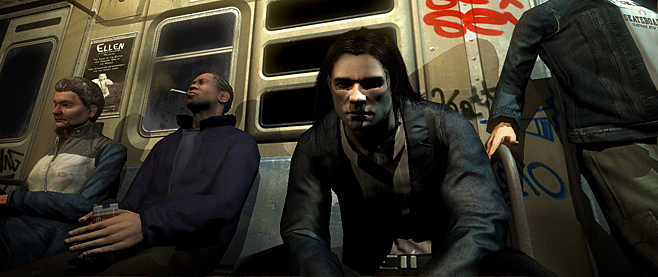
One thing I love, and not to sound like a video essayist describing a Miyazaki movie, is how dreamlike it is. There’s aspects of the city pulled out without context, like the bridges in the final subway scene, placed into the underworld. There’s a blurred line between the fantastical and the real city.
I was kind of inspired by Psychonauts, in how you dive into brains and there’s specific, thematic memories in each person’s brains. So I thought, “What would a Psychonauts level of New York look like?”
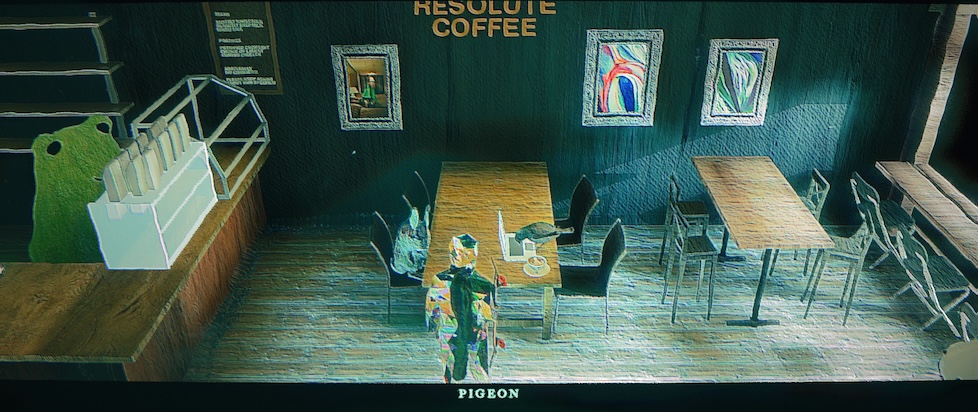
Is the pigeon writing in the coffee shop just you?
So, yeah. That was kinda natural since I wanted a coffee shop, and I just modeled the coffee shop I was at – it’s pretty much a one to one recreation of Absolute Coffee. I don’t really go there anymore, but I used to go every day. I was just life modeling, since I needed a new environment and I was already sitting there. I needed customers, so I put some Department of Death guys there. I’d bought a pigeon asset, so I put him there, and he’s on his laptop. It was all so natural. It’s me, but it’s also a lot of Brooklyn. I’m that person who just buys one black coffee and sits at a laptop, and that’s most people here too.
It’s funny to me how common this is, seeing as it’s kind of a faux pas in England from my experience.
Well, that’s kinda the American outlook, right? “What are you gonna do about it?”
You’ve said before that you were a frequent listener of Blood Cultures before working with them on this soundtrack – what was the process of reaching out to work together like?
That was actually really basic. I was a fan of them, and I wanted to see if I could reach out, if they could do some music. They’re in New Jersey, and have a contact form on their Bandcamp, so I just sent them a message asking “Hey, want to make some music for my videogame?” I met up with them in a coffee shop on the Lower East Side, and said “This is my previous game, I’m thinking of making a skateboarding game, wanna do it?”, and they said ‘Okay, sure!’ They said I can license tracks and named the cost – I could afford it, but they also said they’d be happy to make new tracks for it. I actually did send messages to some other bands, but Blood Cultures got back to me, and they’re local too.
My next question was initially about whether the game’s art and atmosphere evolved alongside Blood Cultures’ music, but I guess you’ve already answered that.
I mean, we didn’t work super closely. We were always just like “Oh, I’ll come over, we’ll jam together!” and never actually did. We’d work online, we’d meet up and listen together. They didn’t actually have anything to play the game on, so I just lent them my Steam Deck for a month to play it. It was pretty asynchronous, but it was cool since we were still inspiring each other. It was like “I’m inspired by your music, so just make some stuff” but then they’d come back and say “Well, can you send us some stuff so we can get inspired?” and back and forth. But yeah, it would evolve over time. There was a lot of painstaking in placing the tracks – I didn’t design the game around the tracks, but I did have to massage the music and massage the game to sew it together.
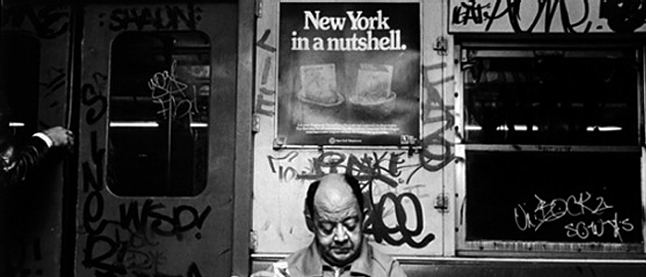
Something funny I’ve noticed being here is that I’ve picked up on the sounds of the city sampled in the soundtrack. For example, the MTA warning for the subway doors closing was something I heard for the first time in the Skate Story soundtrack.
So you’re just on the subway and like “Wait a second, that’s the Skate Story guy!” You might be one of the few people ever to have that experience. But that’s the thing, because New York is the city with the biggest IP in my opinion, because it has so much story behind it and so much media based there; if you’re in it, then it makes sense to leverage it. Since we’re both from here, we were trying to leverage it without doing the same old “bagels and walking fast” thing. That’s hilarious in itself, but it’s stereotypical. I think of New York as an IP that we live in, as a culture and a symbol, so we’re trying to use it and not abuse it. I didn’t want it to be like “Statue of Liberty! Big Apple!”
Your use of the word IP is so interesting because I completely get what you mean. I spoke to my resident friend about this and she said “You realize very quickly, especially if you moved here from somewhere else or you go out of the state or even just to somewhere like New Jersey, that New York is a bubble and there’s nothing like it.” You can go around the UK and it’s all grey and sad and similar, but New York is so insular, for good and bad.
It’s insular, but it’s also open. The event horizon of New York is very small, and there’s a sort of barrier – you’re either in or you’re out. But anyone can go in and out of it, is the thing. Well, I mean, there’s some things that can make that hard, but that’s nothing to do with New York, that’s just the United States being a piece of shit. If you’re in the US, you can just come to New York. People come all the time for day trips to do their job and then leave. It’s not a gated community, and there’s people from all over the world. There’s a lot of biomes, zones and levels – it’s very videogamey.
New York and its landmarks and the soul of it all are in so much, and if you don’t live here, then your perspective is inherently colored by the media that you’ve seen.
Being a tourist in New York is not shameful because tourists are an entire group. Sure, maybe an underclass, and you might feel that way, but most people here are not from here so it’s pretty okay. Whereas, if you’re a tourist in Arkansas, there might be that feeling of “What are you doin’ here?” No one gives a single shit here! I don’t know if you’ve walked around this area at all, but Dumbo is super touristy because of the Manhattan Bridge.
I know there’s a street that has an incredibly clear view of the bridge, and that shot was referenced for a mission [No Sleep] in Battlefield 6. A friend sent me a DM saying “Make sure you go to the Battlefield 6 street” and I just replied “Don’t call it that, come on.”
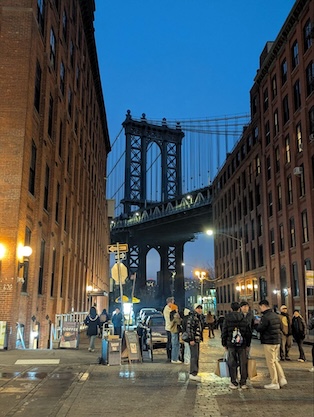
It’s the most famous street here – if you go there, there’s gonna be a million tourists taking photos, including you! I mean, I bought Battlefield 6 because it takes place here, where Gumbo is.
Would you call yourself a skater or developer first?
Definitely developer first. I am still a skater, but I started skating in my 20s, realizing it was the best transport to get around New York since it’s the most mixed-use. You can get on a bus, get on the subway, get an Uber, and then skate the final mile. You can kinda skate on the sidewalk and skate on the bike lane too. It’s way more dangerous than walking, but it’s also cooler. I’ve always loved skateboarding, I always wanted to do it, but at that point I was already working in games and teaching kids game development. So yeah, developer first.
What is skate culture to you?
To me, it’s way more diverse and personal than people outside of skate culture see. There’s a problem within skateboarding where a lot of it is corporate and it’s kinda losing that personal part. There’s these ideas like ‘This is real skateboarding’, but the original soul of skateboarding is just having fun, like you’re kids. You’re having fun and just living in the world with your friends. That’s the core part of skateboarding I like. One thing I struggle with is – well, honestly in New York, it’s not that bad – is that there’s so many different types of skateboarders, and talking to non-skateboarders, they see skateboarding as this monolith. It doesn’t make sense to me, because skateboarding is such a gigantic sport, and everyone does it the way they want. There’s kids’ skateboarding, there’s longboarding, there’s people dancing on skateboards, there’s street skating, there’s vert skating, there’s all these different things. I think skate culture is about having fun with your friends – a freedom away from structure. There’s not much structure, there’s no teams; I mean, I guess you could ride for Spitfire or something, but there’s no rules. You can do any trick, and as long as you’re having fun and your friend thinks it’s cool, that’s all that matters.
It’s also about self-progression. A lot of the 90s skate culture has evolved into what it is currently where you can see so many different types of skateboarders, and though you can still have a stereotypical view of a skateboarder like “hates cops and smokes weed” – which is kinda true but not limited to skateboarders – I think skate culture is really wide and generally a very accepting culture. If you’re riding a skateboard and someone else is, we’re part of the same thing. It’s very personal, too. You can skate with friends, but no one’s riding the board for you. If you’re playing on a soccer team, you have to collaborate and the team becomes a unit. In skateboarding, it’s very personal, it’s just you and the board. You’re doing a sport with friends, you can trade tips and tricks, but that feeling is very unique to me. Skateboarding attracts people who don’t like structure, who are a little more anti-authoritarian, who like going their own way.
In an interview with A.V. Club Games, you described skateboards as “the most minimal, primitive mode of transit; planks of wood with wheels on them.” Where do you fall on the balance of skateboarding being purely pragmatic and functional transport, and being a method of self-expression?
I don’t think those two are completely exclusive. They’re kinda disconnected because something can be complex and self-expressive, something can be basic and self-expressive, and I think you can express yourself through almost any medium. It doesn’t matter how simple or complex it is. So, I don’t mean to say “I reject your question!”, but it’s more that you can express yourself in any medium. I love videogames as an expressive medium because within mass market digital media, it has the widest expression space currently. You can technically fit every movie and every book into a videogame: your entire game could be about reading books, or listening to an album, and the entirety of those pieces of media can be within the game. But then, I also look at it the other way where the expression space of a smaller medium can still be very large. Just because videogames are wider doesn’t mean music is any lesser; you can still express yourself so much in a record. Even in a subset of that, the album art is self-expression, and is a subset in itself of visual art.
I think skateboarding is its own expressive medium within art. It’s very individual – no one can kickflip for you, right? If someone does it for you, you didn’t really do it. It has its own language, culture and history that lets you express yourself within that context. It attracts people who are into that culture and history. That’s my long-winded philosophical theory.
Between the backing of experimental music, harsh camera angles and transitions and surrealism amidst the streets of New York, I’ve heard a few skaters I know say Skate Story reminds them of Colin Read’s skate movie Spirit Quest – is that pure coincidence?
I think I know it! I don’t remember the video names, but I think I know what you’re talking about since it’s super famous. That is probably one of the best of all time. To be honest, I’ve watched a lot of skate videos but I don’t always remember their names. I’m not very good at remembering titles of media and where I found it – I just kind of absorb it. I’m not great at the art history of it all.
Do you have any advice to offer someone considering starting to skate and/or make games, since they’re both skills that rely a lot on self-discipline and a desire to improve?
The most important part is finding the joy in it and knowing that it’s difficult. I think skateboarding has a bit of an advantage since it’s more about having fun, and the physical movement itself is fun since you get endorphins from exercising. You also have no delusions of making money from skateboarding. A problem with game development is that delusion, and I’m aware I’m extremely fortunate to make money from videogames since too many people don’t, but I never really approached it that way. With skateboarding, it’s easier since there’s no pressure that your livelihood depends on it; it’s just a hobby.
I think it’s cool to do both at the same time since you can learn from skateboarding, the muscle memory and difficulty of it, and that’s kinda similar to game development. You start out like “What are these concepts, I have no idea”, but over time the muscle memory builds. Any skill is like that, and I think both of these are very difficult, but skateboarding is known as a very difficult skill. I almost think skateboarding is, I don’t want to say easier, but maybe easier to swallow? You know it’s hard, but you know you’re going to have fun doing it, whereas game development often leads to “I want to quit my job and make a million dollars off of this thing,” and that is extremely difficult.
There’s a lot of people who start developing games in their free time with this outlook of “I’m gonna make Undertale – I’m gonna make this industry defining RPG and make something really special.” It’s a valid outlook, but it’s depressing to consider that there’s so many people with that outlook, and so few manage to get anywhere close.
Only one can win.
And so many people don’t make any money, let alone Undertale money, off of videogames. What you said earlier, “No one can do a kickflip for you”, applies here too, because game development is so fucking difficult to start. You approach skating knowing it’s hard, but a lot of people have rosy glasses towards making a game like “I’m gonna open RPGMaker and make an amazing game!” and then hit the cliff of development being as difficult as it is. It’s a massive time and effort sink, and while there are guides, as there are with any skill, it falls to you. You have to continue existing alongside your game development, and it’s entirely understandable that people get to the point of “Well, I don’t have time for this solo-developed game that isn’t making me any money” and drop it. There’s such a huge graveyard of itch.io games that never got made. [Pause] That was depressing, sorry.
That’s just games, honestly. The industry is just fucked, it’s not in a good state.
I think it’s maybe impossible to have a conversation with a developer or journalist right now without inevitably going there. Anyway, the state of games is awful, let’s talk about the state of New York.
What is New York to you? Not asking for just a one word answer.
“Bagels!”
No, I kid. To me, it’s weird, because New York feels like the real world. We just talked about it being a bubble, but it also feels like the real world because it’s so connected to everything, so it’s like everything is happening here. Wall Street’s here, all these big companies are here, all the cool people are in Bushwick, everyone’s coming from all over the world to come here. It feels like reality. When I visit Montreal or somewhere, or like San Francisco for GDC soon, it feels like it’s kind of a city, but it feels like nothing is happening there. It’s kinda chill. But then New York is always shifting; there’s always buildings going up and going down, new places opening. Everything is here: you can find food from every corner of the world and you can almost definitely find someone from every country here. At least one. Don’t quote me on that.
There’s very few places in the world like that: the diversity; the variety of people, and the economic powerhouse and arts powerhouse of it. I sometimes think this is what Rome might have felt like before, like “This is the world’s city.” And maybe it’s on its way out, but right now it still feels like that. I can count on anything being accessible here. I was just talking to my producer who’s in Madrid, which is also a world-class city, but every time he visits me here he tells me “I’ve gotta go to all these stores that aren’t in Spain.” Clothing, tech, cameras, tiny obscure stuff, you can get everything here. It feels like the entire world condensed, kinda like a videogame level.
I’ve been going around with my friends I’m visiting, and there’s been a lot of times where I, starry-eyed tourist I am, have pointed out something and said “Oh, I’ve never seen this in the flesh!”
Like Flaming Hot Cheetos?
Yes! And they’re looking at me and saying “Yeah? So?”, and I’m just like “No, you don’t get it! This doesn’t exist where I live!”
“This is a meme! This is a JPEG! This isn’t real!”
But yeah, you’re right. It’s the world on your doorstep. There’s the stereotype of “capital of the world”, but it does have merit. It’s so vast, it’s so different to any other city. I can’t walk outside in Birmingham where I live and think “There’s one person from every country somewhere here.”
And you share the sidewalk with them! You go on the subway, and around you there’s one person with a million dollars and one with two.
Did any of your favorite skate spots around the city end up immortalized somewhere in the underworld?
There’s a lot of direct inspiration for sure. A lot of textures are just real photos edited to be a game texture, like the Manhattan Bridge and Washington Square Arch, for example. I didn’t necessarily just take a skate spot, though. I modelled some, like Brooklyn Borough Hall, which is a really famous skate plaza, but it’s not meant to be one. I didn’t want to model actual skate parks because the game isn’t about parks, it’s not about vert – it’s about just skating in the city, since that’s my favorite part. I took a lot of inspiration, but I never wanted to copy a real spot. The design of a videogame is still very different to real life, so I needed to design it for gameplay first, especially considering scale. You’re going way faster, jumping way higher in Skate Story than you could in real life. Real spots are kinda boring in that way. It takes a lot of artistic liberty, but there is a lot of real life reference. I just thought “I like this thing, I’m gonna put it in.”
How does it feel having Skate Story be maybe the last piece of media to feature the Metrocard before its retirement?
Damn yeah, it’s gone now. Well, I feel like I still could have done it in five years, since the game exists in the underworld which is implied to be the afterlife: The MetroCard is kinda the dead version of the new [OMNY] card. I could still do it now!
How did Gumbo take form, and what are your hopes for its future post-Skate Story?
We started with a co-working spot close to here that was just a much smaller office. There were five desks stuffed in there, it was super cramped. Our friends got the office next door, and that was cool since we were hanging out and would invite people, and then more friends got an office next to that. So we had three separate shoebox offices, and we found someone on the same floor who was also doing gamedev, weirdly — we just saw him working and realised ‘Oh, he’s using Unreal!’ We all became friends. I came up with the name Gumbo: “We’re in Dumbo, so let’s just call it Gumbo! For gamedevs!”
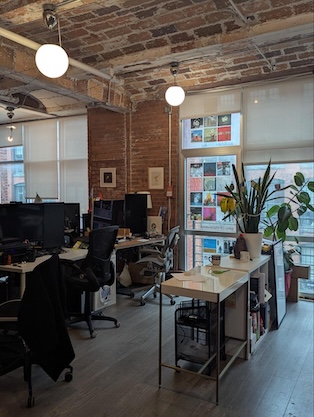
During the pandemic, almost everyone got rid of their offices, but some of us were still going in. One of our friends got really annoyed at the construction going on, couldn’t work with the noise, and wanted to find a new office. We combed through it and saw the space right upstairs from this one. We messaged everyone asking if they could commit to a year of this, and eventually got everyone on board. But, that space got taken, and we were like “Fuck! We can’t do this anymore!”, but this space below it became available, so we just went in immediately. Everyone moved in, this was when the pandemic restrictions were lifting a little, and this group of ten people grew and grew: We’re at about 70 members now. It’s an official non-profit entity. I think it’s a really cool community, and I think that’s something that’s missing; not just in the game industry, but in human life. Everyone’s always talking about third spaces, and that’s what this is, but it’s still a coworking space so it’s still focused on making art together. Unfortunately, it is very hard to make money in games so very few of us make a living in games. It’s a hobby for a lot of us.
With Skate Story, I was lucky to have a publisher. Before that, I was doing a lot of freelance work and other shit to pay for the studio space while games weren’t making money. The nice thing about Gumbo that we want is for people to keep supporting each other, and maybe become the Bauhaus of game development. It’s a place for people to work and network. Right now, we’re focused on being a really good space for people to get their energy from. It’s kinda one of a kind, which is a blessing and a curse because we’re trailblazing but we also have no idea what we’re doing. There’s no model we’re following, and it’s all co-operative so it’s not profitable, and there’s maybe conflict between the people here, let alone the overhead of this expensive city. But I think even though the game industry is really bad, considering crunch culture and harassment, it’s full of cool people. People at Gumbo are of that kind of creed – you put enough people in a room and there’ll be drama, so it’s not a full utopia, but I think most people are well-meaning. Plus, even with those issues, compared to other industries, we actually talk about them. I think games media is more likely to point things like that out than in other industries.
I do agree. There are a lot of indie sites and independent reporters who are doing really important work like this. There was that recent exposé on ClickOut Media killing sites and replacing writers with AI, and that kind of reporting is so great and to the point. There’s less of a feeling of “I’ll get blacklisted forever if I report on this”, which is prevalent in Hollywood and the music industry.
It’s more decentralized. There isn’t that connectivity that leads to the risk of never getting a job again.
What’s your go-to coffee order, and where is the best coffee in New York?
I’m that guy that just orders one black coffee and sits there for hours on my laptop. I’m literally that person we talked about earlier. Some places have a sign that says “No laptops”, but I’m mostly good. I go to Swallow Cafe a lot since it’s close to me and has a cool little cabin vibe. It’s got cool windows, the baristas are all queer and nice. That’s important to me, that the people working there are kind and progressive – I mean I’m in Brooklyn, right, that’s what baristas are here, and I love that. It’s not true in every cafe, but it is in Swallow, and I love it.
I hope at least one more customer goes to Swallow because of this interview.
[Author’s note: I did, at least! It’s lovely! Thanks Sam!]
———
Sam Eng is a solo developer and skater based in Brooklyn. Find him on Bluesky and inevitably in a cafe drinking a single black coffee.
Ashley Schofield is a freelance journalist and critic, as well as the author of VA-11 Hall-A: Design Works for Lost In Cult. Find her on Bluesky and at her personal site.