Upstage History: Musicals, History & Artifice
You feel compelled to support great writing…

Brendon, of the theater documentary YouTube channel Wait in the Wings, was kind to Diana: The Musical. Mind you, his video was titled as an autopsy, but it was still more sympathetic to the show than the people in the comment section or other YouTubers covering it. The video paints a picture of competing ideas and tones resulting in an uneven mess. Is it campy commentary on the Royal Family? A serious examination of Diana and Charles’ relationship? An examination of the cruel circus of celebrity? Yes. A lack of focus leads its overarching message to end up as: Here’s a musical, it’s about Princess Diana.
Thinking about the Diana musical made me wonder about this odd sub-genre of musical theater that Diana belongs to: the historical biography. The sub-genre shouldn’t exist due to the conflicting elements that comprise it: the condensed nature of any performed-media’s biographical take combined with the bombast and overtness of the musical genre where feelings are sung out loud contend with attempts at some accuracy in depicting complicated and nuanced history. However, art is not without paradox.
I thought about the varying reactions to the historical biographical musical – how the concept of something being “too soon” changed depending on both the musical and the audience, and how “accuracy” in these musicals wasn’t just about facts, but how correct it feels to the spectators. It ultimately led me to this question: What is the story being told in these biographical musicals? Is it about the subject, something specific the creator(s) wanted to explore, or both?
Diana, as sacrilegious to the Broadway crowd as it might seem, shares DNA with another musical: Evita. Both stories simplified: Outsider woman gets involved with, then influences, a nation’s politics. Audiences are often compelled by stories about those just-to-the-side of powerful figures, good and bad, to examine their unspoken influence and/or their complicity in events. Even more so when they are women, because what power they have and how they choose to wield it is not always obvious.
From what I could ascertain, Tim Rice’s inspiration and research for the musical included the movie Queen of Hearts and Mary Main’s Perón-critical biography The Woman with the Whip. Already, we have a story a few times removed from the actual events of her life. Added to this, is the fictional narrator character of Che, who is very loosely based off Guevara, who also serves as critic of the Perón presidency.
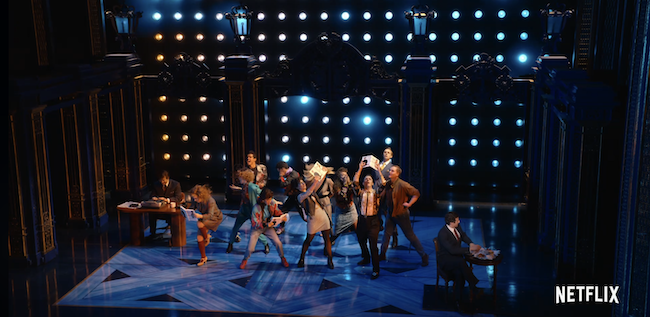
With that in mind, I think it is fair to question how real Evita is, even beyond its musical elements, with its condensed timelines and composite characters. Could it be considered fiction or non-fiction? Maybe that question is a matter of semantics. More interesting to ask: is Evita the story of Eva Perón molded to fit a musical or is it a musical that uses Eva Perón as a vehicle to tell an interesting story, one loosely inspired by her?
Now I’m going to talk about Hamilton.
I have nothing new to add to the discussion about its casting since the musical premiered a decade ago, nor do I think it’s my place to have any input in that discussion! At best, what I’m discussing is adjacent, my interest and critique are about what the story is focusing on.
Lin-Manuel Miranda was inspired to create the musical after reading the biography written by Ron Chernow. However, much of what Miranda seems to have pulled from the book is about Hamilton’s personal life. Which is understandable, because from it, Miranda has crafted a compelling story where a man’s ambition is both his greatest strength as well as his greatest weakness. However, this leaves his involvement with war and politics less realized and drawn in with a mix of American mythology, with nods to 2010’s American liberal ideals and a bit of criticism of politics (“The Room Where It Happens” and King George III as a jester-like figure). It’s hardly a comprehensive look at someone who is considered one of the founding fathers of the country, whose decisions still affect U.S. citizens today. It’s fair to ask: is Hamilton really about Alexander Hamilton?
This isn’t to say that the musical is bad. In fact, I think it’s a well-structured musical. It’s so well structured that you could replace the characters and details of the events and still have it work. You could tell the story of a mafioso climbing up the ranks or a talented screenwriter who eventually lets Hollywood get to him and keep all the same story beats. If that reads true, then it’s also fair to ask, does Hamilton need to be about Alexander Hamilton?
I’m not criticizing these musicals for lacking full adherence to facts nor am I wanting them to define themselves as purely fiction or non-fiction. I understand that these types of musicals are born out of discovering emotional truth(s) in the life of a historical figure and/or historical events.
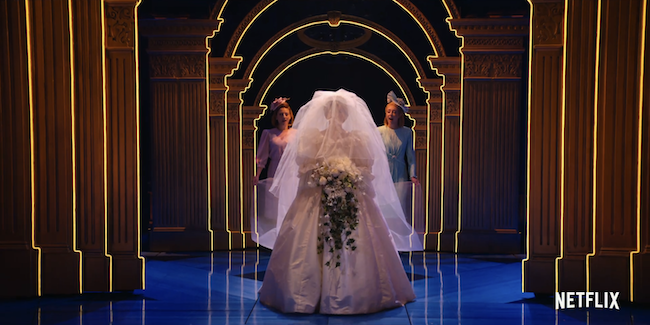
What I am questioning, as both a creator and as a member of the audience, is at what point does a musical cross over from being a representation of a life or event in a narrative form to a story about an emotional truth inspired by them? If a musical is more of the latter, why not lean into the artifice of the musical medium? Doing so might render the emotional truth much clearer.
A good example of what I’m talking about is the musical Six. Six is not interested in depicting the stories of the wives of Henry VIII (of England). It is, however, interested in how they themselves might have told their stories.
The premise of Six is that the six wives are reimagined as competitors of a singing competition for the role of lead singer, determined by each of them convincing the others that they had it the worst. It’s a silly premise, but it allows the musical to establish that the stories of the wives are starting points to overarching questions it wants to ask. Why are these women’s lives told solely through the lens of being married to Henry? It also asks why women are pitted in competition against one another. From there, it’s hard not to ask larger questions about how women’s stories are told throughout history and in current day.
With that in mind, I return to Princess Diana. I do think there’s a way to have her be the subject of a musical without it being “too soon.” You simply don’t have her in the musical. Not just because of the “too soon” critique but because I think the well has been pretty much tapped for depictions of Princess Diana. I think one of the most interesting things about Diana is the varied reasons people are interested in her. I imagine a revue, where the songs are born out of different perspectives on her. The emotional truth of it would be how multi-faceted a human being she was while also acknowledging historical figures and celebrities are not ever fully knowable.
I’m not saying all biographical musicals should abandon narrative all together. Sometimes you get lucky and the facts bear out a story that also aligns with an emotional truth that these facts have also inspired. What I am saying is that the medium of the musical should not be a constraint, but it should be (forgive me) a stage for these truths to come out, however it does and however loudly.
———
Alex J. Tunney is from Long Island, which may explain all the writing about videogames, food and reality TV. You can find all of his writing collected at alexjtunney.com.