A Great Gift of Love is Boredom: On Being Part of the Herd in asses.masses
You feel compelled to support great writing…

On February 14th, I ruined the day of lovey-dovey consumerism by taking my wife to the fifty-first showing of asses.masses at the Institute of Contemporary Art (ICA) in Boston to test what power videogames have to incite change. Created by conceptual artists Patrick Blenkarn and Milton Lim and a team of eighteen programmers, translators, and animators from across the globe, asses.masses is, if I were to be reductive, a more complex Twitch Plays Pokémon. The over-eight-hour experience involves watching a crowd play a roleplaying game centered around the struggles of a group of jackasses and jennets on a revolutionary path. Blenkarn and Lim rely on the nearly universal familiarity people have with videogames as a pastime to ease and initiate audiences into “wasting” a huge chunk of a day engaging in radical politics. Reviews of the show sling words like “endurance” and “boredom” to describe the experience. I read these and said to myself – “Yes. I need this.”
Gabrielle Marceau in a review states that the show turns its participants into “test subjects in an anthropological study of what an audience can endure.” As far as endurance tests go, asses.masses is a pretty lenient one. The show is a relaxing experience fitting for how we increasingly consume media – passively and in the background. I much prefer Kyle Walmsley’s description of the show as “an overwhelmingly delightful durational feat that manages to be both a nostalgic trip and a radical experiment in collective negotiation.” Did I enjoy this “nostalgic trip”? Yes and no. Did my marriage survive this “radical experiment”? Only time will tell.
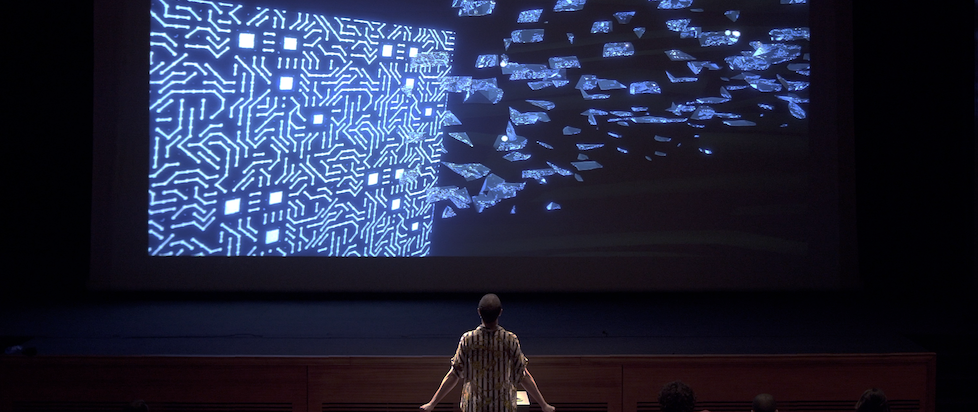
Around 1:30 in the afternoon, a diverse crowd slowly began to gather at the ICA lobby under a banner threatening “ASS POWER.” We joined the herd and in due time were ushered in to sit in the Barbara Lee Family Foundation Theater, which, to my surprise, was almost at capacity. With the hypnotic pull a single player game has on audiences, like being in the living room of a friend whose father sent him a Super Nintendo with a copy of Earthbound from the United States, eyes gravitate towards the screen. Like the showcasing of a holy relic at the Holy See, the show begins with a light shone upon the sole controller in front of the temple – theater. Who will take the controller and become the herd’s representative? The question is answered as quickly as it is posed. The audience and the player, those are the roles negotiated throughout the duration of the show. Both vying for the power to direct the experience.
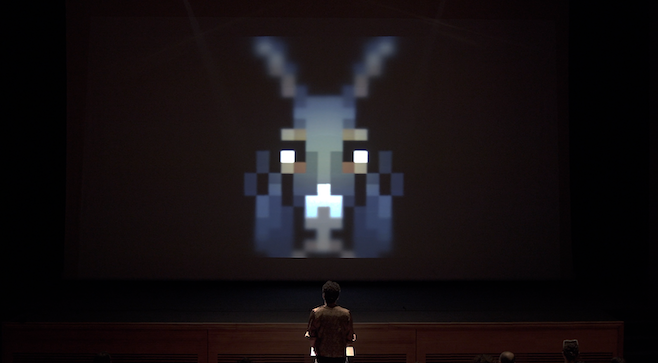
Within the herd there are those more than eager to be the first to lead, just as there are those content to sit, watch, and be led. A barrage of questions fill the screen. One after the other the herd shouts and jeers. What is screamed is sometimes wrong, sometimes right. The player representative decides by pressing buttons, each input moving us to a new question. Once the questionnaire is completed a 3D cube model transmutes itself onto the screen and a 16-bit donkey greets the theater. This is our collective avatar for a time. I sense my wife’s discomfort.
Let us get this out of the way, there are a lot of asses (donkeys) in the show. Crowd favorites quickly emerge: Old Ass, Bad Ass, and Sad Ass. A donkey’s entire personality is hinted at by its name. The poor representative, the player, now called poor ass by this here writer (and will not be capitalized because the leader must be put in their place somehow) had many demands on her shoulders. “Call him Slap Ass!” hollers the herd. I gaze towards my wife and she crosses her arms in disapproval. The show has only just begun.
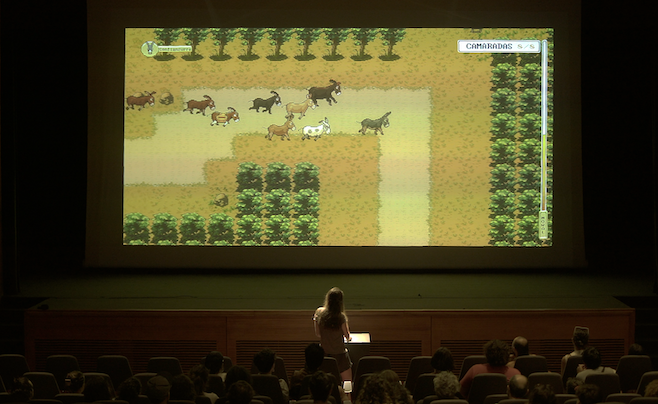
Not unlike Marx in the saloon or organizers at the pub, Blenkarn sees the show as operating within the “politics of the basement.” asses.masses is a question of governance really. Best practice is for poor ass to consult with the audience for input on what to do next and how to build a character. Get them involved. The guardrails stopping poor ass from doing whatever they want are not visible, yet you do feel them. The herd and the game have their limits. If I would have taken the controller and just held it in my hand not doing anything else would the herd erupt in anger after a few seconds or few minutes? This is why whoever gets the controller next and for how long is constantly being negotiated. I was pleasantly surprised to find out that the person sitting behind me is a labor organizer.
The herd’s collective frustrations when someone does something wrong or veers off path is audible. Disturbed laughter reverberates inside the Barbara Lee Family Foundation Theater as the lowest common denominator humor wins out. This becomes the show’s primary logic propelling decisions into a collective outhouse. We are asses after all, so it makes sense. Yet I was nevertheless distraught. The “ass” in asses.masses must surely be a deliberate choice its creators made to ease participants into discarding some inhibitions. My wife sneers and leers at me. Sweat beads gather on my brow. I say to myself “I should have taken her to Bubba Gump Shrimp Co. in Times Square as I originally planned.”
asses.masses as a game has been in development since 2018 and as a result the experience is fine-tuned to mitigate the most oppressive bits of boredom by shaking up the gameplay. 3D open-world segments, rhythm games, Metal Gear stealth, donkey sex, hilarious dialogue, and various styles of turn-based battles. Walmsley states that this experience “strips away the professional hierarchy and the competitive edge” of e-sports and livestream playthroughs. The diverging levels of experience with games are laid bare when someone picks up the controller. Again Walmsley: “You find yourself supporting decisions you didn’t make, and learning to live with the complicity of a collective choice that wasn’t yours.” This is a major point of tension through the duration of the show.
In contrast to the MoMA’s Never Alone exhibit which focused on how games as design artifacts connect us, the show’s raison d’être as conceptual art is built on the assumption that people increasingly spend more time watching others play games instead of playing them themselves. Blenkarn and Lim have the backing of a recent Midia Research report and if we include sports into the mix, the gap between time spent being the player and a spectator widens even more. People love to watch others play. Nevertheless as I look towards my left, I am reminded that my spouse is not one of those people content with simply spectating. Regret over ruining Valentine’s Day floods in.
Videogames, like other games (sports included) are built on top of rules. In asses.masses, I am unsure how much decisions actually matter within the ruleset binding the show. Progressing the story or affecting the direction it can take is further obfuscated by the mystifying effect posed by the language of the controller (i.e., its inputs, outputs and the challenge of someone who does not speak the language taking the gadget in their hands). This is immediately and powerfully evident when an inexperienced player picks up the controller and becomes poor ass. Again the tension is on display. They ask questions of the audience more experienced players do not need to and slow the pace of the already laggard experience to a snail’s pace. Yet, as a herd they push forward.
The modern fourteen-plus button controller appears like an insurmountable ziggurat one must climb in order to speak game. I know many who only play games on smartphones. The touch screen is intuitive. Luckily the herd is patient and quickly yells out instructions.
This is critical. asses.masses, like many videogames, demands our time. I for one, as someone who utters Pedro Pietri’s poem “Telephone Booth (number 905 ½)” like a mantra, am aware of the importance of wasting time doing the unproductive. And if you “feel too good”, maybe videogames are not the ideal way to spend one’s time, just like for Pietri going to work on a beautiful day is not worth it. After all, with large aspects of our lives becoming increasingly gamefied – work and learning being turned more into micro-empty achievement compilations – asses.masses’s greatest gift is the boredom it can offer. As I think of the memory of my annoyed wife sitting beside me as the herd shrieks in jubilation at the site of a rhythm game that buffoonishly presents 3D modelled donkeys having sex to electronic music, maybe like Pietri she felt so sick that she would rather be at work. To each their own. But this does not invalidate lounging as a radical act.
To feel bored as a collective is an act of intimacy that can ratchet up discomfort. It reveals things about those involved that some would not want to know or experience. asses.masses forces its participants into a state of intimacy where dulldrum numbs us to an extent that an elderly gentleman can no longer hold in his fart after hours of sitting on his ass and eating vegetarian food and as a result he lets it loose directly in front your spouse without even noticing. The asses run wild. All one can reasonably do is laugh because you are weirdly tired. Tired of watching others play games, no matter if the story being presented is deep and entertaining. Tired of the cold world bridled with jaded people that awaits you outside of the ICA’s Barbara Lee Family Foundation Theater. I have to take her to a fancier place than Bubba Gump to make up for this.
asses.masses is an argument for videogames and that “boredom is freedom.” As one participant said: “It is hard to describe, but this is surprisingly enjoyable.” So if you decide to leave the theater on Valentine’s Day, there are enough people willing to pick up the controller and become poor ass so the game will continue without you.
asses.masses delivered an endurance test. My wife after the ordeal tells me “videogames are not the best way to generate change or educate.” In contrast, Derek Manderson says: “Optimistically, I believe that community-building theatrical games such as this [asses.masses] represent the best device we have in our social toolkit for encouraging engaged co-presence, interrogating leadership, and making space for generative play.” After seeing people play a game about revolutionary donkeys for eight hours I agree with both. The experience crystallized for me that unlike this show, mass market games rely on addictive and mentally manipulative means to hold our attention. No real investment from the player is needed. Your attention is guaranteed. asses.masses respects the human by giving them boredom. The perfect subject for the twenty-first century is no longer homo economicus but homo ludens. Please daringly forgive me!
———
Luis Aguasvivas is a writer, researcher, and member of the New York Videogame Critics Circle. He covers game studies for PopMatters. Follow him on Bluesky and aguaspoints.com.
———
All photos by Francisco Castro Pizzo.