The Aesthetics of Impermanence: How Frieren Visualizes Untranslatable Japanese Philosophy
You feel compelled to support great writing…

Frieren: Beyond Journey’s End operates as something rare in contemporary anime – a sustained meditation on concepts so embedded in Japanese aesthetic and philosophical tradition that English lacks an adequate vocabulary for them. The series achieves what language rarely can: It renders mono no aware and ma felt – a visual translation of the untranslatable.
The narrative architecture of Frieren mirrors the structure of these concepts: episodic yet cumulative, hushed yet devastating, concerned not with plot momentum but with the weight of what remains unspoken. An elf processing grief across centuries. The empty space between dialogue. Light filtering through leaves. The acceptance that nothing perfect lasts – and the strange beauty in that acceptance.
This isn’t cultural tourism. It’s anime engaging with its own philosophical inheritance at the highest formal level, building a visual language where stillness carries as much narrative weight as action, where absence matters as much as presence.
Mono no Aware: The Pathos of Transience
“The pathos of things.” In Japanese aesthetic tradition, mono no aware describes a profound awareness of life’s impermanence as the very source of beauty instead of something to be feared. The cherry blossom is beloved precisely because it falls. The moment is precious precisely because it passes.
Frieren: Beyond Journey’s End builds its entire emotional architecture on this principle. The series begins after the grand adventure ends – after the Demon King falls, after the hero’s party disbands. Most fantasy narratives end where Frieren begins. This structural inversion is itself an expression of mono no aware: The story asks not “Can they win?” but “What remains after victory?”
When Frieren reunites with her former companions fifty years after their journey, we see Himmel aged, diminished, mortal in ways Frieren will never be. The meteor shower scene – where the elderly hero party watches the same celestial event they witnessed as young adventurers – distills mono no aware to its essence. For Himmel, this is a moment he has waited fifty years to experience again. For Frieren, fifty years is barely a pause. The scene’s devastating beauty lies in this asymmetry: Himmel treasures what Frieren failed to notice slipping away.
When Himmel dies shortly after their reunion, Frieren finally confronts what mono no aware means. She realizes she spent ten years with people whose entire lifespans are, to her, ephemeral intervals. The regret she feels – the understanding that she should have known them better, should have treasured those years more consciously – is the core ache of mono no aware. It’s the recognition that beauty and sorrow are inseparable, that love and loss are the same truth viewed from different angles.
The anime reinforces this through visual repetition: the same fields, the same paths, the same landscapes revisited across decades or centuries. We see Frieren standing in places where her friends once stood, where cherry blossoms have bloomed and fallen hundreds of times since. The world endures. The people don’t. This is mono no aware made manifest – the visual language of bittersweet impermanence.

Ma: Negative Space as Meaning
Hayao Miyazaki once explained: “We have a word for that in Japanese. It’s called ma. Emptiness. It’s there intentionally.” The concept describes the meaningful pause, the deliberate silence, the space between things that gives shape to what surrounds it.
Western animation tends toward constant motion, perpetual dialogue, relentless narrative momentum. Frieren refuses this. Instead, the series trusts silence.
Consider how often the anime simply holds on to a landscape: mountains at dawn, forests in autumn, towns blanketed in snow. These shots are ma – breathing room for contemplation, visual silence that gives emotional weight to what precedes and follows it. When Frieren walks through a field without speaking, when Fern and Stark sit together without words, when the camera lingers on in an empty room after characters leave – these moments aren’t empty. They’re ma. They’re the space that allows meaning to settle.
The series’ pacing embodies ma structurally. Episodes often lack conventional climaxes. Stories begin, meander, recede. The first exam arc takes eleven episodes to resolve. Frieren refuses to compress time artificially, letting the exam unfold at the pace it would actually unfold. This unhurried rhythm mirrors how Frieren herself experiences time: slowly, without urgency, with room for digression.
Even dialogue demonstrates ma. Characters pause mid-conversation. Responses arrive after beats of silence. The script trusts that audiences will feel what goes unsaid. When Frieren gives Fern a butterfly hairpin for her birthday – mirroring the butterfly spell that first inspired Fern to study magic – the gesture contains more emotion than any monologue could convey. The silence around it is ma. The space where meaning resonates.
This approach feels radical in contemporary anime, where exposition often overwhelms subtlety. Frieren proves that stillness can be dramatically potent, that the pause between words carries as much weight as the words themselves.
Yugen: Profound Mystery
Yugen describes beauty that cannot be fully grasped – mystery that deepens rather than resolves, meaning that exists just beyond articulation. It’s the feeling of gazing into fog-shrouded mountains, of sensing something vast and incomprehensible just outside perception’s edge.
Frieren operates in this register constantly. The series never fully explains its magic system because explanation would diminish yugen. Magic remains mysterious, ancient, tied to emotion and memory in ways that resist logical mapping. When Frieren collects obscure spells – magic that turns grapes sour, magic that conjures illusory flowers – she does so not for power but for the ineffable quality each spell contains. These are not tools. They’re artifacts of yugen, fragments of beauty that exist for their own sake.
The demons in Frieren embody yugen in a disturbing fashion. They’re intelligent, manipulative, entirely devoid of empathy. They mimic human emotion without feeling it and this creates an uncanny psychological tension: Demons are comprehensible enough to seem almost human, yet alien enough to remain fundamentally unknowable. The audience never fully grasps how demon cognition works – and this uncertainty is the point. The series preserves yugen by refusing complete explanation.
Landscapes in Frieren radiate yugen. The anime’s backgrounds – vast forests, mist-covered valleys, ruins half-consumed by nature – evoke a sense of depth that extends beyond the frame. These aren’t just pretty images. They’re visual invocations of yugen, spaces that feel charged with unspoken history, with stories that will never be told. When Frieren stands before the ruins of a civilization she knew in its prime, the shot holds long enough for us to feel the vastness of time, the weight of vanished lives. This is yugen: beauty intensified by what cannot be recovered.
Komorebi: Sunlight Through Leaves
Komorebi is one of those words that reveals how language shapes perception. It describes specifically the dappled light that filters through tree leaves, creating shifting patterns of brightness and shadow on the ground. English has no equivalent – “dappled sunlight” doesn’t capture the contemplative, almost sacred quality komorebi evokes.
In Japanese culture, komorebi symbolizes the interplay of light and darkness, presence and absence, the beautiful impermanence of a moment that exists only as long as the sun and wind cooperate. It’s beauty that cannot last, beauty inseparable from its own transience.
Frieren‘s visual language returns to komorebi quite obsessively. Forest scenes glow with filtered light. Sunbeams pierce canopies to illuminate characters mid-journey. The anime uses komorebi as a visual metaphor for memory itself: light breaking through darkness, moments of clarity amid vast spans of time, beauty that flickers and fades.
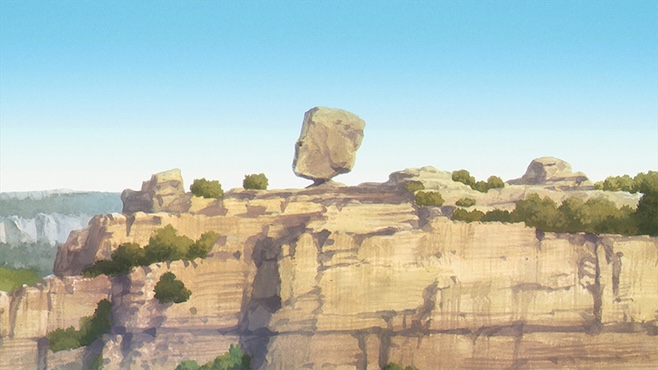
Consider how often pivotal emotional scenes occur in forests under dappled light. When Frieren recalls Himmel’s face – struggling to remember details that once seemed permanent – the scene bathes in komorebi. The visual metaphor is precise: Memory, like sunlight through leaves, shifts and fragments. What seemed solid becomes ephemeral. The light that illuminated the past now filters through layers of time, never quite as bright as it was.
Komorebi also functions as a visual reminder of nature’s constancy against human transience. The same forests, the same filtered light, exist across centuries in Frieren. The komorebi Himmel walked through as a young hero is the same komorebi Frieren walks through after his death. Nature endures, light continuing to filter through leaves while people pass like shadows beneath trees that will outlive them.
This recurrent visual motif – light and shadow dancing across characters’ faces, across paths they travel, across graves they visit – becomes Frieren‘s visual signature. It’s the aesthetic embodiment of the series’ central meditation: beauty exists in transience, in the fleeting interplay of presence and absence, in moments illuminated briefly before darkness returns.
Shizukesa: Serenity Through Stillness
Shizukesa describes a particular quality of quietude – not mere absence of sound, but a cultivated stillness that invites contemplation. It’s the silence of a temple at dawn, the hush of snow falling, the calm of a mind at peace.
Frieren embodies shizukesa in its compositional discipline. The anime refuses visual clutter. Character designs are clean, unadorned. Backgrounds, while detailed, maintain a painterly softness that soothes rather than overwhelms. The color palette skews toward muted pastels – soft greens, gentle blues, warm earth tones – reminiscent of vintage hand-drawn animation or Studio Ghibli’s aesthetic restraint.
This visual shizukesa extends to cinematography. The camera rarely moves abruptly. Pans are slow, measured. Cuts respect rhythm rather than chasing momentum. When fights occur – and they do, with fluid, devastating choreography – they’re framed as discrete events within a fundamentally peaceful world. Violence never defines the series’ baseline tone. Stillness does.
The anime’s sound design reinforces shizukesa. Evan Call’s score favors orchestral subtlety over bombast. Music enters quietly, swells gently, fades without demanding attention. Ambient sound – wind through trees, flowing water, distant birdsong – fills scenes more often than dialogue. The soundscape mirrors the visual philosophy: Less is more, silence is meaningful, quietude allows deeper engagement.
Shizukesa also characterizes Frieren herself. As an elf who has lived over a thousand years, she moves through the world with profound calm. She rarely rushes. She rarely raises her voice. Her default state is serene detachment – not coldness, but the stillness of someone for whom urgency makes no sense. Time, for her, is abundant. Why hurry?
This narrative embodiment of shizukesa – a protagonist who moves slowly through a slow-paced story – creates an unusual tonal coherence. The series’ formal qualities mirror its thematic concerns. The stillness is the point. The quietude is the message. In an era of accelerated content, of Netflix autoplay and TikTok attention economies, Frieren‘s commitment to shizukesa feels almost revolutionary.
Hakanai: Ephemeral Beauty
Hakanai describes something fragile, fleeting, dreamlike – beauty that exists precisely because it cannot last. Cherry blossoms are hakanai. Morning dew is hakanai. The brief clarity of a childhood memory is hakanai.
The central tension of Frieren is hakanai incarnate: An immortal elf learning to value mortal lives. Every human Frieren befriends is hakanai. Every connection she forms is temporary. The decade she spent with Himmel, Heiter, and Eisen – a lifetime for them, barely a moment for her – is the series’ foundational example of hakanai beauty.
The anime visualizes hakanai through its treatment of human aging. We watch characters grow old across episodes. We see children become adults, adults become elderly, elderly become memories. Frieren remains unchanged. This visual strategy – immortality as stasis, mortality as transformation – makes hakanai concrete. Humanity’s brevity becomes the source of its preciousness.
Consider Fern, Frieren’s apprentice. Fern ages from child to adult in what feels, to Frieren, like an eyeblink. The series frequently juxtaposes young Fern with current Fern, reminding viewers (and Frieren) that time passes faster than an immortal perceives. This creates poignant dissonance: Frieren sees Fern as constant, unchanging, while viewers watch Fern mature, change, age. We’re witnessing hakanai in real time – the fragile beauty of a life that will end long before Frieren’s does.
The anime’s episodic structure reinforces hakanai. Many episodes feature one-off characters – a village elder, a traveling mage, a demon from Frieren’s past – who appear briefly then vanish. These encounters are hakanai by design: meaningful connections that exist for a handful of scenes before dissolving. The series doesn’t pretend these relationships will recur; instead, It honors them precisely because they’re temporary.
Even magic in Frieren carries hakanai qualities. Spells are depicted as fleeting, beautiful phenomena – flowers blooming momentarily, light dancing briefly, illusions that shimmer then fade. Magic doesn’t impose permanence on the world. It creates ephemeral beauty, then releases it. This aligns hakanai with the series’ central philosophy of mono no aware: The most beautiful things are those that cannot be held.
Wabi-Sabi: Beauty in Imperfection
Wabi-sabi might be the most famous untranslatable Japanese concept, but it remains notoriously difficult to define. At its core, wabi-sabi describes finding beauty in imperfection, impermanence, and incompleteness. It’s the aesthetic of things worn, weathered, flawed. It’s tea bowls cracked and mended with gold. It’s wood aged silver by rain. It’s the acceptance that nothing perfect exists, and perfection wouldn’t be beautiful anyway.
Frieren embodies wabi-sabi by refusing narrative perfection. The series doesn’t resolve every arc tidily. Quests end ambiguously. Characters part without closure. Conflicts fade rather than conclude. This can frustrate viewers accustomed to conventional structure, but wabi-sabi reframes “incomplete” as aesthetically intentional. Life doesn’t offer neat resolutions and Frieren honors that truth.
The anime’s visual treatment of ruins demonstrates wabi-sabi explicitly. When Frieren revisits cities she knew centuries ago, we see them half-consumed by nature – stone walls crumbling, wooden beams rotting, gardens grown wild. These aren’t depicted as tragic decay. They’re wabi-sabi beauty: impermanence made visible, time’s passage rendered tangible. The anime lingers on moss-covered statues, on vines reclaiming architecture, on the weathered dignity of things aging gracefully.
Characters, too, embody wabi-sabi. Frieren is not a perfect hero. She’s forgetful, emotionally distant, socially awkward. She collects useless magic and wastes time on what seems to be trivial pursuits. She fails to recognize love when it’s offered. She’s flawed, incomplete, imperfect – and these qualities make her human (ironically, despite being an elf). Wabi-sabi teaches that imperfection is what allows for connection, while perfection is sterile, untouchable. Flaws are where empathy finds purchase.
The series’ treatment of magic training reveals wabi-sabi philosophy. Fern and Stark don’t become instantly powerful. They improve incrementally, messily, through failures and small victories. Their growth isn’t a montage of achievement – it’s a slow accumulation of mundane effort. This aligns with wabi-sabi‘s rejection of polished finishes. Mastery in Frieren looks unglamorous: daily practice, minor setbacks, gradual progress. Beauty lies in the process, not the perfection.
Even the anime’s occasional animation shortcuts – still frames held slightly too long, motion tweens that simplify movement – could be read through wabi-sabi lens. These aren’t failures but acknowledgments of limitation, of resource constraints, of the impossibility of perfection. The series doesn’t apologize for being “imperfect.” It trusts that substance trumps polish, that what’s expressed matters more than how seamlessly it’s executed.
Yohaku: Deliberate Blank Space
Yohaku literally translates to “blank space” or “margin,” but in Japanese aesthetics, it describes intentional emptiness – the space left unpainted on a canvas, the silence between musical notes, the pause in conversation where meaning settles. Yohaku is what’s deliberately excluded to give shape and significance to what remains.
Frieren practices yohaku relentlessly. The series withholds information constantly. We never learn Frieren’s precise age. We never see the full journey to defeat the Demon King. These absences are yohaku, a narrative blank space that invites us to imagine, to wonder, to fill gaps with personal meaning.
Character backstories demonstrate yohaku particularly well. The anime reveals pasts through fragmentary flashbacks – glimpses, not comprehensive biographies. Himmel’s childhood appears in fragmentary vignettes. Heiter’s priesthood is sketched, not detailed. Eisen’s warrior past remains largely mysterious. These are not oversights. They’re yohaku, deliberate withholdings that respect characters as having lives beyond the frame, histories that exceed what can or should be shown.
Visual composition employs yohaku constantly. Scenes often feature characters occupying small portions of the frame, surrounded by empty sky, blank walls, expansive landscapes. This “negative space” isn’t wasted – it’s yohaku, visual silence that focuses attention on the figure while evoking vastness, solitude, the enormity of the world beyond immediate action.
Dialogue in Frieren exemplifies yohaku. Characters rarely explain their feelings explicitly. Emotional revelations arrive obliquely, through gesture, through what’s not said. When Frieren struggles to remember Himmel’s face, she doesn’t deliver a monologue about memory and loss. She simply stands there, unable to recall. The yohaku – the blank space where memory should be – communicates grief more powerfully than words could.
This commitment to yohaku makes Frieren unusually respectful of audience intelligence. The series trusts viewers to infer, to feel, to understand without being told, believing that what’s omitted can be as meaningful as what’s included. At a moment when everything demands to be explained, Frieren‘s yohaku feels almost subversive. It insists that ambiguity is not a flaw. It’s an aesthetic choice, a philosophical stance, a way of honoring the untranslatable complexity of experience.
Conclusion: Visual Translation of the Untranslatable
Frieren: Beyond Journey’s End doesn’t “teach” these concepts. It doesn’t pause to explain mono no aware or wabi-sabi. Western audiences might never consciously recognize the philosophical frameworks shaping every scene. Yet, the series communicates these ideas viscerally, through image and sound and rhythm, through what’s shown and what’s withheld.
This is visual translation at its most sophisticated: taking concepts that resist verbal definition and expressing them through purely cinematic language. Frieren proves that some truths are better felt than explained, that cultural specificity can produce universal resonance, that formal discipline can yield profound emotional impact.
The anime’s greatest achievement is making stillness dramatically compelling, silence emotionally rich, absence as significant as presence. In doing so, it offers an alternative to Western narrative imperatives – to constant momentum, relentless plot, characters who change definitively by story’s end. Frieren insists that stories can meander, that endings can be ambiguous, that impermanence itself is the story worth telling.

For Japanese audiences, Frieren likely feels like home – a series that speaks their aesthetic language fluently, that assumes familiarity with concepts woven into cultural fabric. For international viewers, the series becomes an education in seeing differently, in valuing what Western culture often overlooks: the pause, the incomplete, the fleeting moment’s beauty.
Frieren: Beyond Journey’s End is anime as philosophical practice. It’s a visual essay on impermanence. It’s proof that some things are better left untranslated – their foreignness is precisely the point, and collapsing them into words would diminish what image and silence convey perfectly on their own.
The series asks: What if we valued the journey over the destination? What if we found beauty in what doesn’t last? What if we honored the space between things as much as the things themselves?
These are questions without answers – or rather, questions whose answers resist language. Frieren doesn’t provide answers. It provides a way of seeing, a mode of attention, a reminder that the most profound truths often arrive not through explanation but through patient, quiet, sustained contemplation of what remains when everything else falls away.
This is why Frieren matters – it teaches nothing explicitly, yet embodies these concepts so completely that they become the air the series breathes, the rhythm it moves to, the lens through which every frame is composed.
Algorithmic content, optimization, engagement metrics, stories engineered for binge-watching and instant gratification – against all of this, Frieren insists on slowness. On silence. On the beauty of things that cannot be rushed or explained or made efficient.
This is anime operating at the highest level of cultural and aesthetic sophistication – conscious of its inheritance, fluent in its philosophical vocabulary, confident enough to trust that formal restraint can produce the deepest resonance.
Frieren: Beyond Journey’s End doesn’t translate untranslatable concepts into English. It proves that some truths transcend language entirely, that the grammar of image and sound and silence can communicate what words cannot, that the most profound beauty often exists precisely where explanation fails.
———
Beatrix Kondo evolved like a Digimon: from level-1 translator to final boss of a 30+ year quest dismantling plot holes and gender issues in pop culture. She writes about K-dramas, anime, and everything Asia produces (the good and the questionable) for international outlets. Her specialty is ruining happy endings by pointing out red flags and finding feminism in dungeons where patriarchy thought it was safe.