Sensing and Leaving the Unicorn Trap
You feel compelled to support great writing…
This column is a reprint from Unwinnable Monthly #196. If you like what you see, grab the magazine for less than ten dollars, or subscribe and get all future magazines for half price.
———
Thoughts about being something else.
———
I don’t like all nonhuman creatures equally. For instance, I normally don’t care for the unicorn. I think part of that is because even when I was little, I could tell that when it came to unicorns and dragons, unicorns were pushed onto girls, and dragons were meant for boys. But it wasn’t just a younger me pushing back on that; I genuinely enjoyed dragons more. My mother has said I liked playing with dinosaur toys the best, and I have vague memories of their hard-textured, scaly figures. (I remember more clearly watching dinosaurs in movies and TV, reading dinosaur books, and enjoying every minute of them.) Dragons were close to dinosaurs, even down to theories that the discovery of dinosaur bones led to stories of dragons. The dinosaur-to-dragon pipeline was a natural fit for me. But even as I just thought dragons were better, I knew unicorns were intended for little girls like me, and I didn’t like that expectation. That expectation obviously didn’t know that I, a little girl then, loved the look of dragons more. It made the opposite assumption without getting to know me. Gender divisions even then, even between unicorns and dragons.
In contrast to dragons, unicorns looked…well, boring to me. The details of their face didn’t come together into an appealing picture in my mind. For me, this applied to horses too, due to their obvious similarity. I definitely wasn’t a horse girl. (Even Lisa Simpson wanted a horse, something I could never relate to.) It was yet another thing that felt too assumptive of gender. But again, there was also just my personal taste – horses were, well, bland to me. Or maybe I was one of the few people who found horses intimidating and off-putting.
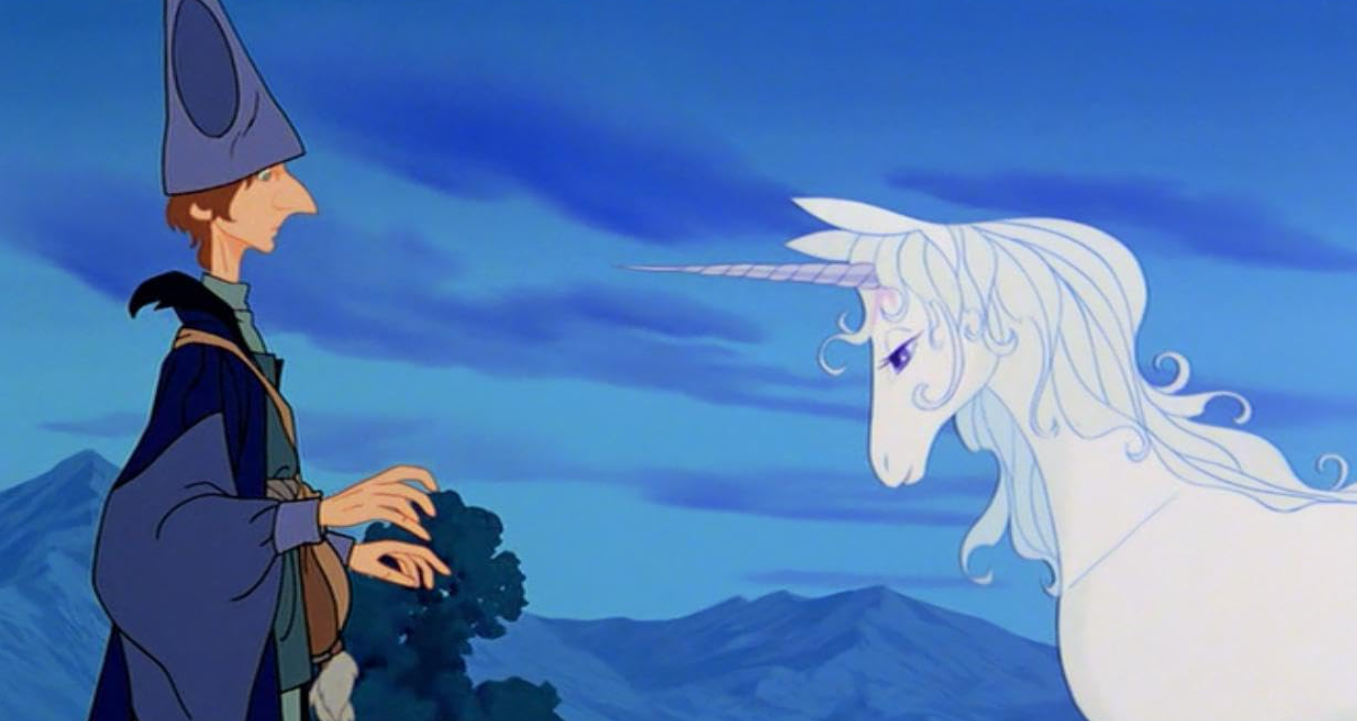
This hasn’t really changed for me in the present day, although there are a couple of minute shifts. Dragons are better to me, but I’m a little more accepting of the unicorn in some select cases. The Last Unicorn by Peter S. Beagle is a wonderful book, with the eponymous unicorn herself having more of her own character to delve into. It’s something I should reread, and that I would recommend to others, feeling that it’s one of those classics that deserve its reputation. The film adaptation, thanks to it being animated, draws the titular unicorn more appealing than a photographic horse with a horn stuck on, smoothing her lines out more into an elegant silhouette. There’s the feel of some simplified art nouveau in her curves.
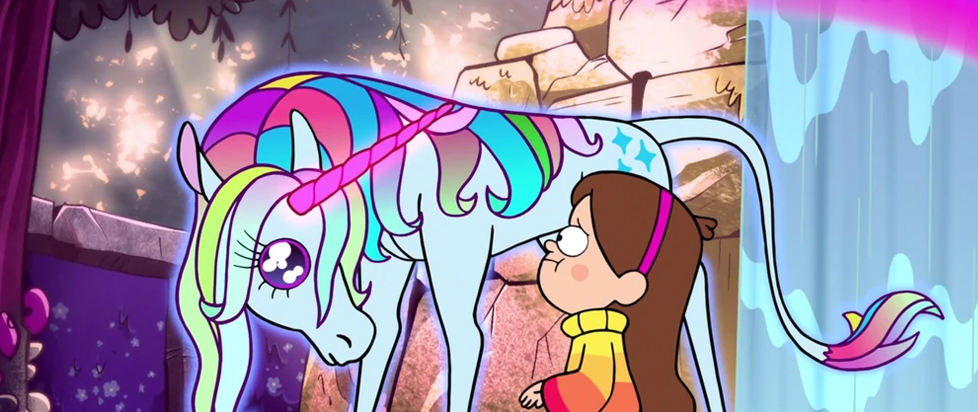
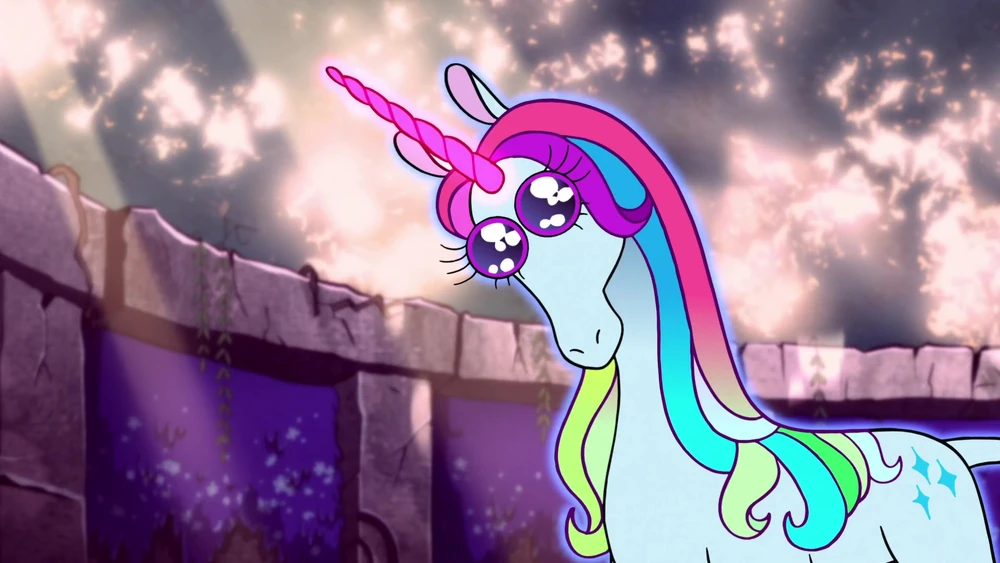
Unicorns as more antagonistic figures, flipping their assumptive script, have more intrigue. The unicorns in Gravity Falls make for hilarious jerks, or at least one of them fully does. On top of that, animation again gives them a better visual. More abstraction and stylization again giving them smoother lines that are more appealing to see and shifting to a more realistic presentation for moments of visually off-putting comedic effect. They’re also drawn with funny, shiny, cutesy anime-kawaii-style eyes that are both neat to watch and add to their appearance as the ultra-adorable height of unicorns while masking their pompous and asshole attitude. And yet their extremely large eyes do also hint a little at this unpleasant undercurrent, feeling a little eerie in their exaggerated size paired with their often unexpressive or even invisible mouth – their eyes are wide and watching, judging. One unicorn judges Mabel Pines as impure of heart, uncaring of how this psychologically torments a kid like her. This unicorn doesn’t even really do what she preaches, but has no compunction about harshly judging everyone else while holding herself as a perfect idol without fault. This unicorn is riding high on her own apparent cuteness and weaponizing it too. She’s animated so overly adorable to serve up a gag that also doubles as a smokescreen for a toxic core. Even after twisting the traditional image of the unicorn, Gravity Falls does offer some extra nuance on this. The unicorn playing judgmental mind games with Mabel is stated to do this to get humans to leave her alone; Mabel herself, though a kid, does end up partly treating moral behavior as more about her identity than doing the right thing, and this doesn’t get entirely addressed with a substantive conclusion. But the episode is only 20-something minutes and ultimately wraps with the unicorn as a mainly antagonistic force, which is still a more interesting role for her to play.
Then there’s a slightly more intimidating turn in “The Princess, the Cat, and the Unicorn,” one of Patricia C. Wrede’s short stories from her anthology Book of Enchantments. Actually, given my vague memories of reading this pretty early on in my life, I wonder if this also influenced my views on unicorns. In the story, a princess and a talking cat encounter a unicorn while they start their own quest. At first, the unicorn is ridiculously arrogant, expecting the princess to be here to lavish attention on it. She couldn’t possibly be there for anything else. When the princess refuses and tries to leave with the cat, they eerily walk right back to the unicorn. Less a haughty joke and more sinister now, the unicorn implies that it’s using magic to trap the princess. Fortunately, this fairy tale ends with the princess and the cat escaping. This particular unicorn is remembered as a more interesting, unsettling villain that also partly answers the unasked question of what would Beauty and the Beast’s Gaston be like as a unicorn.
Perhaps in the end, much of the unicorn’s traditional trappings feel like…well, a subtle trap, particularly for women. Meant to constrain and ensnare. The unicorn goes to the virgin. It goes to the pure, the perfect. It won’t come if you don’t meet its high standards. It’s assumed you want to meet those standards. The unicorn expects the woman to cater to it. The unicorn is only for girls; they couldn’t possibly want something different. The unicorn is another thing that tries to fit women into a narrow definition. Even beyond gender, the unicorn seems to demand that people be morally pure, inflexible on the possibility of being open to any human imperfection.
Part of what makes The Last Unicorn great is how it subverts and challenges this. Reactor Magazine and a post on Tumblr note that though the titular unicorn is apparently the last of her kind and is late to come to the older human woman Molly Grue, she still comes to her all the same, accepting every aspect of her. She isn’t only for the young and fresh. She does not pigeonhole what Molly can be. She doesn’t judge her. And there’s a history of the unicorn in general being trapped too. Hunted and captured, their horns harvested. There are The Unicorn Tapestries depicting a unicorn hunted down, a classically horned equine on the run.
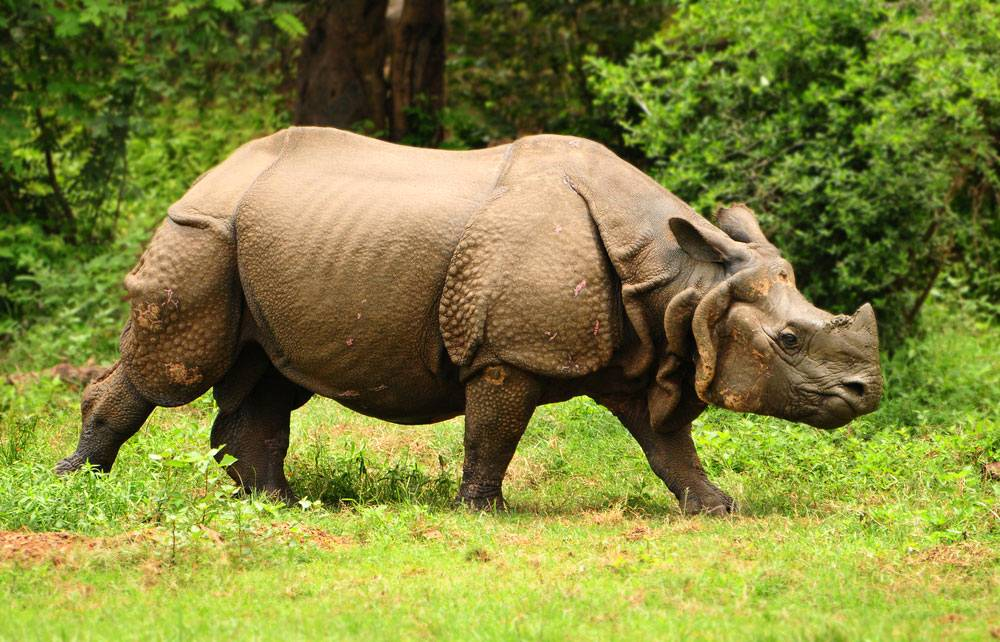
But the unicorn can have other shapes besides the equine. In spite of their popular image, the unicorn has a more varied design history with visuals that intrigue more. In an article with Prospect Magazine, Young V&A Museum’s assistant curator Tanaya Basu De Sarkar said that how unicorns look and what they mean in pop culture has changed over time. There are theories that like dinosaur bones and dragons, the single-horned rhinoceros actually inspired tales of the unicorn. The scientific name for the Indian rhinoceros is even Rhinoceros unicornis. And rhinos aren’t just real animals, but also look more charming than equine-like unicorns to me. Their short, rounded snouts with their small horns are sweeter. With rhinos on land, narwhals are their counterparts in the sea – another real animal species sporting a singular *horn that also likely inspired unicorns, another real creature that looks cuter than a unicorn. (*What looks like a horn is actually the narwhal’s tusk protruding from its mouth.) Picture books and graphic novels for all ages like Not Quite Narwhal and Narwhal: Unicorn of the Sea! remind me that real narwhals are more adorable. There are older descriptions of unicorns that sound more interesting than the most common image seen of them, and I can’t help but think that they should be more iconic. For example, according to Monstrum host Dr. Emily Zarka, Aristotle envisioned the unicorn resembling a goat with a singular horn, another more eye-catching aesthetic. Goats, antelope, etc. – while with multiple horns instead of one, they’re still other real and horned animals that outshine the look of a fantasy creature like the unicorn in my mind.
And come to think of it, part of me actually feels like I would’ve found The Last Unicorn even more captivating if everything was the same, but she was a dragon instead. (Only a part of me – the whole book focuses on a unicorn for a reason, and it truly works. And yet part of me can’t help but wonder.) A work of art by science & editorial illustrator Mary Sanche echoes this sentiment perfectly, and gives me another piece of wonderful eye candy. It’s inspired by The Unicorn Tapestries, specifically The Unicorn in Captivity. But instead of a white, classically equine unicorn, it’s some kind of theropod dinosaur with startlingly white feathers encircled by a barrier all around. It’s Sanche’s The Dinosaur Is In Captivity and No Longer Extinct, something Jurassic Park could have a field day with (but likely better served for another discussion). Sanche’s art is personal proof for me that dinosaurs could supplant unicorns, and it would be for the better. Or a rhino could take their place. Or a narwhal.
———
Alyssa Wejebe is a writer and editor specializing in the wide world of arts and entertainment. Her work has included proofreading manga, editing light novels, and writing pop culture journalism. You can find her on Bluesky and Mastodon.