Dragon Quest VII and Reimagining the Critic in 2026
You feel compelled to support great writing…

“I think part of it is actually the difficult experience of seeing the limits of what cultural work can do in a direct way.”
– Austin Walker in A Dialogue with Austin Walker, by Autumn Wright.
Social media is not a place for meaningful discussion. There, it is too easy to be misinterpreted. It is also too impulsive a forum for thoughtful points to come across as such. Nevermind that it is an opioid for the collective. So when the recent release and subsequent reviews of Dragon Quest VII Reimagined sparked a fire in me, I made the mistake of replying with a rant on social media to a post defending the game from the perspective of it being aimed for children. A fool’s folly on my part.
———
I recently finished reading Francoise Ega’s Notes to a Black Woman, a collection of letters addressed to Carolina Maria de Jesus, a writer across the vastness of the Atlantic Ocean. So the legend goes, De Jesus’ collected scraps of paper she found in Canindé, a favela north of São Paulo. She painstakingly assembled her own collection of letters, Quarto de Despejo, literally piece by piece. Her efforts garnered international acclaim and commercial success for herself and inspired Ega to write. Notes to a Black Woman, part journal, part epistolary-fiction, is a deep act of admiration to the impact a writer can make on another. Ega’s retelling of her life and the injustices faced by domestic workers faced in Marseille, France are written in letters addressed to de Jesus, though never shared with her and it is unclear if Ega ever intended them to be.
What do Ega and her book have to do with writing about videogames? Everything. Many great pieces have been written about criticism being a kindness. All of which I agree with and try my best to emulate in spirit. Like Ega we should pour our soul as critics to create work that is more. We should move away from sorts of writing that can be easily replicated by LLMs. I implore writers and readers to demand more from criticism. Critics, we can do this by going outside of the self and the medium for inspiration. Connect the games with the society that makes them. We owe this to the readers and ourselves.
In 2026 why should anyone care about a cookie-cutter review? The uninspired writing on mainstream sites consistently fails to meet our moment, or any for that matter. It should be of little surprise that the most misunderstood game in the Dragon Quest series, Dragon Quest VII, would be pommelled with tomatoes of indifference. The reviews for the recent remaster, Reimagined, again reveal the emperor wears no clothes. Let me be clear – this is not an argument against negative criticism from critics about the game. For example, though I strongly disagree with William Hughes’ review of the game, I appreciated his strong voice and clear argument. It is the positive reviews that motivated me to write this piece, as I found myself preoccupied by how few of the dozen or so mainstream English language (mainly American really) reviews took the time to pick the fruits of the moment to provide something more.
I understand the material conditions on which these reviews are produced. With all its streamlining, Reimagined is still a long game that can take tens of hours to complete the main story. A time-crunched critic being paid close to minimum wage (or less) might encounter this task with the enthusiasm of Prometheus having to start the day being eaten by crows (yes, I know in the myth it is an eagle but crows are more macabre). This leaves no time for research, a must for any close reading. This highlights a consistent problem with games media that is passed down to the reader: The current state of games criticism makes it increasingly difficult for a critic to earnestly engage with a game and provide context to it as an artifact, made by people in a fixed time and cultural context. Lack of context is what ultimately makes these reviews disposable and indistinguishable from one another.
I will not waste my time discussing if game criticism is dead, because as we know everything that functions and works through capitalist logic is undead. And this article is not really about Dragon Quest VII, but about what it means to write criticism in a moment where we are all that yellow cartoon dog inside the burning house. The structure has yet to collapse; it does not function but it still stands. In a house aflame expressions must change.
This here internet magazine published recently an excellent conversation between Autumn Wright and Austin Walker (quoted at the beginning of this piece). In it Walker brilliantly calls out the elephant in the room: “People are going to keep talking about games and making games anyway, what if we did it in ways that prepared us for the opportunities and engaged with the wholeness of who we are? I know that that retreats down into a You do it for the love of the game, which is not ideal, but I do fear that it’s our reality right now.” I strongly agree. Maybe those sort of conditions were not dissimilar to those at the creation of criticism as a field.
2026 and the critical discourse around Reimagined broke the dam for me. It became clear that at this stage most folks do this because it is simply just work (understandable given the circumstances, yet nevertheless regretable). Dozens of pieces all saying the same thing, critics that have not had the opportunity to develop their own aesthetic positions, talking like degenerate fans, as if criticism is simply topical descriptions or fan ramblings (the “hater” perspectives in mainstream games media is sorely needed). The reference points used by critics are predominantly Western-centric and reveal a lack of engagement with the world outside of gamer culture. I always ask myself, why should I even review a game if I do not have anything meaningful to say? And what is “meaningful” or “essential” to discuss in a review anyway?
Either we follow the blueprint of the consumer review as it has been laid out in sites like IGN, or write half-ass opinion pieces/blogs because we need to turn out content to get noticed. This, while also being uninspired and cynical, spells D-O_O-M for our field (and not the fun game one). What if instead we took our time with writing games like some fortunate critics like Andrea Long Chu. Pipedream, yes, but those that are not beholden to writing about games as a primary means of income should feel empowered to do so and we should support them on the journey.
We must kill the content creator inside of us that has taken over our being like a body snatcher. Content is the information inside our work. To belittle one’s work by calling it content is disgusting and self-defeating. Writing is a craft, a tool, created to communicate, interpret, and change the world. Let us have the self-respect to say that we are writers. We must not give the bosses the power to demean our work through ventriloquism, as if they speak through us calling our own work what they see it as on their platforms.
During the past year I have almost entirely stopped reviewing games. Increasingly, I lack the fervor and stamina to write meaningfully. Instead I have opted to work on what I have felt has been more gratifying, projects such as editing others’ works, conducting interviews, and event planning. I am fortunate, yet, I keep asking myself – in 2026, what even is the role of a person who reviews videogames as cultural work when people are getting abducted from their homes by the state, and the technology companies we write about are more concerned with getting rich by any means necessary? What is the role of the videogame critic in a moment where the hydra of uncertainty, instability and mistrust, are the collective common sense? Under these circumstances, I find it hard to engage with the medium as usual or simply at all. But, you know what pulls me back, it’s not the games, it is the great writing being done by my peers. As Mike Davis once said: “Fight with hope, fight without hope, but fight absolutely.” No matter how bleak the world might be, we must put in effort and have pride in our work. Places like Unwinnable, TIER, No Escape, AV Club Games, Gamers with Glasses, Bullet Points Monthly, Skybox, Stop Caring, and Deep Hell keep fighting. Support them and let them know that their work matters.
———
Okay so, I lied, this is really about Reimagined. Here is my review.
Let me be frank, I love the Dragon Quest series. My tastes as a critic lean towards the old-school when it comes to videogames. So, Pac-Man and arcade coin-ups, games that might be obtuse in places and not refined to the point where the player eventually becomes bored are my preferences. I hate using the word art, but if a game is a work of art it must at some point provide a sense of boredom by design. Dragon Quest as a series with its “simple” systems by modern RPG standards does just this. The series is one of the few long form games that I enjoy playing. Their episodic nature eases one into their length. Ideally one should play them in thirty-minutes-to-an hour play increments over dozens of sessions. And yes, if you play them for too long of a stretch, boredom is the reward. Boredom is freedom.
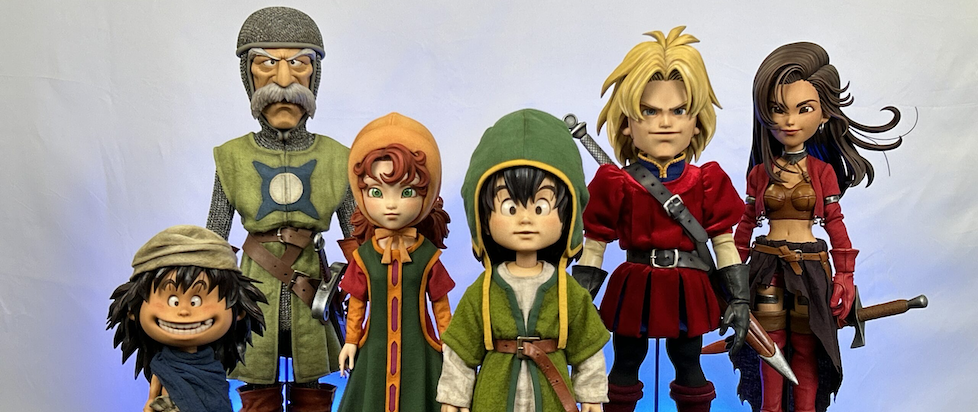
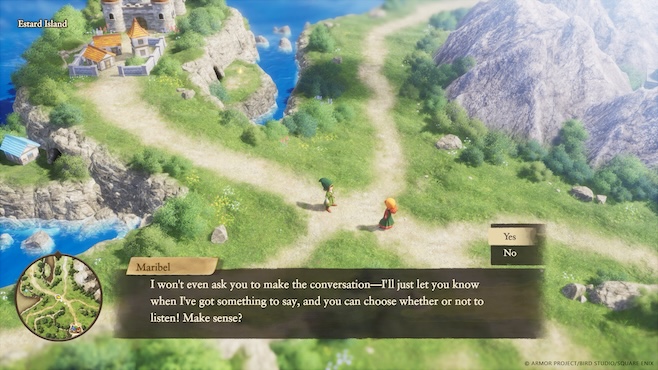
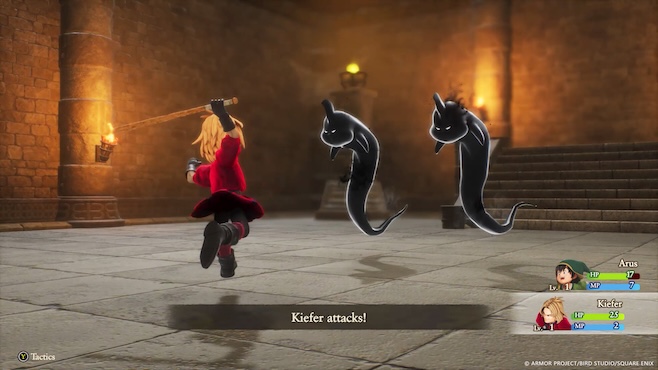
The release of Reimagined comes shortly after Horii Yuji was awarded the Order of the Rising Sun. This makes him the only game developer to receive the honor, a surprise considering that Japan has done much towards popularizing videogames as a medium and source of entertainment globally. But why did Horii receive the award over someone better known internationally and more influential, like Miyamoto Shigeru? Because Dragon Quest is not only a series that sells (Reimagined, for example sold over 400,000 units in its first week in Japan), it is considered an indelible part of Japanese culture. Horii receiving the Order of the Rising Sun speaks to this impact. Reimagined is an appeasement to this perception. The game’s style is described by its producer Ichikawa Takeshi as “doll-like”, and “a diorama-inspired expression” is meant to invoke the feeling of something crafted by artisans. It identifies the game with Bunraku (Japanese puppet theater) along with tipping its hat to its European inspiration.
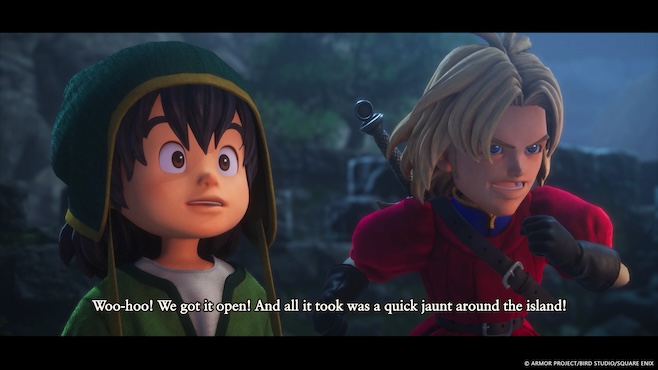
Why provide all this context? Because Reimagined is a flawed and maybe even a misguided cultural statement by Horii and company. The game is being presented as a cultural export. Its easily identifiable aesthetic influences, Sakaguchi Hironobu’s Fantasian or Kawamoto Kihachiro’s The Book of the Dead (and Japanese puppetry broadly), hint at the game’s dual lineage of high and low culture: pencil and pen RPGs, Ultima and Wizardry, and shonen manga, classical music, high fantasy, fables, and accessible gameplay. What other game series do you know that is played by septuagenarians and octogenarians?
The original Dragon Quest VII’s western release came late into the PlayStation’s lifespan and was viewed as being an outdated failure, outclassed by Final Fantasy VII released years before. Critics can be so wrong! Dragon Quest VII is one of the best written games, whose structure – even the original’s 100 hours of playtime – is a masterclass in design, a melding of traditional turn-based RPG elements with the puzzle adventure.
That being said, the original game was not without its faults, and the subsequent 3DS remake and Reimagined bring their own, including incorporating too much feedback to shorten the original’s brilliant opening. In that opening Horii intercalated his adventure game designer roots of The Portopia Serial Murder Case while also channeling Cyan’s Myst. Unfortunately, this loss is compounded with each subsequent remake removing more and more adventure game segments and sanding off the exploration. These concessions to those that want modern game design, obsessed with addictive gameplay loops and comfort is a tragic misstep in Reimagined.
Yet, the story in Dragon Quest VII continues to be a triumph. It has gained new resonance as a counter to our current moment of global retrenchment based on civilizational myths and borders. In the game you reassemble the world with a ragtag group of vagabonds, high fantasy hobos, and as the world grows it becomes more prosperous. Contrast that to our world, the real one where some countries are being forced to reluctantly consider decoupling from one another. Others, like Japan, are embracing this without hesitation. Dragon Quest VII Reimagined in this moment resists that change even while holding on to worthwhile traditions, no matter the consequences.
———
Luis Aguasvivas is a writer, researcher, and member of the New York Videogame Critics Circle. He covers game studies for PopMatters. Follow him on Bluesky and aguaspoints.com.