Boy, Have We Got a Vacation for You: Watching Westworld (1973) After All This Time
You feel compelled to support great writing…

“It’s the realest thing I ever done. I mean that.”
Despite its relative ubiquity in popular culture, the closest I had ever come to watching Westworld (the 1973 movie or the 2016 HBO series) was the Simpsons “Itchy & Scratchyland” episode, which obviously spoofs it.
Due to that selfsame ubiquity, however, Westworld is one of those movies that you basically have seen, even if you haven’t, thanks in no small part to the fact that writer/director Michael Crichton repurposed many of its essential building blocks for what would become his biggest hit: the 1990 novel turned Steven Spielberg blockbuster Jurassic Park.
Though Westworld is Michael Crichton’s feature film directorial debut, it wasn’t technically his first time behind the camera. The year before, he had made an ABC TV movie called Pursuit, starring Ben Gazzara, E.G. Marshall, and Martin Sheen, adapted from Crichton’s 1972 novel Binary, the last of eight thrillers he wrote under the pen name John Lange early in his career.
By the time he made Westworld, however, Crichton was already a bestselling author with a name that could help put audiences in theater seats. His 1969 novel The Andromeda Strain rocketed him to stardom, while a 1971 film adaptation directed by Robert Wise became a hit. By 1973, Crichton already had bylines on four films, with plenty more to come.
While his cachet as a writer was and would remain considerable, Crichton never really enjoyed the same success as a director. Though he would helm another five movies between 1973 and 1989, none would have the same cultural impact as Westworld (unless we count the fact that his 1984 flick Runaway gets mentioned in an episode of Community as the movie where “Tom Selleck fights mechanical spiders.”).
For those few who are somehow unaware, the plot of Westworld concerns a futuristic resort-slash-amusement park called Delos, where realistic humanoid robots are used to bring three different historical periods to life. There’s Roman World, Medieval World, and, of course, the eponymous Westworld.
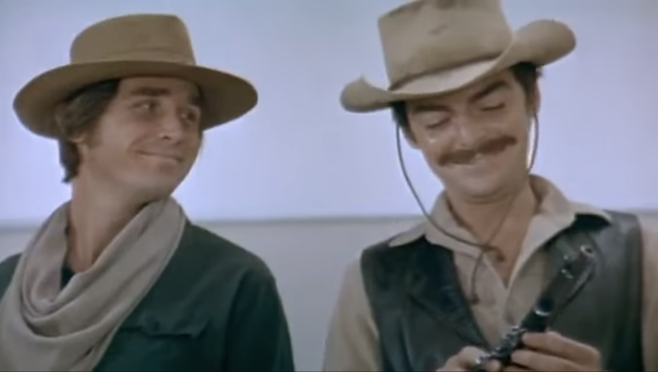
Despite the title, action in the movie takes place at least partly in all three zones, not to mention the endless, anodyne maintenance corridors below the park, where lab-coated technicians monitor and control everything that happens above, trying to ensure the park’s repeated motto that, “Nothing can go wrong.”
Of course, this is a movie, so something does, inevitably, go wrong. The robots begin to malfunction. First in small, seemingly unimportant ways and then, finally, catastrophically, homicidally, all at once.
For a movie that is less than 90 minutes long, however, it takes roughly 10,000 years for the robots to finally go berserk, even though we all know that’s where this is headed – and if you think that audiences weren’t as suspicious of it back in 1973, the trailer gives it all away, up to and including the final reel/fate of James Brolin’s character.
Until then, we mostly watch our two leads (James Brolin and Richard Benjamin) drinking whiskey, getting into bar fights, busting out of jail, sleeping with robot prostitutes, and repeatedly shooting down a robot gunslinger played by Yul Brynner. In fact, for most of my life, this was my primary association with Brynner, even though I had never seen this, and he was also famously in The King and I, The Ten Commandments, and The Magnificent Seven, to name a few.
The latter is the most relevant title here, as Brynner’s character in Westworld (credited simply as “The Gunslinger”) is clearly styled to remind audiences of his lead role in The Magnificent Seven – like if a modern filmmaker made a movie about an evil robot assassin, cast Keanu Reeves, and dressed him just like he dresses in John Wick.
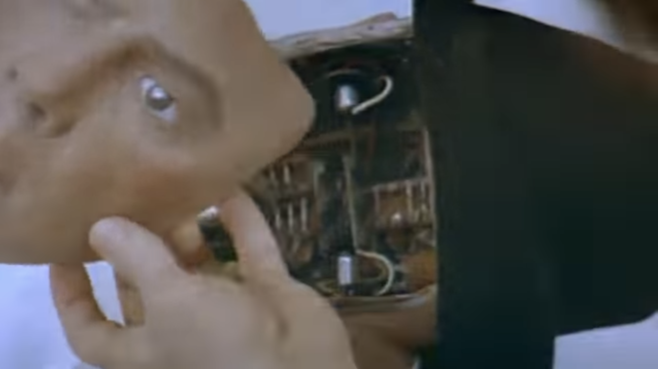
While playing “pin the inspiration on The Terminator” is a mug’s game – Harlan Ellison took them to court for the film’s similarity to his short story “Soldier from Tomorrow” and its Outer Limits adaptation – it seems undeniable that Brynner’s Gunslinger was a significant influence on that film’s T-800. Already, his unstoppable and implacable nature, his blank yet threatening stare, his visual readouts, and even his return in a partially-destroyed, semi-skeletonized state are fully established.
Of course, Terminator is far from the only bit of pop culture where echoes of Westworld can be seen. Those endless maintenance corridors have shown up in lots of places besides “Itchy & Scratchyland,” including films as unlikely as 2011’s Cabin in the Woods, while Westworld itself not only spawned a 1976 sequel (Futureworld) but also the aforementioned 2016 HBO series.
I’ve never seen either of those. Perhaps they explore more thoroughly some of the ideas that Crichton’s Westworld brings out and largely leaves on the table. Ideas that, honestly, may feel more relevant today than they did in 1973. Like the fact that, with seemingly unlimited technology, what we create is corporate nostalgia for a fictionalized version of history that we never actually experienced, where discomfort is a game, and consequences don’t exist. Or the ethical concerns raised by the fact that guests are having sex (and doing god knows what else) in such a heavily monitored environment.
While Westworld’s actual depiction of technology run amok may feel a bit quaint (and occasionally inconsistent), some of the concerns thrumming just under the narrative have extra resonance in a modern world where corporations own everything, manufactured nostalgia is the coin of the realm, surveillance has never been higher, and the rise of “AI” presents us with immediate and tangible examples of the dangers inherent in making something that looks and sounds like intelligence, but isn’t.
In many ways, Brynner’s Gunslinger seems like the least of our worries.
———
Orrin Grey is a writer, editor, game designer, and amateur film scholar who loves to write about monsters, movies, and monster movies. He’s the author of several spooky books, including How to See Ghosts & Other Figments. You can find him online at orringrey.com.