Tokyo Mirage Sessions #FE
You feel compelled to support great writing…

 This is a reprint of the Games essay from Issue #96 of Exploits, our collaborative cultural diary in magazine form. If you like what you see, buy it now for $2, or subscribe to never miss an issue (note: Exploits is always free for subscribers of Unwinnable Monthly).
———
A magical barrier ripples across the planet in a cascade of striated, shimmering blue lines. From a bird’s-eye view, the streaked world resembles a piece of sheet music. So flows the Honmoon, the fiend-repelling shield conjured through song by the musical trio Huntrix, in K-Pop Demon Hunters. Like the Honmoon, the film and its soundtrack have enveloped the earth – topping box offices and record charts, winning myriad awards, asserting the cultural cachet of animation and vigorously churning the Korean Wave.
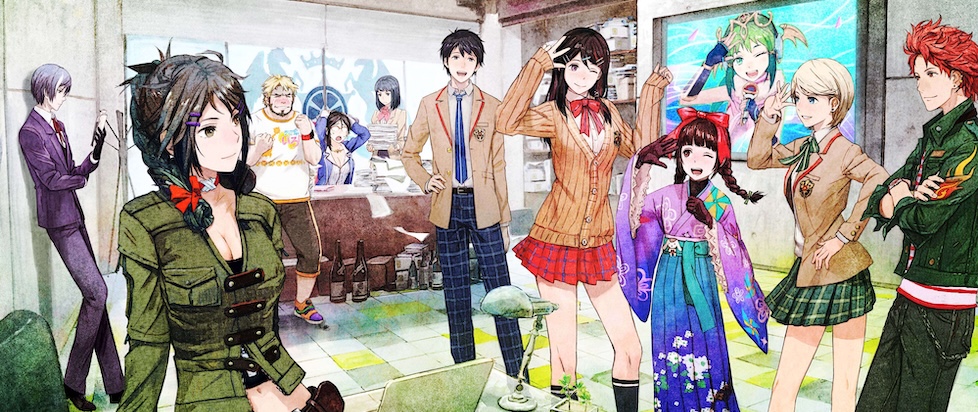
But a decade before K-Pop Demon Hunters came the J-pop demon hunters: The aspiring idols, actors and models of Tokyo Mirage Sessions #FE, a videogame that first released in Japan in December 2015 – Final Fantasy X-2’s girl group deserves kudos as well, but that’s a different essay. Tokyo Mirage Sessions #FE fuses the Fire Emblem and Shin Megami Tensei series; your cadre of entertainers wage war alongside interplanar allies who reimagine characters from the former with the gnarly aesthetic sensibility of the latter. In other words, boyish cavalier Cain sports a horned helmet and swaps his horse for a motorcycle.
One of the finer, more refreshingly creative RPGs of the 2010s, Tokyo Mirage Sessions #FE imbues its showbiz fantasy with remarkable diegetic texture. In the vein of the Persona series, dungeons give physical shape to psychological phenomena and power structures: Consider the level that explores the relationship between photographers and their subjects, with vaguely Escherian architecture that evokes the disorienting effect of being captured on camera. Then there’s combat: While party members in turn-based RPGs often strike nonsensically flashy poses during and after battles – who are they stunting for? – our crew here hams it up with professional purpose as fights unfold beneath bright lights and before a voracious audience. When characters execute cross-team combos they call out the name of the next companion in the queue, as though introducing a guest on a track. And worry not: Every attack in a chain nets you cash or an item. All labor is rewarded generously, each worker spared alienation. That’s praxis.
The game’s plot culminates with the party staging an ancient opera to banish a primordial foe. The climax poses a question that, ten years on, maintains a distinct sense of urgency: What does art offer us at the brink of the abyss? The answer lies in the meaning our protagonists find in a long-forgotten text – in the work’s function as a time capsule that, once cracked open, reveals the context, vocabulary and direction they need to avert the apocalypse.
Art, as Tokyo Mirage Sessions #FE understands, can catalyze reckonings. It can serve as a reminder that evil is persistent but rarely novel; a monstrous force that wields familiar tactics, wearing new faces while exploiting old fears. But art reminds us, too, that for as long as evil has assailed us, humanity has mustered the imagination and courage, the personal and collective will, to crush it. To hunt the demons everywhere, every time. Tokyo Mirage Sessions #FE knows that art is a pen, yes, but also a sword. We all have a role to play.