> Terminal: A review
You feel compelled to support great writing…

This column is a reprint from Unwinnable Monthly #196. If you like what you see, grab the magazine for less than ten dollars, or subscribe and get all future magazines for half price.
———
We are what we’re afraid of.
———
A long, long time ago (i.e., circa 2012) when I was just starting out in this whole media analysis game, I became obsessed with the idea of “ergodic literature.” If you’re not familiar with the term (and why would you be?), it’s a theoretical term coined by Espen Aarseth, who uses it to describe the sorts of media that require literal active engagement to experience the content. This type of literature, he claims, is different from a traditional book or film because there, the only effort is to focus your eyes on the content and then do the cognitive work of interpreting it. With new media such as videogames, however, there is an extra layer of “nontrivial” effort needed to access what the media wants to show you – you need to learn to play it. And because there is this extra layer, we both experience and interpret things like games in a way that is qualitatively different from books, film or music.
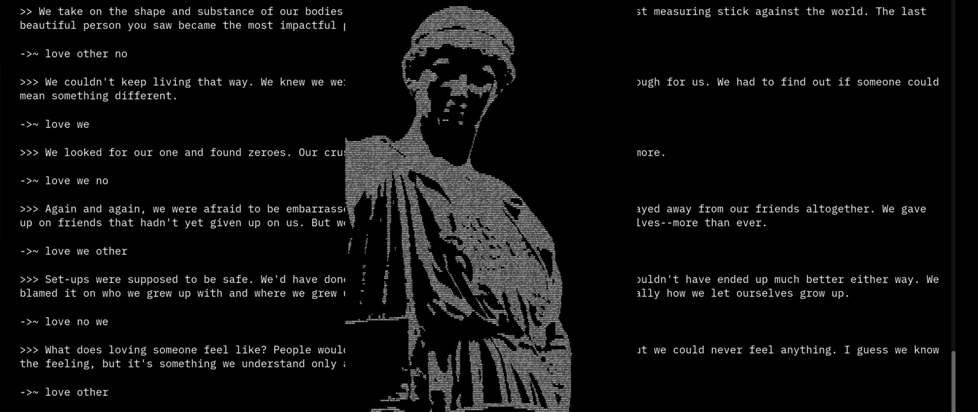
I admittedly hadn’t thought about this idea in a while, but it occurred to me again as I undertook my assignment for this month: a review of an indie command-line horror game called > Terminal. The central conceit of the game is that you play as Tera, a woman locked in a battle of wits with a malicious sentient computer program (or… not? Spoilers, maybe) with whom you interact by typing prompts into a terminal. It’s an almost entirely text-based game, with minimal images or audio. So, exactly the sort of thing about which we can have debates on the essential definition of “game.”
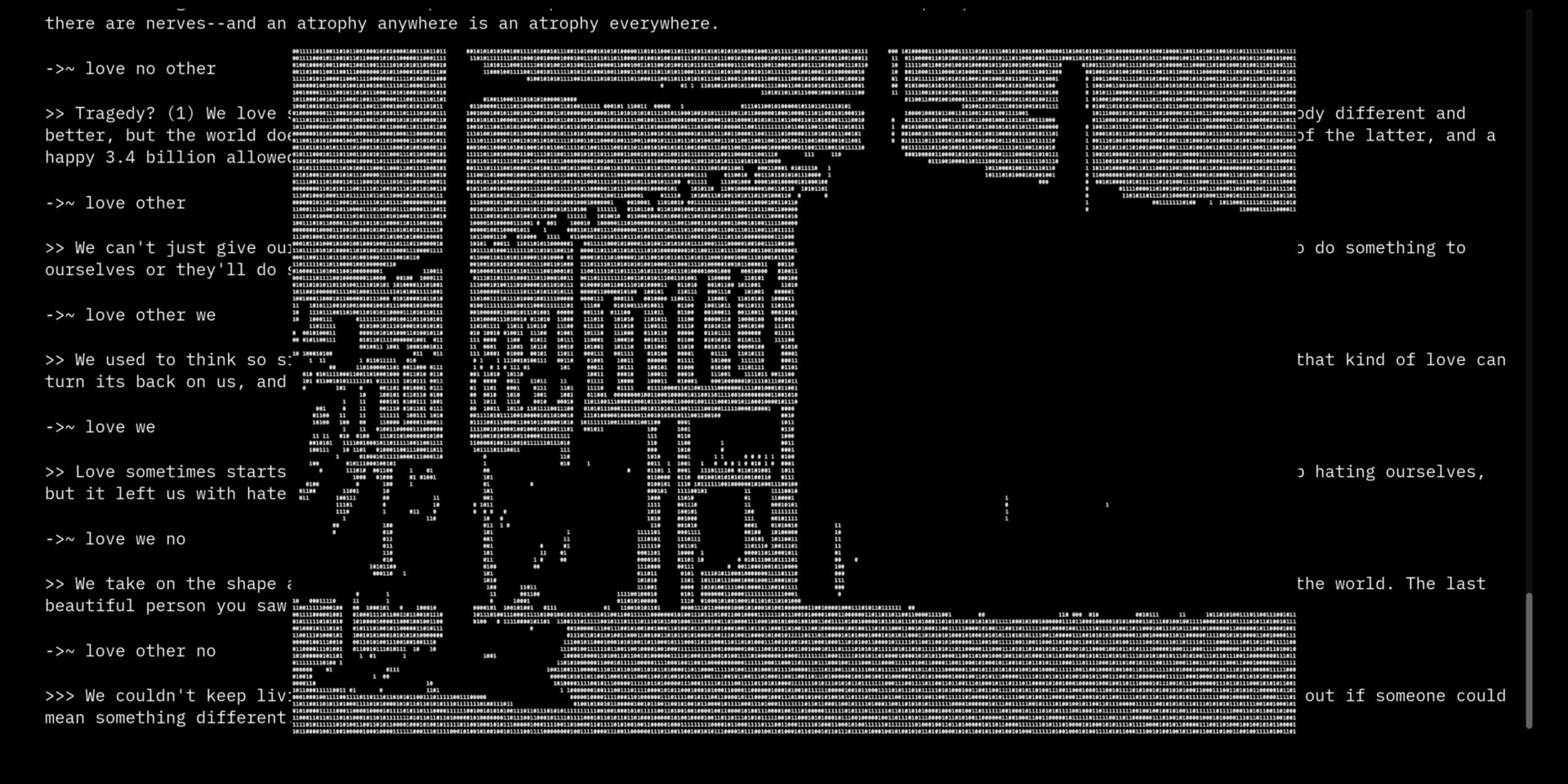
The mechanic (and there is really only one) of > Terminal is that, for each chapter, you are given an opaque, riddle-like sentence, and you must string out all of its possible verb structure permutations into the command line. Each successful set of words earns you a new snippet of text. And here we run into the primary issue: this mechanic does not seem to contribute to, or even make sense in relation to, the action of the game. Since you can only prompt with words from your riddle-sentence, you end up typing phrase after phrase of gibberish. It doesn’t feel so much like a puzzle as a chore. I ended up using the “full text” cheat prompt to see all the text for a chapter at once.
Which ended up being… a lot. There’s hours upon hours of reading in this game, all parsed into individual chunks that give you a single anecdote or interaction. The random nature of the word puzzles means there can’t be any reasonable order for these to go in. The text, when it’s unfurled all at once, feels ponderous and overwhelming, and I absolutely own the fact that this is not what the author intended as the primary experience. But I felt that it was the only way to be sure that I was getting the totality of what > Terminal was trying to show me. And ultimately, I’m very glad I did.
The best part of this game is that, buried in all the content, there are some truly gorgeous, deeply impactful moments. Tera has a fraught relationship with her parents – a troubled and distant mother, and a caring father who cannot fully reconcile his knowledge of the abuse Tera suffered with his love of (and obligation to) his wife. The death of her father presents itself as the emotional hinge on which > Terminal swings, and the game shines most when it presents small moments of vulnerability between father and daughter, which also serve to illuminate the stark disconnect of the mother from them both. You have to get through a lot to get here, but it’s worth it – at several points, a quietly poignant exchange found me in tears.
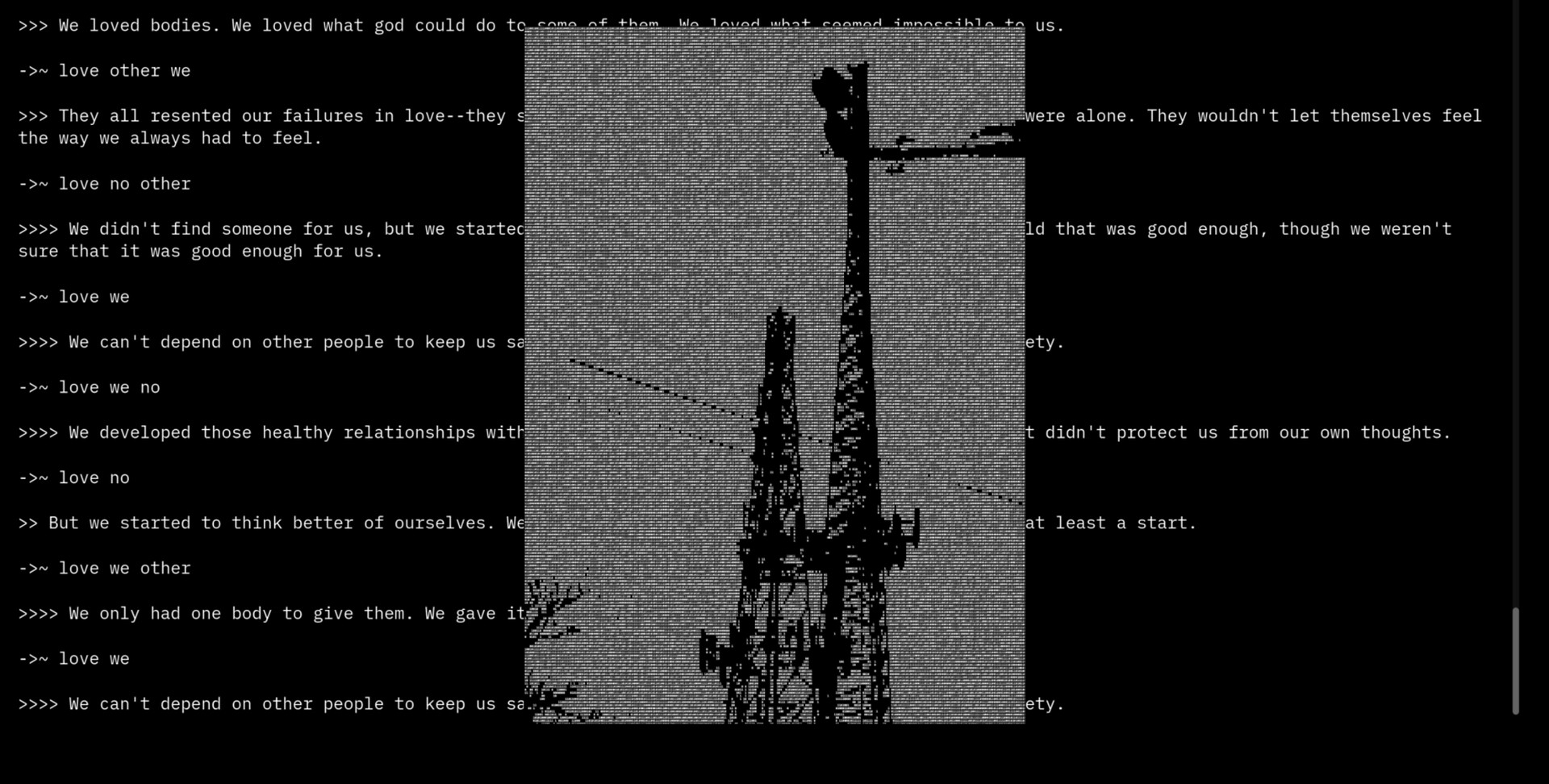
So, how does one reckon with a thing like > Terminal? It is not that the game is bad. It is, rather, that I hesitate to describe the thing as a game at all. The relatively game-light structure can prompt us to treat this more as a novella than an experience of play – it feels like the choices aren’t there to be choices so much as give you something small to remain engaged as the story rolls out. And as a point of fact, the choices aren’t really choices – by prompting the command line, all you’re doing is choosing to continue engaging, in only a slightly more involved way than turning the pages of a book. Additionally, and perhaps more importantly for the remit of this column, > Terminal is not something I would consider horror. While I could see it moving at the edge of some foundational horror themes – fear of death, fear of a misused life, the long slow march of time and entropy that fills the gaps between the two – it never felt like it got there in the way we expect of horror. To separate a horror from a high-concept drama, there needs to be a visceral discomfort at the thing you are experiencing, beyond confronting the normally abstracted distress surrounding your mortality. And whether it’s a product of the mechanics, the pacing, or the narrative, > Terminal never delivers.
So, is it a game? I don’t really think so, but I’m willing to cede the point that there are other things called games that don’t have any more game-like qualities than this. Is it horror? On this, I give a resounding no. But it’s absolutely still worth experiencing, for the sheer power of some of the emotional beats.
———
Emma Kostopolus loves all things that go bump in the night. When not playing scary games, you can find her in the kitchen, scientifically perfecting the recipe for fudge brownies. She has an Instagram where she logs the food and art she makes, along with her many cats.