The Morning Will Come
This is a feature excerpt from Unwinnable Monthly #196. If you like what you see, grab the magazine for less than ten dollars, or subscribe and get all future magazines for half price.
———
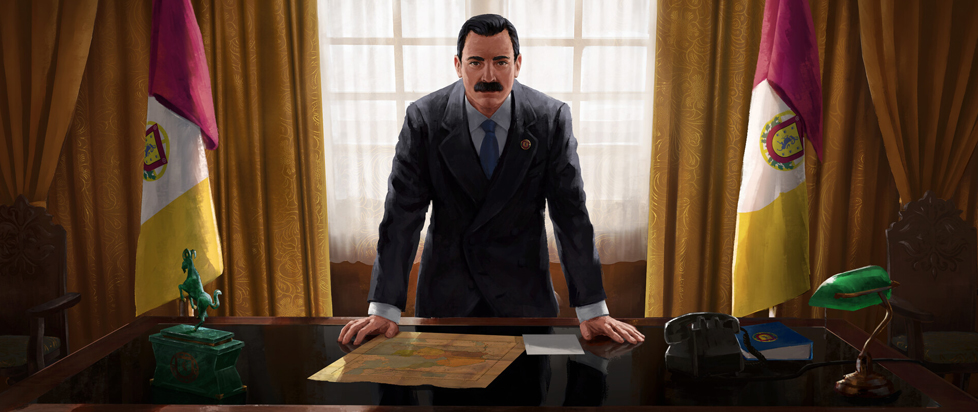
Only a few months ago, I was sitting in my armchair within the Maroon Palace. I looked out upon the city of Holsord and appreciated its subtle splendor. Recession had come for the capital, certainly, as it had come for all Sordland. It was my job to fix it. My job to shepherd this country, the country I have given all of my life in service to, into a brighter dawn.
Now, in the next room my twelve-year-old daughter cries. Her mother, fraught with grief, clutches her closely. She pets the child softly as if this will offer the comfort needed, but there is a hollowness to the movement.
My attention is torn between my family and the one-sided radio chatter being monitored by a commander of the Sordish armed forces. And of course, the rumbling. Every few minutes, without fail, the room shakes. Silt falls from its ceiling. Something topples from a table.
That very city I watched with the caring eyes of a parent and guided with the powerful hand of a President had been overrun. The enemy was closing in. How many Sords yet lived?
“This isn’t a war any longer,” a voice says over the radio loud enough for me to hear. It is a young voice, untainted by the decades of tobacco and whiskey coloring my own. It is a voice that should not be reporting any of this. Should not be witnessing any of this. It is a voice like that of my son. As I think of him, my eyes return to my wife and daughter. One is sheltered in the arms of the other. The woman I love looks at me with an empty fear I have never seen before. It is partially anxiety, partially acceptance. I turn back to the radio to hear the young man’s voice finish his declaration:
“This is a massacre.”
Three years ago, I ascended to the Presidency of Sordland. I was only the fourth man to do so. My lifetime had seen the rise and fall of nationalism, a violent coup, attempts at social reform. But through it all, Sordland had persevered.
I knew in my heart that I would be the final President of Sordland. If history remembered my name at all, it would be remembered as that of an ineffectual man whose idealism erased his nation from the face of this earth.
“Get comfortable, Mr. President,” the commander says as he finally switches the radio off. “This room will be our tomb.”
I am Anton Rayne. I will die in this panic room. With me will go Sordland. And here at the end, when I had hoped I could cling to the principles that had guided my Presidency…
I cannot help but ask myself what was all of this for?
* * *
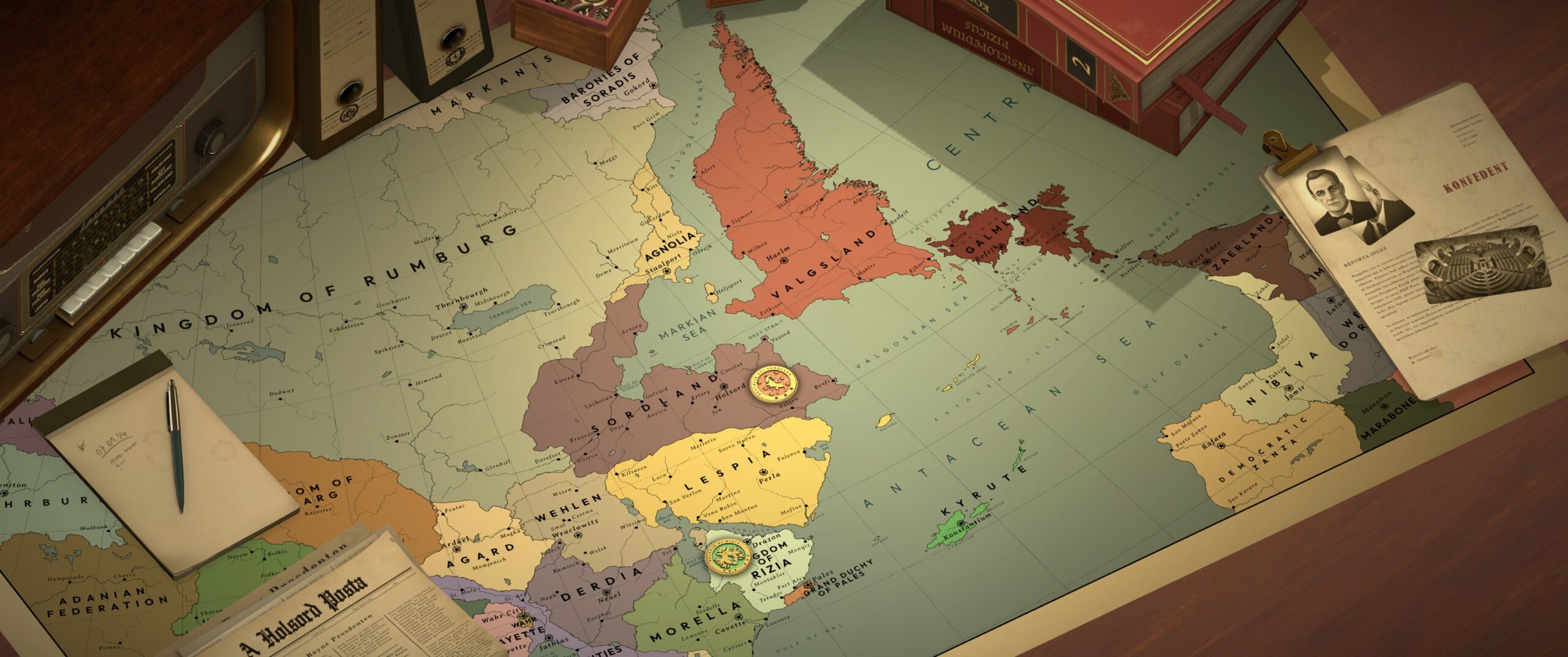
In two whirlwind sessions, I have played the visual novel Suzerain. It borrows from the politically-minded moral questioning of something like Papers, Please while simultaneously adopting the choice and consequence structure of Disco Elysium. Placed in the role of Anton Rayne, players are given the opportunity to guide their fictional nation out of a recession in the beginning of the 1960s.
Much like Disco Elysium, Suzerain fascinates narratively by refusing to rely on the Game Over. Harry du Bois may have a heart attack while reaching for his tie, but many of his choices are reflected in the characters and world around him. However, Harry is low level. His influence is limited to the lives he directly touches. Anton Rayne, by contrast, is the figurehead of a country. Whether people like it or not, their lives are undoubtedly shaped by the decisions he makes. By the type of man he is. By his ability to think forward.
An ability that, as it turns out, is not a given. This first play through of Suzerain saw my attempts to push the socially conservative Sordland toward my own ideals: equal rights regardless of race or gender, less power within the office of the President, and a bolster to a decrepit and often ineffectual healthcare system. On paper, these are great ideas! They’re great ideas in practice, even!
However, these rapid and dramatic shifts in decades of built-up political policy made me no allies within my own party, nor within the competing parties of the Sordish political machine. Moving away from the policies of the nation’s first President, a militaristic genius who overstretched his own authority, made me an enemy to the conservative wing of my party. My inability to produce meaningful changes in the greater economic situation, as well as my participation in certain international affairs, made me a target for the more liberal minds in that same party.
There simply was no winning with these people. I could give them what they wanted and they would complain about the wrapping paper.
Though none of the players in this game of global politics come directly from our world, there are strong parallels to be drawn between the proper nouns of Suzerain and those of our own history. “Capitalism” and “Communism” dominate the economic landscape, with superpowers representing each school of thought ready and willing to pull the strings of smaller nations like Sordland to achieve their aim of global exposure.
Hey, do you think there’s a reason why the game is called “Suzerain?”
At the center of all of this is a personal story. Anton is not the simple portrait-in-a-corner leader you might see in a strategy game like Civilization or Romance of the Three Kingdoms. He’s a character, one that you initially define through a series of choices in a quick prologue. How supportive of the first regime were you? How did you handle your predecessor stepping down? These sorts of things inform who Anton is when he takes office, but what matters is who he becomes after moving into the Maroon Palace.
You will have to handle the larger decisions of a bureaucratic government – what company will be awarded a lucrative but important construction contract, for instance. But there are also questions closer to the heart. How do you speak to your son? Your wife? How do you treat your driver, a symbol of Sordland’s working class? When sex and drugs enter into your hemisphere directly and indirectly, how will you deal with the people who invited them in? There are branching paths that seem to interweave and dovetail with such frequency that I have difficulty imagining the amount of storytelling work that had to go into keeping it all straight. At times, these decisions intermingle and the lines between Anton and President Rayne become blurrier and blurrier.
I am beginning to think that there is no line at all. When tasked with representing the human interests of your own people, perhaps you cannot be afforded the luxury of separating your personal and professional lives. Perhaps this is one of the sacrifices necessary for the ideal public servant.
But then again, who can successfully make that sacrifice?
* * *
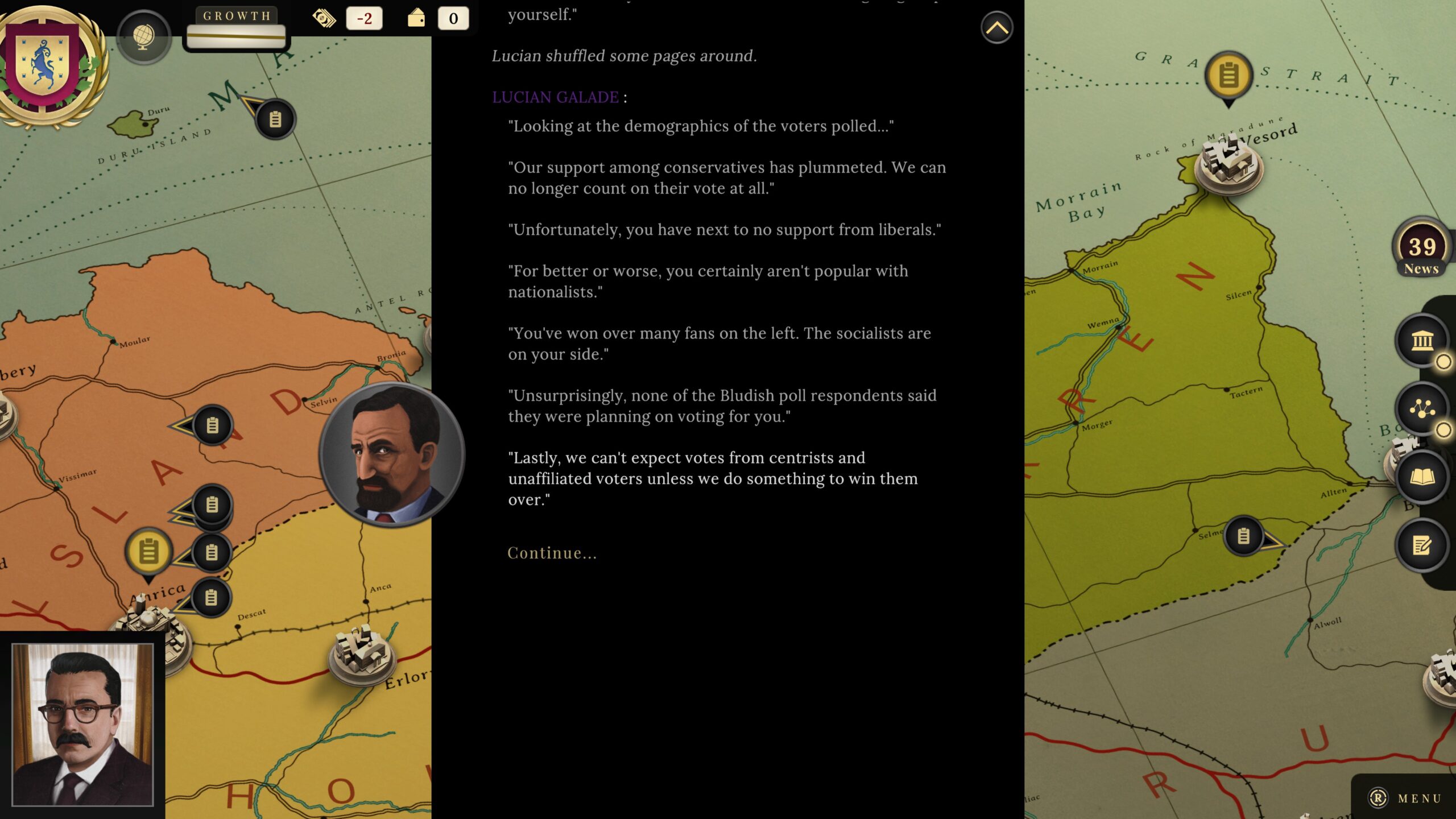
In my hubris, I believed my vision for a reformed Sordland was what my people needed. I felt that rumbling deep in my heart when I stood before the crowds and promised them equality and consideration. I promised those people, my people, that I would make their lives better.
As I enter what looks to be the final turn of Suzerain, an achievement appears telling me that I have triggered four simultaneous “late-game crisis events.” My attempts to nationalize the economy to keep it out of the hands of oligarchs led to an increase in the deficit. I thought I could counter this with careful taxation, but those only upset the working class and caused those same oligarchs to lower employment rates within our borders. This led into what my Minister of the Economy woefully declared “The Sordish Depression.”
Nothing for nothing, but you know the situation is bad when even the leading article is capitalized.
Racial division within Sordland is at an all-time high, despite my direct efforts to reach out to and provide for Sordish citizens of Bludish descent. There were riots in the streets. My reforms for women, focused primarily on their right to life outside the home and proper education, were deemed radical. The oldest living President of Sordland emerged from his retirement on a private island to personally voice his dissatisfaction with my leadership, a move that swayed a significant number of my citizenry and what vestiges of support I had left within my own party.
Of course, all of that was before the invasion. Before the bunker. Before the man who had been my Minister of Defense, when there had been a Ministry for him to lead, handed me a loaded pistol and told me that what I did with it “was my own business.”
I take its cold metal into my hands and look back to my silent wife and weeping daughter.
The room shakes again. One final decision to make.
———
David Cole is a writer and multimedia artist from Kentucky. His games work has appeared at startmenu, Stop Caring, The Imaginary Engine Review, and others. Find David on YouTube, Bluesky or at his website.
You’ve been reading an excerpt from Unwinnable Monthly Issue 196.
To read the article in its entirety, please purchase the issue from the shop or sign up for a subscription to Unwinnable Monthly!