Home Away from Home: 30 Years in the World of Pokémon
You feel compelled to support great writing…

Almost every videogame’s unspoken goal is to immerse players so thoroughly that they feel like they could live in its world, setting up camp in any corner and imbuing it with the personal touch necessary to elevate it from “house” to “home.” For almost 30 years, the Pokémon series has mastered this art. And with its mantra that applies just as much to its cardinal gameplay goal as to its toys and trading cards – “Gotta catch ‘em all!” – the series encourages players to bring its world back into their own. This loop played a major role in building Pokémon into the multimedia powerhouse it is today.
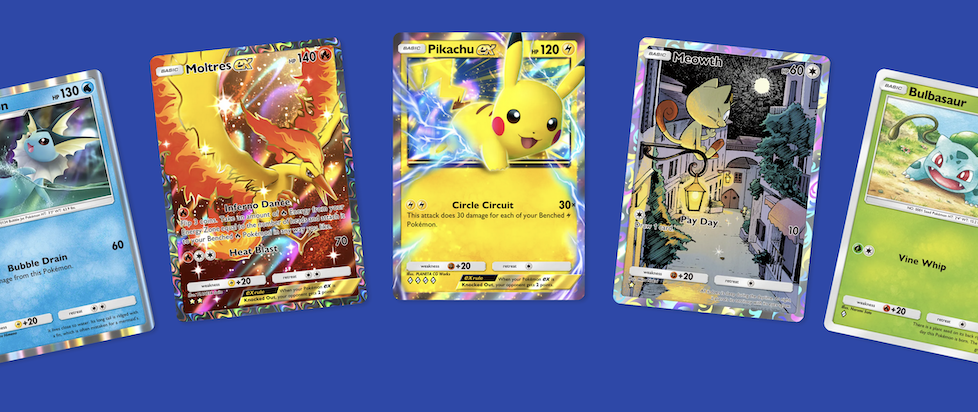
When the series was younger, many goods were characterized by how they played right back into the games. Codes in trading card packs allowed players to build an online collection alongside their physical one in the digital client. Using the Game Boy Advance’s e-Reader accessory, players could swipe select trading cards to unlock additional in-game content the same way they or their parents could “unlock” new physical collectibles with the swipe of their credit card.
Mainline Pokémon games are often criticized for “needing” extra knick-knacks to get the “complete” experience. Multiple consoles and different versions of the same game for trading exclusive Pokémon (plus wires for connecting consoles pre-DS) were just the start. Getting room decorations in Gold, Silver, and Crystal Versions was much harder without a Transfer Pak and Stadium 2 on Nintendo 64. Visiting an exclusive location complete with legendary Pokémon and one-of-a-kind Soul Dew item in Ruby or Sapphire Versions necessitated a physical “Eon Ticket” card and e-Reader to scan it.

But these hassles came with benefits. The e-Reader cards are reusable; anyone wanting to start a new save file on their copy of Ruby or Sapphire maintains access to the event, rather than losing it. Clicking the game cartridge into the Transfer Pak, pressing it into the Nintendo 64 controller, and pushing the hefty power switch on creates a ritual that deepens the player’s connection to the game they’re about to experience.
It also gives fans more agency over their own belongings. As scalpers continue to make it nearly impossible to buy packs, 2024’s TCG Pocket gives players a way to “collect” cards while also introducing them to a simplified version of the often neglected game aspect of the trading card game. But it doesn’t offer true ownership over those digital cards. If the app ever shuts down, all cards across all accounts – and the real money spent on them – are lost. And players can only use the cards the way the app intends. No one can trade cards of differing rarities, even if they’re of equal competitive value. Battles have to adhere to the rules; kids can’t open packs and make up rules to play against each other on the fly, employing the imagination that got them immersed in the world in the first place.
For all the convenience digital media provides, it’s been rushing headlong in a direction where audiences are paying more and owning less. Pokémon Box is a physical GameCube title that lets fans store their Pokémon from Ruby and Sapphire, and it can still be played today with the right hardware. The Nintendo 3DS equivalent, Pokémon Bank, cost $4.99 a year, meaning anyone who used it from 2014 until its shutdown in 2023 paid $44.91 and can no longer utilize its most helpful feature: transferring Pokémon from the 3DS to the Switch. The yearly plan for the Nintendo Switch Pokémon storage service, Pokémon HOME, is $15.99. Players on this plan since 2020 will have paid $95.94 before Pokémon’s 30th anniversary officially begins in February 2026. Anyone who doesn’t consistently pay the premium risks having their stored Pokémon permanently erased.
Physical media is tricky to preserve due to being finite and subject to degradation. But even as Pokémon games shift to focus on digital distributions, there are still losses over time. Digital events can reach more people, but once the distribution period is over, anyone who missed out, loses out. Fans could transfer all their Pokémon from older games into later ones until Sword and Shield, when the scope of transferring was cut significantly. After two rounds of DLC, more than 200 species were still stuck aimlessly in HOME, held hostage to ensure their Trainers pay the subscription fees. But no one can revoke a plush toy, not even of a Pokémon that can’t be transferred into the latest games.
Not everything has changed from the olden days. Fans lucky enough to find packs that aren’t marked up by resellers will still get code cards, even if the current digital client isn’t as polished as TCG Pocket. Spin-off games like Pokémon Pokopia have game-key card faux-physical releases, but mainline games continue to offer the option between true physical and digital.

The latest installment, Legends: Z-A, treats the player character’s world the same way fans treat the world of Pokémon: the player is a guest who finds “home” where they’re visiting, but it isn’t permanent. As much as fans consider the games’ worlds their second home, they’re ultimately tourists staying for a limited time. When the next game releases in a year or two, the player packs up and moves again.
For 30 years, Pokémon fans have paid for moments that feel like they’ll last forever, but just like toys that get worn down over time, the digital-only media will be gone before anyone realizes it. Despite capitalistic intentions, the feedback loop between digital media and physical merchandise is what evolves the Pokémon experience into one that’s deeply personal, outlasting all the associated games and goods. As the digital side of this relationship weakens, with increased costs and fewer player protections, cracks start to form in the foundations of the homes built on top. It’s possible for the foundations to be rebuilt while the intended inhabitants are away, but only if the series strives for better digital preservation or, better yet, the entire industry evicts its rising anti-consumer practices.
———
Niki Fakhoori is a writer and artist with a focus on writing about videogames. You can find her on Bluesky or on her website.